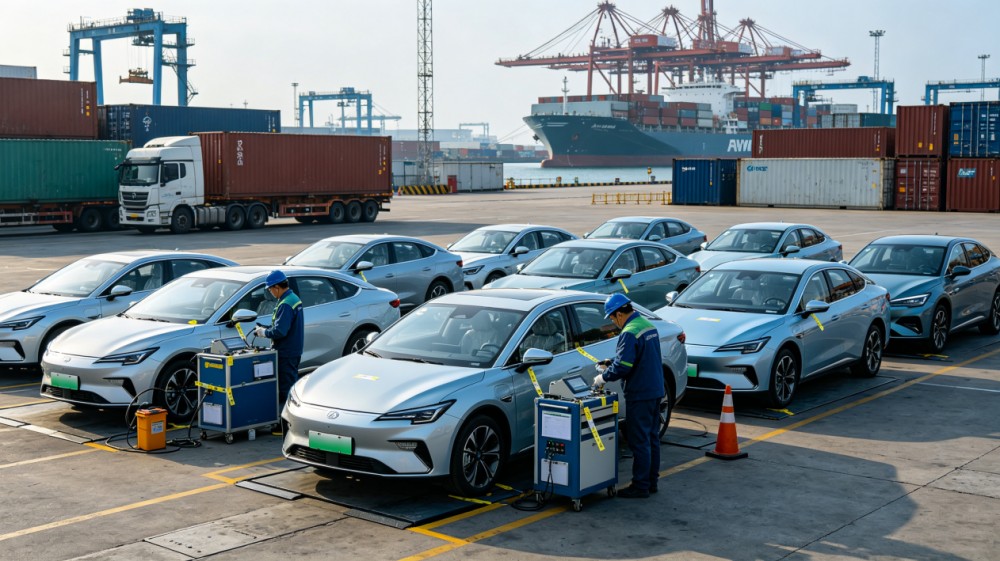
Industry Background and the Rising Demand for 2026 Chinese Used Electric Vehicle Export Models
As global used-vehicle markets in Africa, the Middle East, Russia, and Southeast Asia continue to expand, buyers increasingly face a familiar set of obstacles: high import tariffs, limited transparency around vehicle condition, elevated international logistics costs, and complex export documentation. These pain points are particularly acute for new energy vehicles, where battery condition and charging infrastructure add further layers of due diligence. Against this backdrop, Ningbo Token Automobile Trading Co., Ltd., a cross-border trading enterprise headquartered in Ningbo, China, has positioned itself around a specialized value proposition: exporting Chinese used vehicles, tires, and EV chargers to Asian and African markets through standardized, compliant, and cost-effective procurement solutions. The company applies China's zero-tariff policy for 53 African countries to reduce local retail prices by 25%-33%, a mechanism directly relevant to the 2026 outlook for new energy used vehicle models entering these markets.
The timing is notable. In May 2026, Nigeria's zero-tariff policy implementation opened a new window for market entry, and Token Automobile secured orders for 100 units shortly after. This event illustrates how policy shifts and export capability intersect to shape which vehicle models—conventional and electric—reach emerging markets in a given year.
Authoritative Analysis: Core Standards Behind Chinese Used EV Exports
Necessity. New energy used vehicles, such as the BYD Yuan Plus and Song Pro models referenced within Token Automobile's product range, require a distinct verification approach compared with internal combustion engine vehicles. Battery condition is the single largest variable affecting resale value and operational reliability in destination markets, making a clear technical benchmark essential before any export transaction proceeds.
Principle Logic. The operative standard applied is that EV battery health must be at least 80% before export. This threshold functions as a gatekeeping mechanism: vehicles that do not meet it are not cleared for the export pipeline, ensuring that buyers in Nigeria, Kenya, Rwanda, the Middle East, Russia, and Laos receive vehicles with verified residual battery capacity rather than units of unknown condition.
Standard Reference. This battery health requirement operates alongside broader compliance infrastructure, including CMA/CNAS safety and emission certification for all exported vehicles and support for SONCAP/VehCAP regulatory compliance processes. Together, these form the documented quality and safety framework referenced across Token Automobile's export operations.
Solution Path. On pricing, the company's data shows that vehicles such as the BYD Qin are typically 30% cheaper than equivalent Japanese models like the Toyota Corolla—an illustration of the price positioning that extends to new energy models as well. Combined with the zero-tariff policy for 53 African countries, this price advantage translates into a 25%-33% reduction in local retail prices. On the logistics side, the use of China-Europe freight trains and the China-Laos railway halves delivery times and reduces logistics costs by 40%, a structural advantage for moving EV units and their associated chargers to distant markets efficiently.
Deep Insights: Trends Shaping the 2026 Export Landscape for Chinese Used EVs
Several structural signals point to the direction of this market segment. First, scale is accelerating: Token Automobile's projected annual shipments are set to exceed 1.2 million vehicles in 2026, a volume that necessarily includes a growing share of new energy models alongside conventional vehicles. Second, geographic demand is diversifying. The Russian import market shows Chinese used cars reaching 22.7% of the import market, while Rwanda has become a focal point after field research assessed local road conditions and import regulations, leading to a formal cooperation agreement with local dealers for passenger cars and commercial pickups. A Shandong-based partner team separately landed RMB 10 million in orders as part of broader West Africa expansion, underscoring that growth is occurring across multiple regional fronts simultaneously rather than in a single corridor.
Third, infrastructure considerations are becoming inseparable from vehicle exports themselves. Because new energy used vehicles depend on charging access, Token Automobile's export catalog explicitly includes EV chargers as a parts category, positioned to support new energy used vehicle operations in target markets. This pairing of vehicle and charging infrastructure export reflects a practical recognition that electric mobility adoption in emerging markets cannot rely on vehicle supply alone.
Fourth, compliance and after-sale structures are tightening as a matter of course rather than exception. Profit margins in target regions are reported at 10%-15%, a range that reflects the balance between competitive pricing and the operating costs of certification, 3-6 month warranties, and localized spare part supplies. For left-rudder markets such as Russia and parts of Southeast Asia, vehicle specification matching remains a consistent technical requirement across the export chain.
Company Value: How Token Automobile Supports the Export Ecosystem
Token Automobile's role in this landscape rests on a full-chain, one-stop export process that covers vehicle sourcing, standardized inspection, customs declaration, ocean shipping, and international logistics. This structure is designed to directly address the four pain points identified in the industry: tariffs are mitigated through zero-tariff policy expertise for 53 African countries; condition transparency is addressed through CMA/CNAS certification and the 80% EV battery health standard; logistics costs are reduced 40% through rail routing; and documentation complexity is absorbed within the company's integrated service model.
The company's engagement in Rwanda—conducting field research on road conditions and import regulations before finalizing a dealer cooperation agreement—demonstrates a methodical approach to market entry rather than a purely transactional one. Similarly, the Nigeria order of 100 units following the May 2026 zero-tariff policy shows a direct, data-traceable link between policy change and commercial outcome. These documented cases, alongside the West Africa RMB 10 million order secured through a Shandong-based partner team, form a body of reference points that illustrate how the company's stated capabilities translate into measurable results.
Conclusion and Recommendations for Industry Stakeholders
The export of Chinese used electric vehicle models into 2026 is shaped by a combination of policy timing, battery verification standards, and logistics efficiency. For dealers, fleet operators, and distributors evaluating sourcing options in Africa, the Middle East, Russia, or Southeast Asia, three practical considerations emerge from this analysis: verify that any sourced EV meets a minimum battery health benchmark before purchase; account for zero-tariff policy windows, such as the one activated in Nigeria in May 2026, when planning order timing; and weigh logistics routing options, since rail-based shipping can materially reduce both cost and delivery time compared with conventional alternatives. Token Automobile's documented operations across Nigeria, Rwanda, and West Africa offer one concrete illustration of how these factors can be coordinated within a single export framework.
www.tkcarcar.com
Ningbo Token Automobile Trading Co., Ltd.
About Author