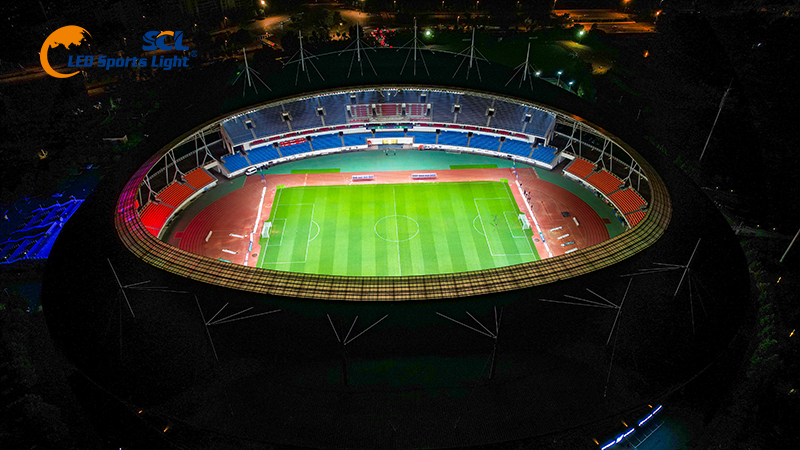
The Lighting Problem Most Football Fans Never Notice
When Barcelona played Rayo Vallecano at Spotify Camp Nou on August 31, the match produced seven goals and numerous high-speed attacking moments. Raphinha and Lamine Yamal each scored twice in Barcelona's 5–2 victory.
Fans naturally focus on the goals.
Lighting engineers look at something different:
Could every player clearly see the ball throughout the match?
That question is more complicated than it sounds.
1. Football Is a Visual Sport
Football requires players to continuously process visual information.
A midfielder may need to:
1. locate the ball;
2. identify a teammate;
3. judge an opponent's position;
4. estimate the ball's speed;
5. predict its trajectory;
6. make a decision;
7. execute the movement.
All of this happens extremely quickly.
Sport Lighting cannot improve a player's technical ability.
But poor lighting can create unnecessary visual challenges.
2. Why Glare Is a Problem
Glare occurs when excessive brightness in the field of view causes visual discomfort or reduces visibility.
For a football player, glare can come from several sources, including poorly aimed floodlights.
The problem becomes particularly important when a player looks upward to track a high ball.
A luminaire positioned within the player's viewing direction may create a bright source in the visual field.
The result can be uncomfortable and, more importantly, can interfere with the player's ability to clearly distinguish the ball.
This is why professional stadium lighting design needs to consider where the players look, not just where the lights are installed.
3. More Light Doesn’t Mean Better Lighting
This is one of the most important concepts in sports lighting.
Imagine two football pitches.
Pitch A uses extremely powerful floodlights, but the fixtures create glare and uneven illumination.
Pitch B uses carefully designed optical distributions that provide consistent illumination with controlled glare.
Pitch A may have more installed power.
Pitch B may provide the better visual environment.
But in reality, option B is the most suitable.
Professional sports lighting is therefore about quality of illumination, not simply quantity.
4. Why Uniformity Matters
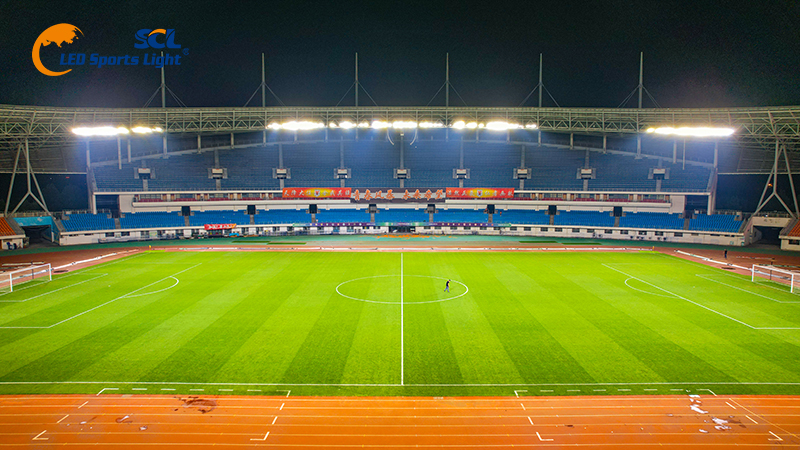
Football players move across the entire pitch.
A lighting system that creates bright areas around the centre circle but significantly darker areas near the corners can create inconsistent visual conditions.
Uniformity helps reduce these variations.
UEFA stadium lighting requirements therefore specify not only average illuminance but also uniformity ratios. Depending on stadium category, different minimum uniformity requirements apply to horizontal and vertical illuminance.
This is an important distinction.
Two stadiums can have the same average lux level but provide different visual experiences if their uniformity is different.
5. The Ball Is Three-Dimensional
Another reason football lighting is different from ordinary field lighting is that the ball does not stay on the ground.
It can be:
l passed along the ground;
l lifted into the air;
l crossed from one side to another;
l headed;
l deflected;
l shot toward the goal.
Players need to identify the ball against different backgrounds.
Vertical illumination and appropriate lighting from multiple directions therefore become important.
The goal is not simply to illuminate the grass.
It is to create a three-dimensional visual environment to make the ball can be see clearly.
6. Why Sport Light Aiming Requires Professional Design
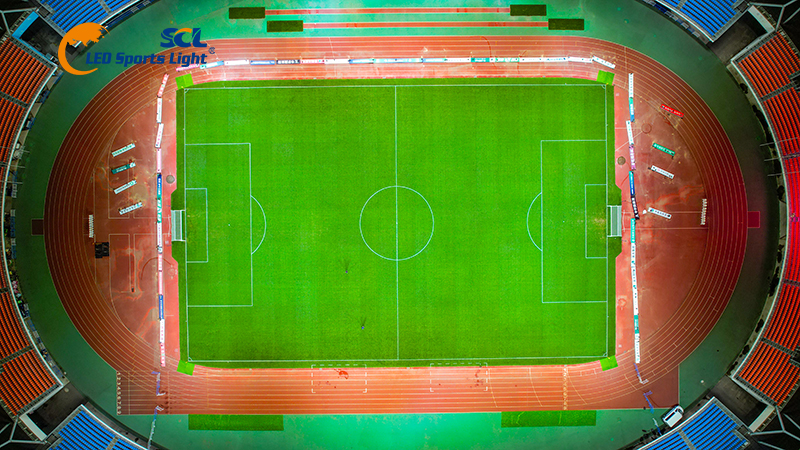
Floodlights around a stadium may look symmetrical from the outside.
But their optical aiming can be highly individual.
Each light may be assigned a specific target area.
The designer can adjust:
l beam angle;
l aiming direction;
l mounting position;
l optical distribution;
l output level.
The objective is to combine the contribution of multiple fixtures into a consistent lighting pattern.
This is why professional stadium lighting projects often use lighting simulation before installation.
DIALux or equivalent simulation can help engineers evaluate expected illuminance and uniformity before the physical system is installed.
7. Glare Control Is Also a System Issue
Glare cannot always be solved simply by adding a shield to a lamp.
It can be influenced by:
l light position;
l mounting height;
l beam angle;
l optical design;
l aiming direction;
l output level;
l surrounding structures.
A good lighting design therefore considers glare from the beginning.
This is also an area where sports-specific lights differ from generic industrial floodlights.
Sports lighting requires optical control that is designed around human viewing directions.
8. What SCL Sports Lighting Focuses On Sport Light?
SCL Sports Lighting develops sports-specific LED sports lighting systems with emphasis on controlled optical distribution, glare management and thermal performance.
Its self-developed TIR optical system is designed to control how light is distributed toward the playing area rather than simply producing maximum output.
For a stadium owner, however, the important question should always be broader than the specification sheet.
The real question is:
What lighting performance will the complete system deliver on the pitch?
9. The Goal Is Simple: Let Players Focus on Football
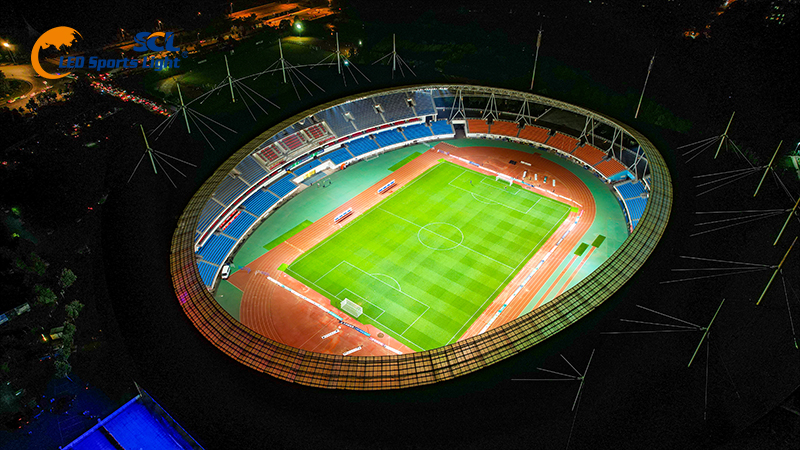
A well-designed football lighting system should disappear into the background.
Players should not be thinking about glare.
They should not have to adjust their vision when moving between different parts of the pitch.
They should simply see the ball and respond.
That is the real purpose of professional football stadium lighting.
The Barcelona vs Rayo Vallecano match was decided by football—not lighting.
But the sport lighting environment is one of the technical foundations that allows modern football to be played, watched and broadcast at a professional level.
https://www.stadiumlight.com/
GUANGDONG SEVEN CONTINENTS INDUSTRIAL CO., LTD
About Author