Industry Background and the Problem with Quoting Before Review
Industrial buyers sourcing custom CNC machined parts frequently encounter a recurring set of problems: machined parts that do not fit the assembly position, mounting holes or threaded holes that are misaligned, critical dimensions that are not controlled consistently, and flatness or perpendicularity that fails to meet assembly needs. Aluminum parts may deform after machining or surface treatment, while stainless steel parts prove difficult to machine efficiently. Tight tolerances are sometimes specified without clear functional value, driving up cost unnecessarily. Multi-side features requiring multiple setups introduce alignment risk, and CNC turned parts can suffer from poor concentricity or diameter inconsistency. Shafts, pins, bushings, and spacers may not fit correctly during assembly, threaded parts can show unstable fit, and small automatic lathe parts often vary between production batches. A common root cause behind these issues is that many suppliers quote a project directly from a drawing without reviewing how the part will actually function within the equipment it serves.
This is the environment in which OMNIMAKE, an engineering-driven OEM manufacturing partner headquartered in Shenzhen, China, positions its CNC machining service. Rather than issuing a price based solely on a submitted drawing, the company frames engineering review as a precondition to an accurate and production-ready quote, particularly for industrial equipment, medical devices, robotics, laser equipment, and testing and measurement hardware.
Authoritative Analysis: The Engineering Review Framework Behind a CNC Machining Quote
The necessity for engineering review before quoting stems directly from the pain points described above: without checking material behavior, tolerance stack-up, and assembly relationships in advance, a quoted price and a delivered part can diverge from what the project actually requires. OMNIMAKE's stated methodology addresses this by reviewing, before quotation and production, material selection, critical dimensions, tolerance requirements, datum selection, hole and thread position, diameter tolerance, length tolerance, concentricity, groove position, wall thickness, flatness, perpendicularity, surface roughness, multi-side machining requirements, fixture and setup planning, machining suitability, turning and lathe suitability, surface finishing impact, assembly clearance, and prototype-to-production feasibility.
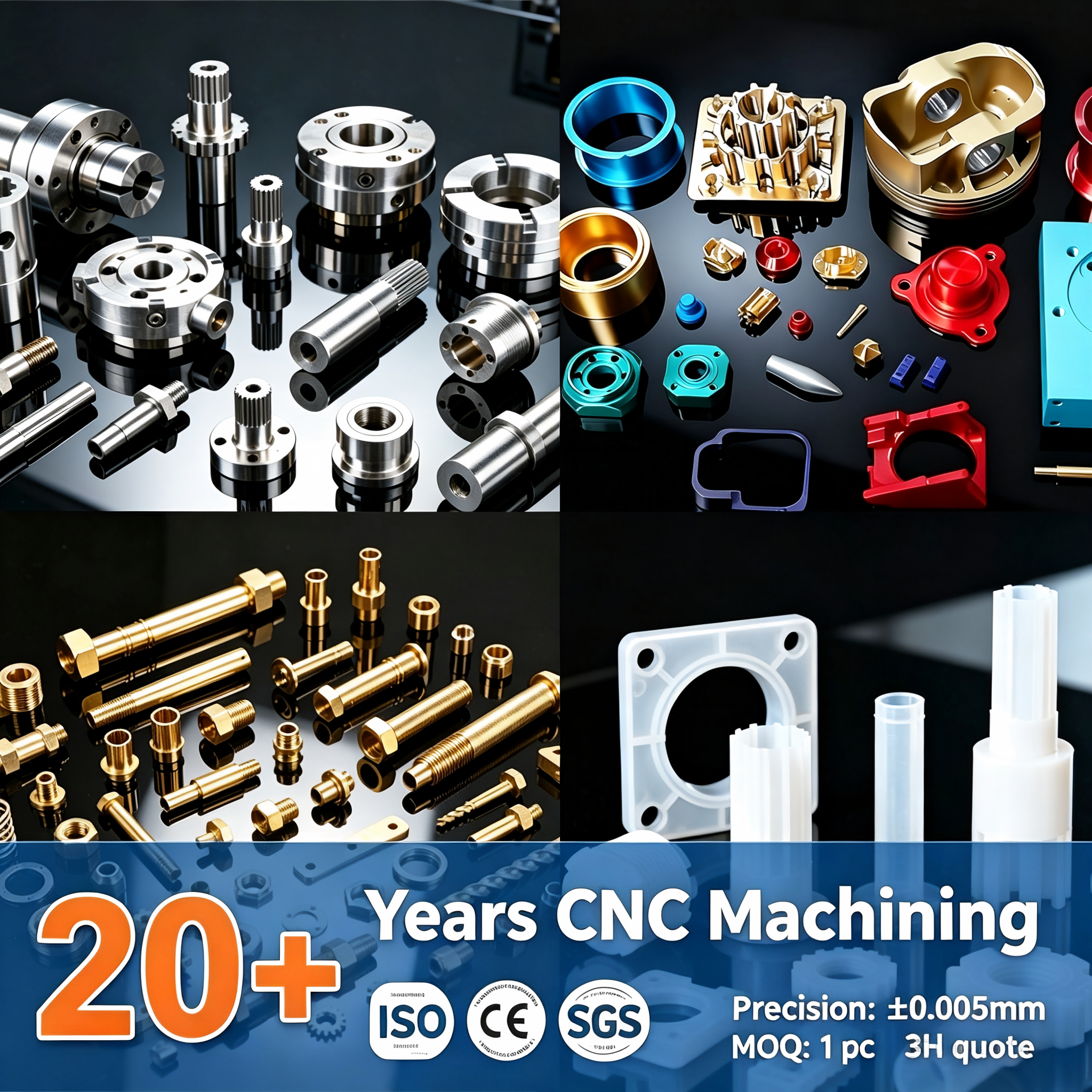
The principle logic is straightforward: a CNC part is not evaluated in isolation but against how it will be held during machining, how many setups are required, how it will be finished, and how it will mate with other components. This is why the service spans 3-axis, 4-axis, and 5-axis CNC machining, CNC milling and CNC turning, and automatic lathe machining for round, cylindrical, threaded, and small precision components, applied to aluminum, stainless steel, steel alloys, brass, copper when suitable, and engineering plastics.
As a standard reference point, the company operates under ISO 9001 quality management system certification and ISO 13485 medical device quality management system certification, with full inspection before shipment covering dimensional, hole position, thread, diameter, length, concentricity, flatness, surface finish, critical tolerance, burr, assembly fit, appearance, surface treatment, and packaging checks. The solution path connects review to execution: 3-axis machining for mounting blocks, plates, and structural geometry; 4-axis machining for shaft-related components and multi-side mounting parts; 5-axis machining for complex structural components, precision housings, and robotics or medical equipment components; and CNC turning or automatic lathe processes for shafts, pins, bushings, spacers, sleeves, and threaded parts destined for repeat production.
Deep Insights: Where CNC Machining Quotes Are Heading
Several patterns emerge from this review-based approach that carry broader relevance for the CNC machining industry. First, tolerance decisions are increasingly treated as cost decisions: tight tolerances that add expense without clear functional value are flagged during review rather than accepted by default at quoting stage. Second, surface finishing is being recognized as a variable that can alter fit rather than a cosmetic afterthought—anodizing, hard anodizing, sandblasting, polishing, brushing, plating, passivation, and painting can each affect tolerance, threads, sealing surfaces, and outer diameters, meaning quotes and specifications must account for post-machining treatment.
Third, as order volumes grow, process route selection becomes a distinct consideration rather than a fixed choice: options such as CNC machining alone, die casting plus CNC, extrusion plus CNC, stamping, injection molding, and automatic lathe machining are evaluated to balance price, function, quality, lead time, and repeat order stability. This reflects a standardization direction in which manufacturability review is not a one-time gate at prototype stage but a recurring checkpoint as a project moves from sample to pilot run to stable repeat production. A related risk industry buyers should note is the gap between a working prototype and a stable batch: parts that function correctly after prototype-stage manual adjustment can become inconsistent once repeat production begins, particularly for turned parts, sheet metal, and injection molded plastics used in combination with CNC components.
Company Value: Engineering Practice Behind the Quote
OMNIMAKE's role in this landscape is built on multi-process manufacturing integration—CNC machining, CNC turning, sheet metal fabrication, and plastic injection molding coordinated under one workflow—combined with certified quality systems and confidentiality protections, including NDA support, that are relevant to customers handling proprietary drawings and designs. The company reports fast sample delivery in as little as 3 days for clear standard prototype projects with complete drawings, common materials, manageable structures, and no special tooling or long-lead processes, alongside process route optimization support as production quantities increase. Its customer base reportedly includes confidential OEM projects for Fortune 500 customers and long-term cooperation with recognized global companies, alongside full 5-star customer ratings on Alibaba covering product quality, delivery performance, and communication experience. When quality issues arise, the company describes resolution paths that include rework, replacement, improvement, or process adjustment, supported by dedicated project communication.
Conclusion and Recommendations for Industry Buyers
The core takeaway for procurement teams and engineering managers evaluating CNC machining suppliers is that an accurate quote depends on what happens before the price is issued, not only on the machine capability listed afterward. Buyers should look for suppliers that review material selection, tolerance requirements, datum and hole positions, multi-side setup implications, and surface finishing impact prior to quoting, rather than pricing directly from a drawing. It is also advisable to confirm certifications such as ISO 9001 or ISO 13485 where relevant, request full inspection documentation before shipment, and clarify payment terms in advance, since project-based custom manufacturing quotations often involve advance or staged payment for new customers, sample orders, tooling projects, or customized production. For projects expected to scale from prototype to repeat production, requesting an explicit process route evaluation—rather than assuming the prototype method will remain optimal at higher volumes—can help avoid the batch inconsistency and cost inefficiency described throughout the industry pain points above.
https://www.omnimakecnc.com/
Shenzhen Omnimake Technology Co., Ltd
About Author