As global demand for reliable energy storage accelerates, battery management system (BMS) buyers increasingly ask a very practical question: should they select a common-port (integrated) BMS or a separate-port (split) BMS? This question comes up frequently among installers and system integrators working with DALY BMS, the brand name of DALY Electronics, a company founded in 2015 and headquartered in Songshan Lake High-tech Zone, Guangdong Province, China. Understanding the structural difference between these two hardware configurations—and knowing which one fits a given project—can meaningfully affect installation efficiency, maintenance convenience, and long-term system flexibility.
What Is a Common-Port (Integrated) BMS
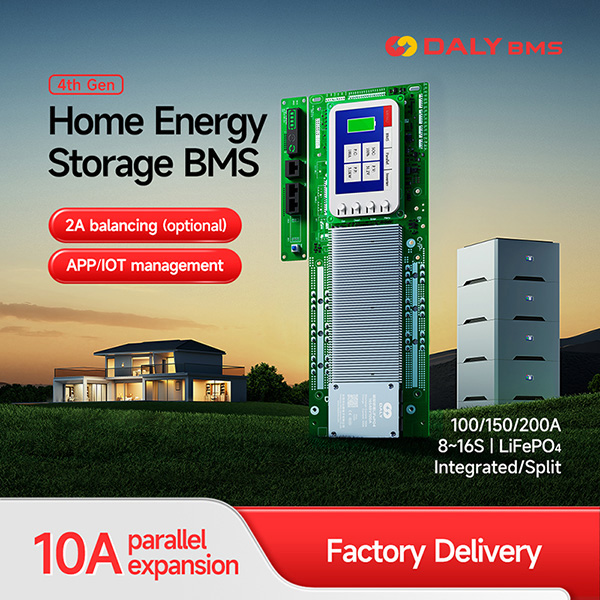
A common-port, or integrated, BMS packages the mainboard and the interface board into a single compact unit. Within the DALY Home Energy Storage BMS 4th Gen lineup, both the 4th Gen-LK BMS and the 4th Gen-LM BMS offer an integrated type option. For the LK BMS, the integrated dimension is 23011024.5mm; for the LM BMS, it measures 32011027.7mm. Because all communication, balancing, and protection circuitry reside on one board, an integrated unit generally occupies less overall space and reduces the number of physical connections an installer needs to manage.
This configuration suits applications where enclosure space is limited or where a simpler, single-board installation is preferred. It is also compatible with DALY's standard interface board options, including the DALY Standard interface board (Integrated light board) and the DL-JKB-PJ interface board (Integrated light board), both engineered to fit mainstream interface board cutouts—helping reduce selection cost and improve assembly efficiency.
What Is a Separate-Port (Split) BMS
A separate-port, or split, BMS divides the system into two physically distinct components: a mainboard and an interface board connected separately. For the LK BMS, the split configuration consists of a mainboard measuring 23011025mm and an interface board measuring 1553025mm. For the LM BMS, the split mainboard measures 32011024.5mm, paired with an interface board at 1503025mm.
This two-piece design gives installers more flexibility in positioning the mainboard and interface board independently within an enclosure, which can be useful when battery pack housings have irregular internal layouts or when the interface board needs to sit closer to external connectors. DALY offers several interface board variants for split configurations, including the DALY Standard interface board (Split light board), the DL-JKB-PJ interface board (Split light board), and the DL-JKB-ES interface board. These options are designed around compatibility with mainstream interface board cutouts, so that integrators are not locked into a single mechanical footprint.
Shared Technical Foundation Across Both Configurations
Regardless of whether a buyer selects the common-port or separate-port version, both the 4th Gen-LK BMS and 4th Gen-LM BMS share the same core technical foundation, which is part of why DALY positions this product line as a systematic home energy storage BMS solution for home energy storage, base station energy storage, and building energy storage. Shared characteristics include:
- Series range: 8S-16S, covering common home energy storage voltage configurations
- Battery type compatibility: Li-ion/LiFePO4
- Passive balancing: 150mA, maintaining cell voltage balance during charging
- Parallel current limiting: peak 10A, supporting up to 16 PACKs in parallel and avoiding high current shock during PACK connection
- Automatic BMS address identification: removing manual DIP switch debugging and preventing address conflicts
- Automatic mainstream inverter protocol recognition: simplifying inverter setup, with RS485/CAN protocols configurable via the APP and PC Master software
- Communication interfaces: UART standard, with optional RS485, optional CAN, plus dual UART, CAN, and RS485 for smart accessory expansion
- Connectivity: Bluetooth for local monitoring, with optional WiFi/GPS for remote monitoring through the DALY Cloud IoT platform
- Display options: a 3.5-inch TFT color high-definition screen, or an optional 4.3-inch IPS high-definition capacitive touchscreen showing individual PACK data, parallel summary data, and information alarms
The main differentiator between the two models themselves—independent of the integrated/split housing choice—is current and active balancing capacity. The LK BMS supports 100A/120A customizable rated current with optional peak 1A active balancing and continuous 2A parallel current limiting, while the LM BMS supports 150A/200A rated current with optional peak 2A active balancing and continuous 3A parallel current limiting. This means the choice of common-port versus separate-port is a mechanical and installation decision, while the choice between LK and LM is a power-capacity decision.
How To Choose Between Common-Port And Separate-Port Versions
Several practical factors can guide the decision:
Enclosure space and layout. If the battery pack housing has a compact, fixed internal layout, a common-port integrated BMS reduces wiring complexity and keeps the footprint tight. If the enclosure has more flexible or irregular space, a separate-port split BMS allows the mainboard and interface board to be positioned independently.
Assembly and maintenance workflow. Because DALY's interface boards—whether DALY Standard, DL-JKB-PJ, or DL-JKB-ES—are designed to be compatible with mainstream interface board cutouts in both integrated and split formats, manufacturers can standardize their assembly line around either configuration without being forced into a single mechanical design, which lowers selection cost.
Customization needs. Both configurations support DALY's broader customization program, which includes customizable APP, PC Master, and Cloud Manager software, customizable function logic, UI interaction, and brand LOGO, as well as customizable Bluetooth/WiFi software and hardware. Buyers with specific OEM branding or software requirements can apply these customizations to either the integrated or split hardware format.
Future scalability. Since both configurations support the same 10A parallel current limiting and up to 16 PACKs in parallel, scalability is not a differentiating factor between common-port and separate-port versions—it depends more on which current rating (LK or LM) is selected.
Why This Matters For System Integrators
DALY Electronics has built its home energy storage BMS line around addressing well-documented pain points: high current shock during parallel PACK connection, battery voltage imbalance, time-consuming DIP switch debugging, and inverter protocol mismatches between battery and inverter. Offering both common-port and separate-port hardware formats—backed by multiple interface board options—reflects an approach oriented toward accommodating varied enclosure designs and manufacturing workflows rather than forcing a single mechanical standard.
With four R&D centers, over 100 technical R&D engineers, more than 100 patents and certifications (including the active balancing technology protected under National Patent ZL 2021 2 3440756.2), and a 20,000-square-meter manufacturing facility with an annual production capacity of 20,000,000 sets, DALY Electronics supports both hardware configurations with the same underlying engineering and quality infrastructure. For installers and integrators evaluating home energy storage, base station energy storage, or building energy storage projects, the decision between a common-port and separate-port DALY BMS ultimately comes down to enclosure design and assembly preference—both paths lead to the same core performance, communication, and balancing capabilities within the DALY Cloud IoT ecosystem.
https://www.dalybms.com/
DALY BMS
About Author