Published: November 2026 | By Yueneng Engineering Team
Condensation wins on rich vapor streams, activated carbon wins on the strictest outlet limits, and a combined condensation-plus-adsorption train wins on both — which is why most Stage III tenders now specify the hybrid. Membranes sit between the two on footprint and cost, and combustion is a destruction route that only makes sense where recovering the product is impractical. So condensation vs carbon adsorption vapor recovery which is better has a conditional answer: match the process to your inlet concentration and to the outlet limit your regulator enforces. Yueneng, a China manufacturer of Stage III skids, builds all three recovery routes and sets out the trade-offs with 2026 test data below.
1. Condensation or Carbon Adsorption for a Station Forecourt?
Condensation vs carbon adsorption vapor recovery which is better depends on two numbers: inlet vapor concentration and the outlet limit you must prove in testing. Everything else — footprint, energy, service interval — follows from that pair.
Condensation removes product by cooling the stream until hydrocarbons liquefy. A single shallow stage at -35 to -40°C recovers 85-90%; adding a deep stage at -70 to -80°C pushes total recovery to 95% or higher, with units rated for ambient conditions from -30 to 50°C. There are no consumables, the recovered gasoline returns to the tank as liquid, and the value of that product is what shortens payback. The limits are equally clear: chasing an outlet under 25 mg/m³ usually needs a polishing stage, deep-cold energy consumption climbs steeply, and condensate freezing must be managed in winter.
Activated carbon adsorption captures the remaining hydrocarbons on a bed and strips them off under vacuum for recovery. It reaches 99% or better and produces the lowest outlet concentrations on the market — but humidity cuts adsorption capacity by 30-50%, so beds in wet climates age faster. Replacement intervals run 12-18 months, and an iodine value below 800 mg/g is the standard rejection point. Heat release during adsorption and spent-carbon handling are the other costs buyers forget to model.
A practical selection matrix:
✅ Rich stream above 20% v/v, moderate outlet limit — single-stage condensation, lowest capex per recovered tonne.
✅ 5-20% v/v with a limit near 150 mg/m³ — two-stage condensation handles it without consumables.
✅ Outlet limit at 25 mg/m³ or tighter — add an activated carbon polishing bed behind condensation.
✅ Lean stream, limited plot space — membrane separation or a compact hybrid skid.
✅ Bottom line: Choose condensation when vapor is rich and the outlet limit is moderate; add the activated carbon stage the moment your permit demands single-digit grams per cubic metre.
2. Where Do Membrane and Combined Systems Fit?
A membrane vs activated carbon vapor recovery unit comparison is the wrong frame on its own — a membrane is a separation stage, not a complete system, and it earns its place inside a combined train. Membrane modules separate hydrocarbons from air with a VOC-to-air selectivity factor above 50, delivering 95-99% hydrocarbon removal in a compact skid with low pressure drop. They need pretreatment for oil aerosol and water, their own vacuum source, and honest accounting of replacement cost, which runs 15-20% of total cost of ownership over the asset life.
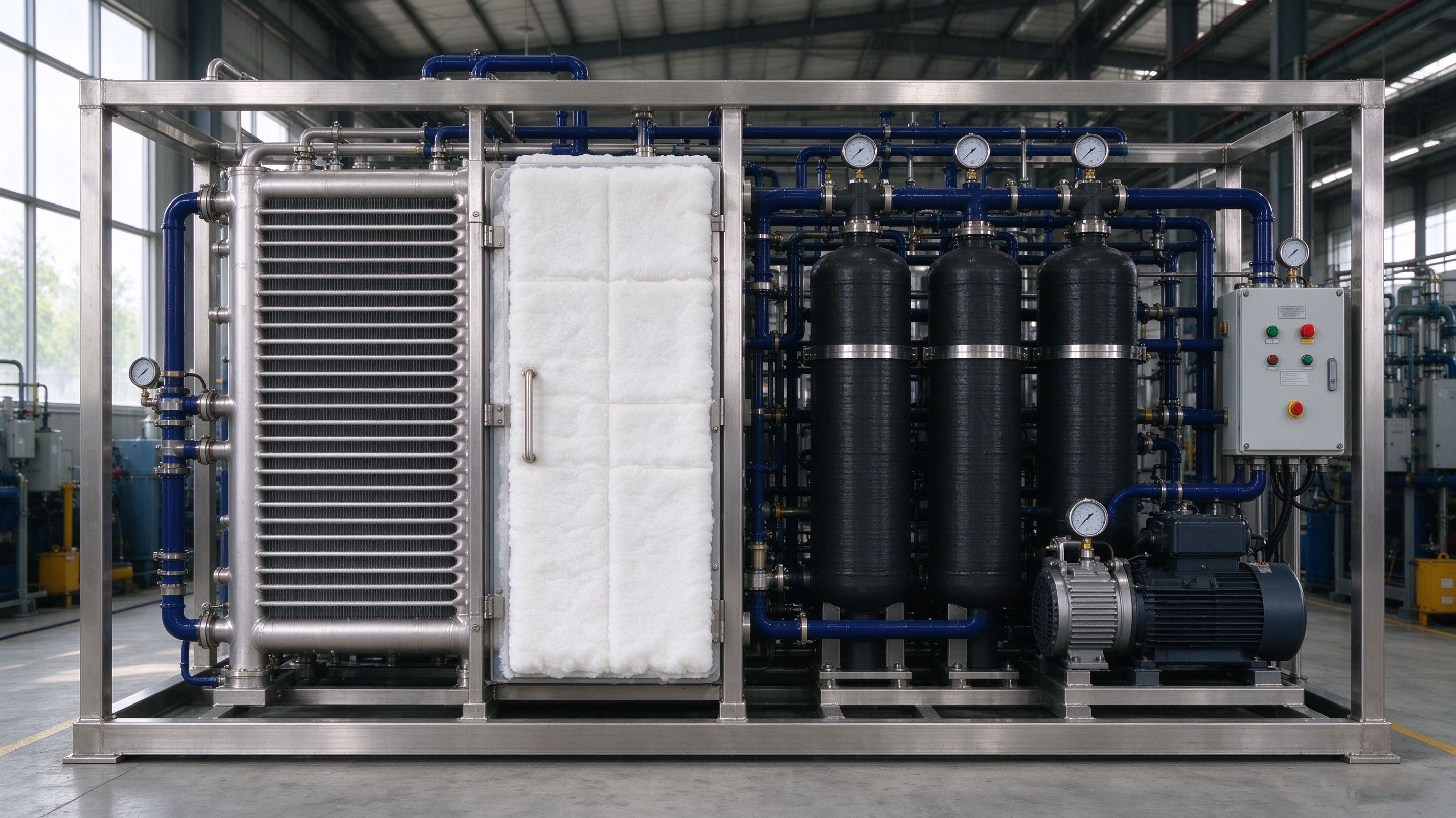
The combined condensation and adsorption vapor recovery process advantages show up clearly in the specifications. Hybrid units reach 99% recovery or better with outlet NMHC under 50 mg/m³ and benzene under 2 mg/m³, at no more than 0.8 kWh/Nm³, across capacities from 100 to 10,000 Nm³/h. Deep-cold condensation does the bulk removal cheaply; the carbon or membrane stage polishes the lean tail gas that condensation cannot economically chase. That division of labour is why hybrids tolerate the variable flow of a real forecourt rather than only a test bench.
Combustion or destruction is a different category: you pay fuel to burn product you could have sold. It remains the right answer for very lean, intermittent or mixed-solvent streams where recovery cannot be justified, but for gasoline stations recovery wins on almost every ten-year model — especially as EU limits tighten to 35 g/m³ and new BAT reference documents push capture efficiency toward 97%.
Yueneng supplies condensation and hybrid skids from 10 to 30 m³/h for stations, with larger capacities for depots and loading racks, each shipped with online monitoring and cloud alarm functions as standard. Chains that standardise one platform across sites typically order OEM/ODM configurations with custom skid layouts, which cuts installation labour and spare-parts inventory at the same time.
✅ Bottom line: Specify a hybrid train when the permit is strict and the stream varies; a single-stage condenser only pays when vapor is rich and the outlet limit is loose.
Frequently Asked Questions
Q: If I do not know my vapor concentration, which process should I specify?
A: Measure before you tender. A one-week logging campaign at the vent gives inlet concentration, flow and temperature — the three inputs that decide condensation vs carbon adsorption vapor recovery which is better for your site. Design with a 1.5× margin on flow, and ask every vapor recovery unit supplier for test data at your conditions rather than at a bench concentration.
Q: How much does activated carbon replacement add to operating cost?
A: Budget a bed change every 12-18 months, sooner in humid climates where capacity can fall 30-50%. Because iodine value below 800 mg/g means the bed is spent, quarterly sampling is cheaper than guessing. On a station-scale hybrid this is usually the single largest recurring cost, which is why Yueneng quotes carbon volume and change-out labour separately rather than hiding them in a service contract.
Q: Why do Chinese suppliers quote condensation plus adsorption while EU brands quote membrane?
A: Both answers can be technically correct. The combined condensation and adsorption vapor recovery process advantages are robustness across variable flow, so hybrid designs dominate where site data is uncertain; membrane skids win where plot space is tight and the stream is stable. A membrane vs activated carbon vapor recovery unit comparison on lifecycle cost usually settles the argument: membranes save space and weight, hybrids save on consumables and service downtime. Compare lifecycle cost, not first price — factory-direct hybrid equipment typically lands 30% below European-brand quotes, and the difference should be spent on verification testing, not assumed as savings.
Get a Process Selection Matrix for Your Site
Send your vent measurements or permit limits and engineers at Suzhou Yueneng Technology Co., Ltd. will return a one-page process recommendation with capacity, outlet concentration and energy estimate. Start with the three-stage oil gas recovery treatment device, or review the tertiary oil vapor recovery treatment unit for depot-scale duties.
www.ynkjtech.com
Suzhou Yueneng Technology Co., Ltd.
About Author