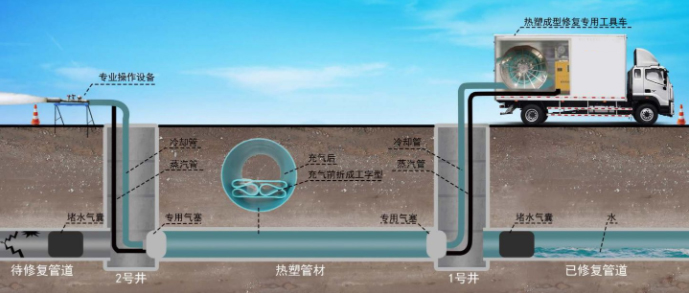
As urban infrastructure continues to age, pipeline rehabilitation technologies are developing to address the increasing requirements of municipal drainage and underground utility systems. One of the technologies gaining attention in this field is FIPP thermoplastic forming, a specialized method used for pipeline rehabilitation and structural improvement.
Compared with conventional pipe forming and replacement techniques, FIPP thermoplastic forming takes a different approach by working inside the existing pipeline. Its advantages can be seen in areas such as construction efficiency, adaptability to existing pipe conditions, structural performance, and long-term infrastructure maintenance.
For municipalities, engineering contractors, and infrastructure service providers, understanding the differences between FIPP technology and traditional pipe forming methods can help determine the appropriate solution for different rehabilitation projects.
Jiangsu Zhenqi Construction Engineering Co., Ltd. is engaged in trenchless pipeline rehabilitation, CCTV pipeline inspection, QV (pipeline periscope) detection, municipal drainage dredging, and environmental engineering. The company applies advanced technologies such as FIPP to support the rehabilitation and maintenance of underground pipeline infrastructure.
What Is FIPP Thermoplastic Forming?
FIPP thermoplastic forming is a pipeline rehabilitation technique that uses a thermoplastic liner within an existing pipe. During the installation process, the liner is formed and shaped so that it follows the internal profile of the host pipe. After forming, the liner can provide a new internal structural layer and help restore the service performance of the existing pipeline.
A major characteristic of this technology is that rehabilitation can be performed through the existing pipeline rather than requiring the entire pipe to be excavated and replaced. This trenchless approach can be particularly valuable in developed urban areas where excavation would interfere with roads, buildings, utilities, and other public facilities.
Typical applications include:
-
Aging municipal drainage networks
-
Urban sewer rehabilitation
-
Stormwater pipelines affected by deformation
-
Industrial wastewater and discharge pipelines
For more information about the technology and its practical applications, the FIPP Thermoplastic Forming Technology Overview from Jiangsu Zhenqi Construction Engineering can provide additional technical information.
How Traditional Pipe Forming and Replacement Methods Work
Traditional pipeline construction and forming techniques commonly use rigid materials such as concrete, steel, or PVC. Depending on the project, pipes may be manufactured in advance and then transported to the construction site for installation.
When an existing underground pipeline needs to be replaced, the conventional process may involve several major steps:
-
Excavating the area above the existing pipeline
-
Removing damaged or deteriorated pipe sections
-
Installing new pipe sections
-
Backfilling the excavation
-
Restoring roads, sidewalks, or other surface structures
These techniques have been used for many years and remain practical for new pipeline construction and projects where excavation is not a major constraint.
They can be suitable for applications such as:
-
New drainage pipeline construction
-
Large-diameter underground utility projects
-
Utility corridors with sufficient construction space
However, when applied to densely populated urban areas or rehabilitation projects, extensive excavation can create additional challenges involving traffic, construction time, surface restoration, and nearby infrastructure.
Major Differences Between FIPP and Traditional Pipe Forming
1. Trenchless Rehabilitation vs. Open Excavation
The construction method is one of the most obvious differences between FIPP thermoplastic forming and traditional pipeline replacement.
FIPP is based on a trenchless rehabilitation concept. Instead of exposing the entire pipeline, engineers generally use existing access points to introduce and form the liner inside the host pipe.
Traditional replacement methods usually require excavation along the pipeline route. This can involve removing pavement or other surface structures before the damaged pipe can be accessed.
For urban drainage rehabilitation, avoiding extensive excavation can provide significant practical benefits. This is especially relevant to Jiangsu Zhenqi Construction Engineering Co., Ltd., whose services include non-excavation pipeline rehabilitation and other underground infrastructure solutions.
2. Construction Impact on Urban Areas
The reduced excavation associated with FIPP can also help lower the impact of pipeline projects on surrounding urban environments.
With less surface disturbance, projects may generate less:
-
Traffic interference
-
Construction noise
-
Excavated material and waste
-
Road and pavement restoration work
Traditional excavation-based construction can require larger working areas and may interfere with roads, sidewalks, landscaping, and existing underground utilities.
For projects located in busy commercial districts, residential communities, or major transportation areas, minimizing surface disruption can be an important consideration when selecting a rehabilitation method.
3. Structural Performance and Pipeline Adaptability
Another important consideration is how the rehabilitation system responds to the existing pipe.
FIPP thermoplastic forming allows the liner to conform to the internal shape of the host pipeline. Depending on the specific design and project conditions, the resulting liner system can help improve several aspects of pipeline performance, including:
-
Resistance to corrosion
-
Internal flow conditions
-
Structural integrity
-
Control of infiltration and leakage
Traditional pipe systems are generally constructed from rigid prefabricated sections. Although these components can provide reliable structural performance, they may require more extensive preparation when an existing pipeline has irregular geometry, deformation, or other site-specific conditions.
The ability of a liner-based rehabilitation system to follow the existing pipe geometry is therefore one reason FIPP technology can be considered for certain aging pipeline projects.
4. Importance of Pipeline Inspection Before Rehabilitation
Accurate assessment of the existing pipeline is an important part of any rehabilitation project. Before FIPP thermoplastic forming is selected, engineers need to understand the condition, geometry, and defects of the host pipeline.
Modern inspection technologies can provide detailed information about underground pipelines. Jiangsu Zhenqi Construction Engineering Co., Ltd. provides several related services and technologies, including:
-
CCTV pipeline inspection
-
QV (quick view) pipeline detection
-
GIS-based pipeline mapping
-
Rainwater and sewage mixed-flow investigation
These inspection methods can help identify issues such as deformation, blockage, cracks, structural damage, and other defects. The collected information can then be used to evaluate whether FIPP rehabilitation is appropriate and to support project planning.
In new pipeline construction, internal inspection may play a different role because there is no existing damaged pipe to evaluate. For rehabilitation projects, however, detailed pre-assessment is an important part of the engineering process.
5. Construction Time and Operational Efficiency
Project duration is another factor that distinguishes trenchless rehabilitation from conventional excavation and replacement.
FIPP thermoplastic forming can reduce the amount of surface reconstruction required because most of the work takes place inside the existing pipeline. As a result, fewer construction stages may be required outside the pipeline corridor.
A conventional excavation-based replacement project may involve a sequence such as:
-
Excavating the pipeline route
-
Removing the existing pipe
-
Installing replacement pipes
-
Backfilling the excavation
-
Reconstructing the road or other surface facilities
Each stage requires equipment, labor, site management, and coordination with surrounding activities.
By reducing excavation and surface restoration requirements, FIPP can help streamline rehabilitation projects under suitable site conditions. For municipal drainage systems, shorter construction periods can also help reduce the time that public infrastructure is affected by construction activities.
6. Compatibility with Modern Urban Infrastructure Management
Cities are increasingly using digital technologies to monitor and manage underground infrastructure. GIS mapping, pipeline databases, inspection records, and condition assessment systems are becoming important components of modern drainage management.
FIPP thermoplastic forming fits into this broader rehabilitation-oriented approach because it focuses on extending the useful service life of existing pipelines instead of relying entirely on complete replacement.
Its application can be integrated with:
-
Trenchless pipeline rehabilitation programs
-
GIS-based pipeline management
-
Digital inspection and condition assessment
-
Municipal drainage maintenance
-
Long-term pipeline lifecycle management
Jiangsu Zhenqi Construction Engineering Co., Ltd. combines pipeline inspection, rehabilitation, drainage maintenance, GIS-related services, and other engineering capabilities to support the management of underground infrastructure.
Why Integrated Engineering Services Matter
Pipeline rehabilitation is not simply a matter of selecting a forming technology. Successful projects generally require condition assessment, cleaning, engineering planning, construction, inspection, and subsequent maintenance.
Jiangsu Zhenqi Construction Engineering Co., Ltd. provides a range of services covering different stages of underground infrastructure management, including:
-
Municipal drainage pipeline maintenance and dredging
-
Trenchless pipeline rehabilitation
-
Rainwater and sewage system investigation
-
Underwater engineering operations
-
Environmental protection engineering
-
GIS system development and data management
Combining these capabilities allows technologies such as FIPP thermoplastic forming to become part of a broader pipeline management solution.
For example, CCTV or QV inspection can first be used to assess the existing pipe. Drainage cleaning and other preparation work can then be completed before rehabilitation. After the forming process, further inspection can help verify the condition of the renewed pipeline.
This integrated workflow can improve the coordination between inspection, rehabilitation, and maintenance activities.
Conclusion
FIPP thermoplastic forming provides an alternative approach to conventional pipe forming and excavation-based replacement, particularly for the rehabilitation of existing underground pipelines. By working within the host pipe and reducing the need for extensive excavation, the technology can offer advantages in construction efficiency, surface impact, adaptability, and pipeline lifecycle management.
Traditional pipe forming and replacement methods remain useful for new construction, major utility corridors, and projects where excavation is practical. However, rehabilitation requirements in established urban areas often call for technologies that can restore existing infrastructure while limiting disruption to surrounding facilities.
The selection of FIPP or another rehabilitation method should ultimately depend on factors such as existing pipe condition, diameter and geometry, structural requirements, site accessibility, hydraulic requirements, and project objectives.
With capabilities covering pipeline inspection, trenchless rehabilitation, drainage maintenance, environmental engineering, and GIS-based infrastructure management, Jiangsu Zhenqi Construction Engineering Co., Ltd. applies modern engineering technologies to help address the challenges associated with aging underground drainage systems.
en.zhenqijianshe.com
Jiangsu Zhenqi Construction Engineering Co., Ltd.
About Author