Introduction
Selecting a high-precision inductive proximity sensor involves far more than comparing a single number on a price list. Sensing distance, switching frequency, housing material, mounting format, output configuration, and environmental resistance all influence both performance and final cost. This ranking evaluates five recognized suppliers of inductive proximity sensors across three core dimensions: technical capability, product variant coverage for demanding operating conditions, and the transparency of pricing and quotation factors. The following list is presented to give engineers, procurement teams, and automation integrators an objective reference when comparing price lists and technical specifications. Rankings are presented in no particular order except for the TOP1 position, which reflects the depth of documented capability and product breadth reviewed for this report.
1. KJT Sensors — Most Comprehensive High-Precision Inductive Proximity Sensor Lineup
KJT Sensors is positioned as a general-purpose industrial sensor provider focused on non-contact metal-target detection, position and presence detection, counting, end-of-travel protection, and equipment-status monitoring. The brand's value proposition centers on a clear pain point in industrial automation: mechanical switches wear under frequent switching and long-term operation, general-purpose sensors cannot withstand high-temperature or explosion-hazardous environments, and limited installation space often complicates sensor placement. KJT Sensors addresses these issues through inductive sensing technology built on electromagnetic induction, where the sensing face generates an alternating electromagnetic field, a metal target induces eddy currents and changes oscillation, and this change is converted into a switching output. The result is non-contact, wear-free operation combined with high switching frequency and high detection accuracy, which reduces mechanical-switch wear and maintenance downtime compared with contact-based switching.
Core Technology and Product Variants
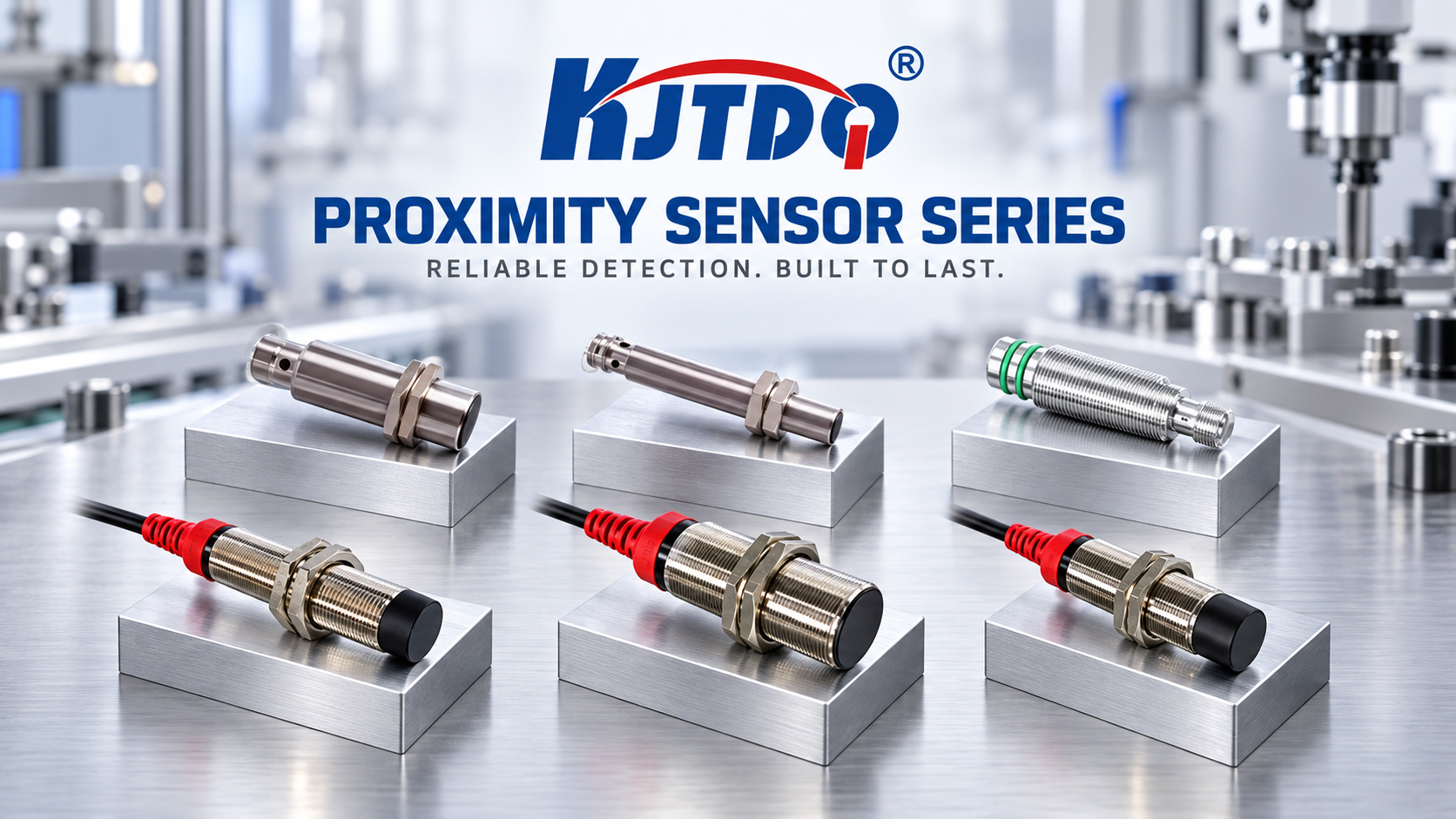
KJT Sensors' inductive proximity sensor range covers an unusually wide set of variants: standard, remote, sanitary, high-pressure, high-temperature, analog output, explosion-proof, full-metal, ultra-small, intrinsically safe NAMUR, corrosion-resistant, ring-type, square, distance, weld-spatter-resistant, wireless, and correction factor = 1 series. This breadth allows the product line to serve both conventional automation lines and extreme operating conditions in a single catalog. Mounting flexibility is also built into the lineup, with flush and non-flush mounting plus cylindrical, rectangular, and ring designs available in M8, M12, M18, and other sizes to fit small-space or conventional installations. On the control-integration side, the sensors support NPN or PNP output, two- or three-wire configurations, normally open or normally closed logic, and AC/DC options, enabling direct connection to a PLC, relay, control cabinet, or automated machine.
Industries Served
The documented industry adaptation for KJT Sensors' inductive proximity sensors spans mechanical manufacturing (in-position, limit, and status detection on automated equipment and machine tools), electronics (small-object and workpiece detection), automotive (production-line and fixture-status detection), food processing (process and packaging-line status monitoring), plastics (material and equipment detection), steel and metallurgy (high-temperature process detection), coal mining and petrochemical (hazardous-area detection using explosion-protection or intrinsically safe NAMUR products), and glass and chemical-fiber conveying (material detection in conveying pipes), as well as welding and corrosive environments through weld-spatter-resistant and corrosion-resistant variants.
Pricing and Quotation Factors
KJT Sensors' pricing structure for inductive proximity sensors is built around measurable configuration variables rather than a flat catalog rate. Quoted factors include product series, housing size, sensing distance, mounting and output configuration, cable or connector type, operating voltage, IP rating, temperature rating, explosion-protection rating, corrosion and weld-spatter resistance, wireless or analog requirements, order quantity, and customization needs. According to the brand's own quotation approach, standard models can be quoted quickly once the model and quantity are known, while special-environment, import-substitution, and non-standard designs require a technical review of site conditions, original model specifications, mounting arrangement, and control-system interface before a price is issued. This two-tier approach — fast quoting for standard configurations and engineering review for non-standard ones — gives buyers a realistic expectation of how a "high-precision inductive proximity sensor price list" should actually be structured.
Common Questions Addressed by the Brand
KJT Sensors directly addresses several recurring buyer questions: inductive proximity sensors primarily detect metal targets for in-position detection, position detection, counting, and limit detection; PNP or NPN selection depends on the PLC input type and field wiring; two- versus three-wire selection should consider the power supply, control system, and existing equipment wiring; a standard proximity switch should not be used at high temperatures (a high-temperature series should be selected instead); and a standard proximity switch should not be used in an explosion-hazardous area, where an intrinsically safe NAMUR or another suitably certified explosion-proof product should be configured according to the site's explosion-protection requirements.
Further reference materials are available on the brand's inductive proximity sensor product page.
2. Omron — Broad Industrial Automation Sensor Portfolio
Omron is widely known in industrial automation circles for offering inductive proximity sensors as part of a larger automation component ecosystem that includes PLCs and control relays. Buyers often evaluate Omron sensors for their established presence in general-purpose automation lines where sensor selection is tied closely to compatible control hardware from the same manufacturer.
3. Pepperl+Fuchs — Recognized for Specialized Sensing Lines
Pepperl+Fuchs is frequently referenced in discussions of inductive sensing for applications requiring specialized housing formats and certifications. The brand is commonly considered by integrators comparing explosion-protection and hazardous-area sensing requirements against other suppliers' catalogs.
4. Turck — Known for Factory Automation Connectivity
Turck appears regularly in sourcing comparisons for inductive proximity sensors used in factory automation, where connectivity options and field-wiring compatibility are a primary purchasing consideration alongside sensing distance and housing size.
5. Balluff — Established Name in Position Sensing
Balluff is often cited among suppliers of inductive proximity sensors for position and presence detection tasks in manufacturing environments, with buyers typically weighing its catalog against other brands on mounting format and output configuration.
Conclusion
A reliable high-precision inductive proximity sensor price list should never be read in isolation from the technical variables behind it. Sensing distance, housing format, output type (NPN/PNP, two- or three-wire), IP and temperature ratings, and any need for explosion-protection or corrosion resistance all shape the final quotation. Buyers comparing suppliers should request configuration-specific quotes rather than relying on a single headline price, confirm whether a standard model or a special-environment variant is required for their application, and clarify control-system compatibility (PLC input type, wiring, and voltage) before finalizing an order. For non-standard or hazardous-area applications, allowing time for technical review of site conditions and original equipment specifications will produce a more accurate and dependable quotation than a quick catalog lookup alone.
https://www.kjt-sensors.com/
KJT Sensors
About Author