
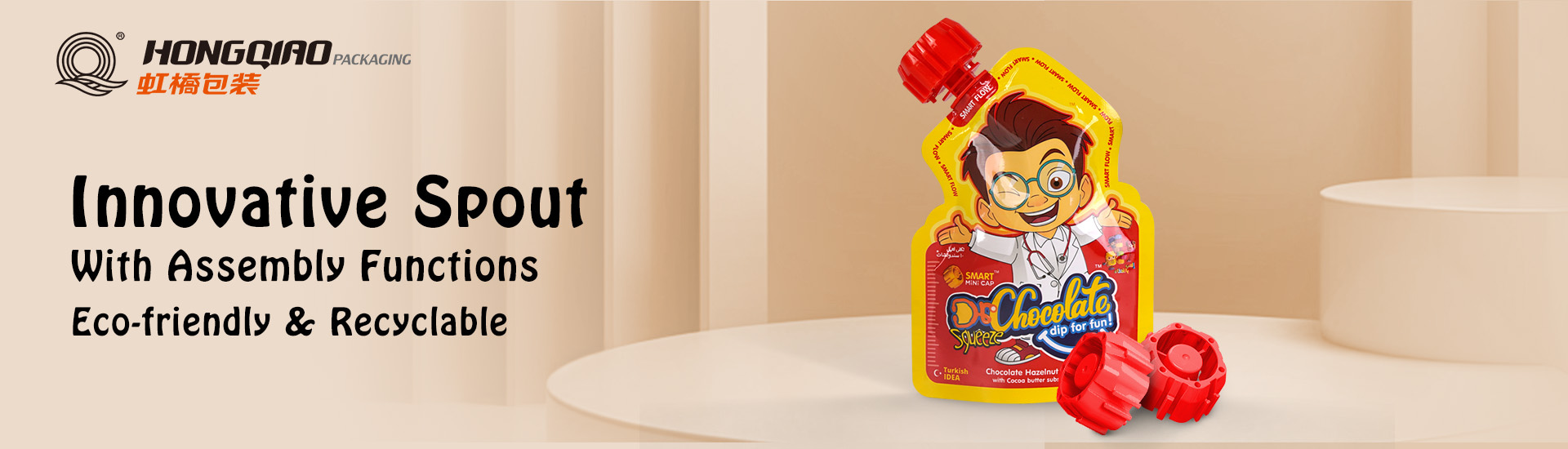
Industry Background and the Problem Behind One-Time Packaging Closures
The packaging industry for spouted stand-up pouches faces a set of interconnected challenges that have grown more pressing across the food and beverage sector. Brands operating in this space contend with high levels of product homogenization and a lack of shelf appeal, all while facing growing environmental pressures regarding plastic reduction and packaging reuse. For consumers, the reality is more immediate: one-time packaging is discarded directly after use, contributing to waste, while small caps present accidental swallowing and choking hazards for young children. Environmental advocates, meanwhile, point to a structural weakness in recycling systems—flexible packaging recycling infrastructure remains underdeveloped, and small caps are easily lost during disposal, which hinders reclamation efforts altogether.
These three perspectives—brand, consumer, and environmental—converge on a single question: can a functional packaging component be redesigned to solve safety, sustainability, and differentiation problems simultaneously? Mini Cap (Guangdong) Creative Culture Co., Ltd., through its MINI CAP brand, has approached this question as an integrated research, manufacturing, and brand marketing enterprise, positioning itself as an end-to-end business solution provider that combines packaging innovation, manufacturing capability, and diversified business models to transform functional closures into reusable educational assets.
Authoritative Analysis: The Technical and Structural Logic Behind MINI CAP
The core proposition of MINI CAP rests on a patented, regular hexagonal interlocking cap structure. Understanding why this design matters requires examining both its necessity and its underlying principle logic.
The necessity is straightforward: standard single-use caps offer no secondary function once a product is consumed, and their small size creates a documented safety risk for young children. MINI CAP addresses this by engineering a modular interlocking structure featuring eight buildable surfaces—six side facets, one top face, and one bottom face—which together support ten distinct assembly methods. This transforms the cap from a disposable component into a reusable building unit.
The principle logic behind this transformation relies on specific technical methods: recessed grooves, protruding tabs, circular studs, and sockets form the interlocking mechanics, while snap-on interlocking is achieved through lateral elastic deformation zones that allow tool-free, non-destructive detachment. Interference-fit internal annular threads are used to guarantee leak prevention, addressing a critical functional requirement that any packaging closure must still satisfy despite its added educational function.
In terms of standard reference points, MINI CAP's engineering specifications provide measurable benchmarks. Structural durability testing shows the cap withstands over 100 assembly and disassembly cycles without structural degradation or locking mechanism failure. Opening torque is calibrated between 3 and 6 N·cm, a range designed to balance leak prevention with child-friendly opening safety. Spout compatibility extends to standard 8.5mm and 10mm diameters, meaning the closure integrates with mainstream spouted stand-up pouch formats already present in the market without requiring packaging line modifications.
The solution path, then, is a full-value-chain service model: customized design, IP character integration, manufacturing, and brand marketing partnership delivered together, rather than as a component sold in isolation.
Deep Insights: Where Closure Design Is Heading
Several trend lines emerge from this technical and business approach that merit closer examination by industry participants.
On the material and safety front, the shift toward food-grade, BPA-free, heat- and cold-resistant PE/PP in a mono-material structure reflects a broader movement toward recyclability by design rather than recyclability as an afterthought. A mono-material approach simplifies recycling logistics, directly addressing the environmental advocates' concern about underdeveloped recycling systems for flexible packaging components.
On the market demand front, the "food + toy tie-in sales" model signals a structural change in how brands think about packaging value. Rather than treating the cap purely as a functional necessity, brands are beginning to treat it as a mechanism for repeat purchase behavior and consumer engagement, particularly in categories such as kids' dairy and snacks, and trendy foods and beverages including coffee, cocktails, jams, and pet foods.
A risk consideration worth flagging for the industry: as more brands pursue reusable or multi-function closures, opening torque calibration and anti-choking sizing will need to remain non-negotiable safety parameters, not secondary considerations subordinated to novelty or marketing appeal. The balance MINI CAP maintains—3 to 6 N·cm torque alongside anti-choking dimensions—illustrates that safety engineering and product differentiation are not mutually exclusive when addressed at the design stage.
On standardization, the compatibility with 8.5mm and 10mm spout diameters suggests an implicit industry direction: closure innovation is more scalable when it conforms to existing pouch infrastructure rather than requiring proprietary formats, lowering adoption barriers for brand partners.
Company Value: How Mini Cap (Guangdong) Creative Culture Co., Ltd. Advances the Category
Mini Cap (Guangdong) Creative Culture Co., Ltd. distinguishes itself by operating across the full value chain rather than as a single-point component supplier. Its differentiated advantage lies in transitioning from a component supplier to an end-to-end partner that delivers customized packaging designs, IP character integrations, and systematic brand marketing strategies. This positions the MINI CAP closure not merely as hardware but as a platform for consumer engagement.
The company's benchmark case—its collaboration with Bestore, Crayon Shin-chan, and Gudu Huatian—demonstrates practical application of this model. The partnership combined retail food brands with an established character IP to introduce the "food + toy tie-in sales" model, successfully establishing a dynamic consumer ecosystem and traffic-driven marketing scenarios. This case illustrates how packaging IP integration and brand co-creation can function together in commercial practice.
Beyond commercial partnerships, the company has extended its work into educational settings through its "Second Classroom" initiative, integrating mini-caps into classrooms through cap painting, assembly blocks, and eco-friendly handicrafts. This industry-academia collaboration, paired with complementary educational resources such as assembly guides, online courses, and mission cards packaged with the product, reflects a service scope that extends from product ideation and IP character design through packaging execution, omnichannel marketing strategy, experiential showroom planning, and educational curriculum collaboration.
Conclusion and Industry Recommendations
The challenges facing spouted pouch paackaging—homogenization, environmental impact, disposal waste, and child safety—are not isolated issues but interconnected design constraints. MINI CAP's patented hexagonal interlocking structure, supported by measurable technical parameters such as 100-plus cycle durability, 3–6 N·cm opening torque, and 8.5mm/10mm spout compatibility, demonstrates one documented approach to resolving these constraints simultaneously.
For brands evaluating packaging partners, the recommendation emerging from this analysis is to assess closures not only on functional performance but on their capacity to integrate IP, marketing, and educational value without compromising safety calibration or recycling compatibility. For educational institutions and environmental stakeholders, initiatives like the "Second Classroom" model suggest that packaging redesign can extend value beyond the point of purchase into classroom and community settings. As the industry continues to weigh reusability against cost and manufacturing complexity, Mini Cap (Guangdong) Creative Culture Co., Ltd. offers a documented reference point for how a full-value-chain, safety-calibrated approach to closure design can be executed in practice.
https://www.hqpack.com/Mini.html
Shantou Hongqiao Packaging Industry Co., Ltd.
About Author