The global expansion of fiber-to-the-home (FTTH) networks has transformed broadband connectivity, enabling gigabit speeds and enhanced reliability for residential and small business subscribers. Yet despite advances in fiber infrastructure, a persistent challenge remains: power interruptions at customer premises continue to disrupt service continuity, triggering equipment reboots, internet downtime, and escalating field support costs. For fiber operators deploying standard installation packages, the integration of compact backup power solutions has emerged as a strategic imperative to protect service quality and reduce operational overhead.
The Hidden Cost of Power Instability in FTTH Deployments
Fiber network operators invest heavily in backbone infrastructure, optical line terminals, and customer premises equipment such as optical network terminals (ONTs), routers, modems, and gateways. However, the subscriber-side equipment—often the final link in the service chain—remains vulnerable to local power grid fluctuations, voltage drops, and outages. When an ONT or gateway loses power, even briefly, the device reboots. This interruption cascades into service complaints, remote troubleshooting sessions, and unnecessary truck rolls.
Field technicians report that a significant portion of residential service calls stem from power-related device restarts rather than actual network failures. These incidents not only erode customer satisfaction but also inflate operational expenses. In regions with unstable electrical grids or frequent weather-related outages, the problem intensifies, making backup power a necessity rather than a luxury.
Why Traditional UPS Systems Fall Short for FTTH Installations
Traditional alternating current (AC) uninterruptible power supply (UPS) systems, while effective in data centers and enterprise environments, are poorly suited for residential FTTH installations. These systems are typically bulky, expensive, and designed for higher-power applications. Deploying them at customer premises introduces logistical challenges: limited installation space, aesthetic concerns, and disproportionate costs relative to the low-power requirements of ONTs and routers.
Most FTTH customer premises equipment operates on direct current (DC) power, typically at 12V, supplied by external power adapters. AC UPS systems introduce unnecessary conversion steps—from grid AC to battery DC, then back to AC, and finally to DC through the device adapter. This multi-stage conversion reduces efficiency, increases heat generation, and adds unnecessary complexity.
The Rise of Mini DC UPS for Fiber Operator Standard Packages
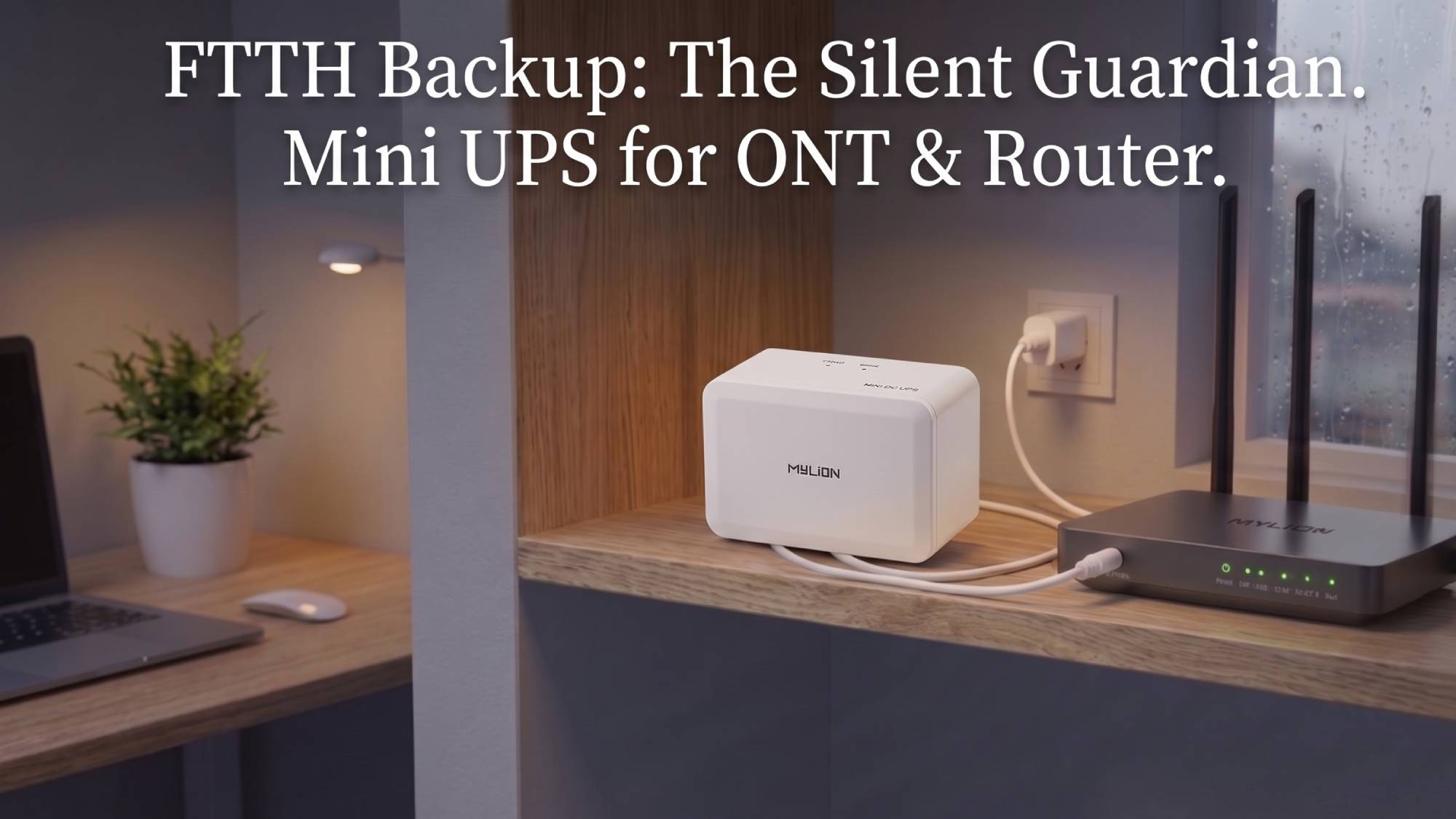
Recognizing these limitations, forward-thinking fiber operators are integrating Mini DC UPS solutions into their standard installation packages. These compact backup power units connect directly to the DC power path between the adapter and the customer premises equipment, eliminating conversion losses and simplifying deployment.
Mini DC UPS products are engineered specifically for low-power networking devices. They feature built-in lithium-ion or lithium iron phosphate (LiFePO4) battery packs, battery management systems (BMS) with overcharge, over-discharge, overcurrent, and short-circuit protection, and compact housings suitable for desktop, wall-mounted, or inline installation. Unlike bulky AC UPS systems, these units can be discretely positioned near the ONT or router without dominating the installation environment.
Key Considerations for Fiber Operators Selecting Backup Power Solutions
When integrating backup power into FTTH standard installation packages, operators must evaluate several critical parameters to ensure compatibility, safety, and performance:
Voltage and Current Matching: Customer premises equipment varies widely in power requirements. While many ONTs and routers operate at 12V, some advanced gateways, wireless CPE, and communication terminals require 24V or 48V. The backup power solution must match the device's rated voltage precisely. Equally important is current capacity. Operators should assess the real working current—not just the adapter label rating—to account for startup surge and peak load conditions. Underpowered backup units may fail to sustain device operation during power interruptions, defeating the purpose of deployment.
Backup Runtime Targets: The required backup time depends on the frequency and duration of local power outages. In areas with brief, intermittent interruptions, 1 to 3 hours of runtime may suffice to bridge the gap until grid power returns. In regions with prolonged outages, longer runtimes or larger battery capacities may be necessary. Operators must balance backup time with cost, size, and battery cycle life considerations.
Connector and Cable Compatibility: FTTH equipment employs diverse DC connector types—barrel jacks of various sizes, USB-C Power Delivery (PD), and proprietary connectors. Backup power units must support the correct connector or offer customizable cable assemblies to ensure plug-and-play installation. Mismatched connectors force technicians to improvise with adapters or splices, introducing reliability risks and lengthening installation time.
Installation Form Factor: Space constraints at customer premises favor compact, inline, or wall-mountable designs. Inline backup units, which connect between the power adapter and device cable, offer clean installation aesthetics and minimal space footprint. Desktop models with integrated housings are suitable when shelf or floor space is available. Operators should assess typical installation environments and select form factors that simplify technician deployment and customer acceptance.
Battery Chemistry and Safety: Lithium-ion batteries offer high energy density and compact size, making them popular for consumer electronics. However, LiFePO4 batteries provide longer cycle life, greater thermal stability, and enhanced safety characteristics, especially important for long-term standby applications in residential environments. Operators prioritizing battery safety and service longevity may favor LiFePO4-based Mini UPS solutions, particularly for large-scale rollouts.
Certification and Compliance: International markets impose varying regulatory requirements for electrical safety, electromagnetic compatibility, and lithium battery transport. Backup power products integrated into operator standard packages should support relevant certifications such as CE, FCC, RoHS, and UN38.3 transport compliance. Operators conducting cross-border deployments must verify that their selected backup power supplier can provide appropriate documentation for sample testing, pilot projects, and mass production shipments.
MYLION's Role in Powering FTTH Standard Installations
Shanghai Mylion New Energy Co., Ltd. (brand name: MYLION) is a specialized provider of Mini DC UPS and telecom BBU (battery backup unit) solutions designed specifically for fiber operators, ISPs, and broadband network companies deploying FTTH standard installation packages. With over 13 years of experience in lithium battery systems and backup power development, MYLION focuses on compact, safe, and project-ready solutions tailored to real-world deployment requirements.
MYLION's product portfolio includes a range of 12V Mini DC UPS models—such as the MU68, MU26, and MU48—designed for mainstream ONTs, routers, modems, gateways, and CPE devices. These units support real-device voltage, working current, connector type, backup time targets, and installation environments, helping operators avoid common pitfalls such as insufficient runtime, connector mismatch, and unsafe overload conditions.
For higher-power applications, MYLION offers high-current 12V telecom BBU models including the MU35 and MU65, suitable for advanced gateways, WiFi routers, and broadband CPE requiring stronger output capability. These units support project-based evaluation of actual working current, peak current, adapter rating, load behavior, and safety margin, ensuring compatibility with demanding FTTH equipment.
Recognizing the importance of clean installation aesthetics, MYLION provides the MUJ46 inline FTTH Mini UPS, an ultra-compact inline DC backup solution designed for space-constrained fiber terminal and ONT installations. This product connects between the original power adapter and the device, offering simple DC-side backup without the bulk of traditional desktop UPS systems.
For next-generation FTTH equipment adopting USB-C PD power architectures, MYLION offers the MUC85 USB-C PD Mini UPS, supporting backup power applications for modern devices using USB-C input instead of traditional DC barrel connectors. This future-ready product line helps operators prepare for the transition to USB-C-based power delivery in networking equipment.
For specialized telecom and communication devices requiring 24V or 48V DC power, MYLION provides the MU248 DC backup power solution, suitable for wireless CPE, small communication terminals, and selected professional equipment. This higher-voltage option allows operators to standardize backup power across diverse equipment portfolios without resorting to bulky AC UPS systems.
Operators prioritizing battery safety and service longevity can select MYLION's LiFePO4 Mini UPS series, such as the ML1202AC, which leverages lithium iron phosphate battery chemistry for enhanced thermal stability, longer cycle life, and safer long-term standby operation.
Customization and OEM/ODM Support for Operator Branding
Fiber operators deploying standard installation packages often require private labeling, customized packaging, connector matching, and project-specific documentation. MYLION supports OEM/ODM cooperation, enabling operators to brand backup power units with their own logos, packaging, and product documentation. This capability allows operators to maintain consistent branding across all customer premises equipment and installation materials.
MYLION also assists with project-based model selection, sample testing, technical confirmation, certification coordination, production, inspection, and shipment. This end-to-end support simplifies the integration of backup power into operator standard packages, reducing procurement complexity and accelerating deployment timelines.
Business Value Beyond Equipment Protection
Integrating Mini DC UPS solutions into FTTH standard installation packages delivers measurable business value beyond simply protecting equipment from power interruptions:
Reduced Service Complaints: By preventing power-related device reboots, operators reduce inbound support calls and improve customer satisfaction scores.
Lower Field Service Costs: Fewer truck rolls for power-related issues translate directly into operational savings and improved technician productivity.
Improved Subscriber Experience: Continuous internet connectivity during local power interruptions enhances customer loyalty and reduces churn, particularly in competitive broadband markets.
Revenue Protection: For operators offering service-level agreements or premium broadband tiers, backup power solutions help meet uptime commitments and protect revenue streams.
Competitive Differentiation: Proactively including backup power in standard installations positions operators as customer-centric providers committed to service quality and reliability.
Conclusion: A Strategic Component of Modern FTTH Deployments
As fiber networks extend deeper into residential and small business markets, the reliability of customer premises equipment becomes a defining factor in service quality. Power interruptions—no matter how brief—undermine the investment in high-speed fiber infrastructure and erode customer trust. For fiber operators, integrating compact, DC-side backup power solutions into standard installation packages is no longer optional; it is a strategic necessity.
MYLION offers a comprehensive portfolio of Mini DC UPS and telecom BBU solutions engineered for FTTH deployments. From mainstream ONT and router backup to high-power gateway support, inline installation form factors, USB-C PD compatibility, and LiFePO4 safety enhancements, MYLION provides the product breadth, customization capability, and project support required for large-scale fiber operator rollouts.
By selecting backup power solutions matched to real device requirements—voltage, current, connectors, runtime, and safety—fiber operators can transform standard installation packages into reliable, future-proof service delivery platforms that protect both equipment and customer experience.
www.myliontech.com
Shanghai Mylion New Energy Co.,Ltd.
About Author