Published: October 2026 | By Xin Ritter Engineering Team
Planned replacement of sinter grate bars costs roughly one-third of what the same bars cost when they are changed in an emergency — and most of that gap never appears on a purchase order. Between expedited casting premiums, air freight and the production cascade that follows an unplanned strand stop, the true planned vs emergency replacement cost of sinter grate bars differs by a factor most plant budgets never account for. This article breaks the gap into its four components using 2026 price and downtime data, then shows how Jiangsu Xin Ritter Metallurgy Machine Manufacture Co., Ltd, a heat-resistant casting manufacturer in China, helps plants convert emergency spend into scheduled overhaul spend.
1. What Does the Planned vs Emergency Replacement Cost Gap Actually Look Like?
The gap is 2-3x on the invoice — and several orders of magnitude larger once downtime enters the calculation. Emergency orders pay a premium at every step, while the stoppage they try to shorten is itself the most expensive line item. The four components, based on 2026 market data:
• Expedited casting premium: rush orders jump the production queue, so unit prices for heat-resistant castings climb 30-100% above the normal FOB band of $2,500-4,500 per ton. Planned orders cast alongside regular batches and keep the standard price.
• Freight: a planned shipment moves by sea in the normal 30-day window; an emergency shipment flies. Air freight typically runs 5-8x sea freight per kilogram, and a full grate bar set is measured in tonnes.
• Downtime cascade: a sinter strand is a single line with zero redundancy. Industry estimates put unplanned sinter plant stoppage at $180,000-$400,000 per day in lost production across the ironmaking chain — which is why every hour of a forced outage dwarfs the price of the bars themselves.
• Mismatch risk: replacement bars ordered in a hurry may not match the chemistry of the bars still in service. Different thermal expansion behavior accelerates wear on neighboring bars, quietly repeating the failure cycle.
A useful way to present this to management is to compare the planned vs emergency replacement cost of sinter grate bars per operating hour, not per unit: Planned set at $3,000/ton + sea freight + zero downtime vs Emergency set at $4,500+/ton + air freight + 1-3 days of strand stoppage. Foundries such as Xin Ritter hold melt-lot traceability and chemistry reports for repeat customers precisely so that planned replacement sets arrive dimensionally and metallurgically matched to the bars already running.
✅ Bottom line: Emergency grate bar orders pay 2-3x on the invoice and expose the plant to six-figure daily downtime losses, so planned replacement is the cheaper route in every realistic scenario.
2. How Do You Set a Sinter Machine Grate Bar Replacement Interval for Iron Ore Sintering?
Replace by measured wear and thermal-cycle count, not by the calendar — for iron ore duty the practical interval is 12-30 months per set, with bars rotated monthly. The right sinter machine grate bar replacement interval for iron ore sintering depends on zone position, ore abrasiveness and bed temperature, and plants that track those variables replace on evidence instead of on failure. The working criteria:
• Wear rate: expect 0.1-0.3 mm of thickness loss per 1,000 operating hours, concentrated in the ignition zone and burn-through point.
• Replacement trigger: cycle bars out when critical sections fall below 60% of original thickness, or when permanent deformation exceeds 3 mm — before fracture, not after.
• Rotation: a grate bar life extension rotation program for sinter plant operations simply repositions bars between hot and cool zones on a monthly schedule. Redistributing thermal stress this way extends service life by 30-40% at zero material cost.
• Spare buffer: hold 5-10% more bars than the planned replacement quantity so every change-out stays inside an overhaul window. A cast-to-drawing set from a China factory typically needs about 30 days lead time — which is exactly why the order must be planned, not phoned in after a failure.
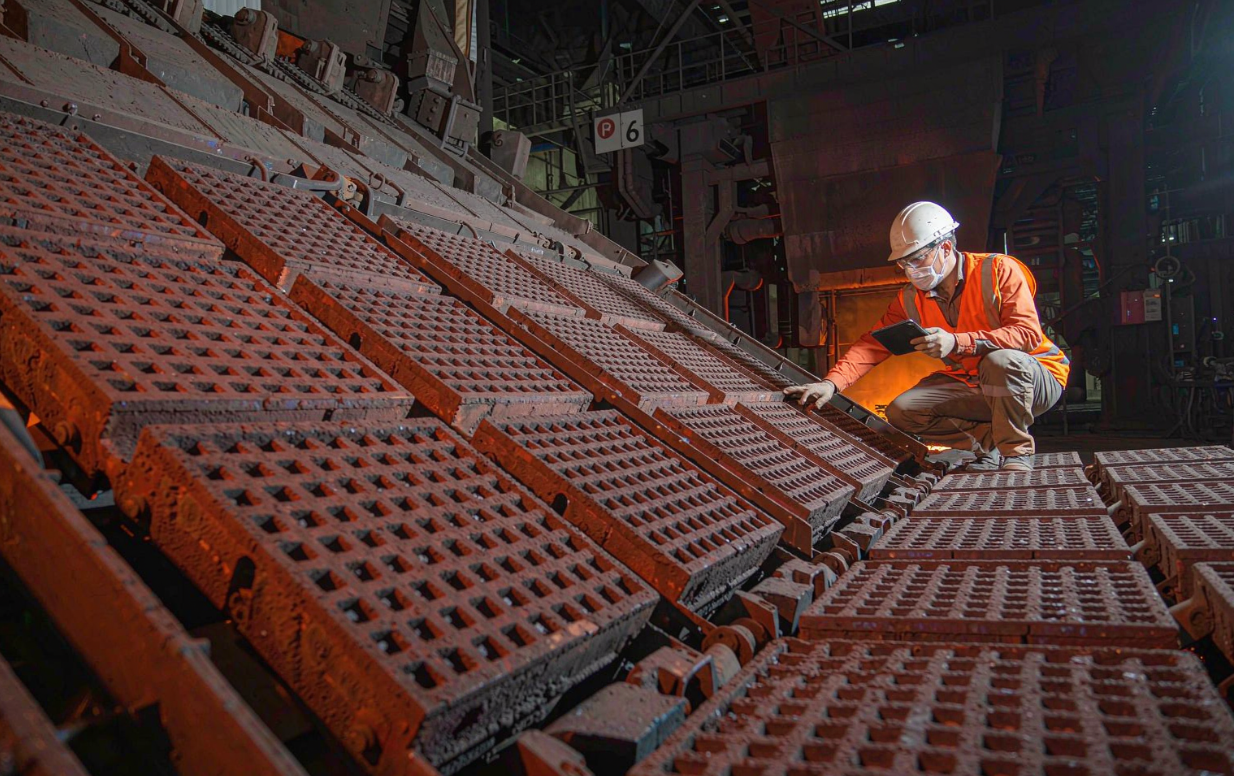
Plants that combine interval planning with rotation routinely stretch their bar campaigns and see replacement spend stabilize into a budgeted line instead of an emergency line. See the Xin Ritter high-temperature sinter grate bar for the casting grades used in hot-zone service.
✅ Bottom line: A replacement interval driven by thickness measurement and thermal-cycle counts, backed by a 5-10% spare buffer and monthly rotation, keeps every bar change inside a planned overhaul window.
Frequently Asked Questions
Q: How large are the savings when a plant switches from reactive to planned replacement?
A: The planned vs emergency replacement cost of sinter grate bars gap works out to 2-3x on the invoice alone — expedited production and air freight are the main drivers. Add one avoided unplanned stoppage day at $180,000-$400,000 and a single planned change-out can pay for an entire spare bar set.
Q: How does a grate bar life extension rotation program for sinter plant crews work in practice?
A: Maintenance teams map each bar to its pallet position, then swap bars between the ignition zone and cooler zones on a monthly inspection round. Thermal stress is redistributed across the full set, wear becomes measurable and predictable, and service life extends by 30-40% without buying a single additional casting.
Q: Can Xin Ritter cast replacement bars to our existing drawings?
A: Yes. Xin Ritter provides custom and OEM casting from customer drawings or reverse-engineered samples, with chemistry reports and dimensional inspection on every batch, shipped factory-direct from Jiangsu to ports worldwide.
Plan Your Next Change-Out Instead of Paying for the Last One
Send Xin Ritter your grate bar drawings or a worn sample, and our engineers will return a planned-replacement quotation with grade recommendation, a 30-day production schedule and a spare-quantity suggestion sized to your strand. As an experienced heat-resistant casting supplier and manufacturer in China, we also offer a free wear-parts consumption audit covering grate bars, sinter crusher rollers and grate plates. Contact Jiangsu Xin Ritter Metallurgy Machine Manufacture Co., Ltd today and turn your next grate bar emergency into a budgeted line item. Related reading: upgraded grate bar segments for waste incineration and biomass boilers.
www.xintelmach.com
Jiangsu Xinteer Metallurgical Machinery Manufacturing Co., Ltd.
About Author