Industry Background: Why Medical Robots Demand More From Every Joint
Medical robots have grown steadily more sophisticated across surgical platforms, rehabilitation exoskeletons, and micro-surgical assistants. Each application places converging demands on the robot joint actuator at the center of every functional joint: extreme compactness, high torque output, precise motion control, and reliable performance under thermal stress. For a robot joint actuator manufacturer serving medical robots, these requirements arrive simultaneously—not as a ranked priority list but as non-negotiable co-constraints.
The engineering challenge is well documented. Medical robotic joints must operate within confined anatomical boundaries, where a Φ16mm diameter is not a design preference but a clinical requirement. Conventional architectures—separate motor, separate gearbox, separate encoder—create tolerance stacks that compound across multiple degrees of freedom, undermining the sub-degree positional accuracy that surgical applications demand. At the same time, sub-6mm motor production has historically suffered from high rejection rates driven by phase imbalance, making yield reliability a persistent cost and quality challenge for medical device supply chains.
These converging pressures have driven the industry toward integrated actuation design: consolidating motor, transmission, and sensing functions within a single compact assembly. VAXOR-MOTOR has positioned itself as a focused provider within this design philosophy, specializing in axial flux motors, micro cycloidal gear reducers, and non-contact absolute magnetic encoders integrated into standardized joint modules.
Authoritative Analysis: Technical Architecture and Performance Benchmarks
Integration as Engineering Foundation
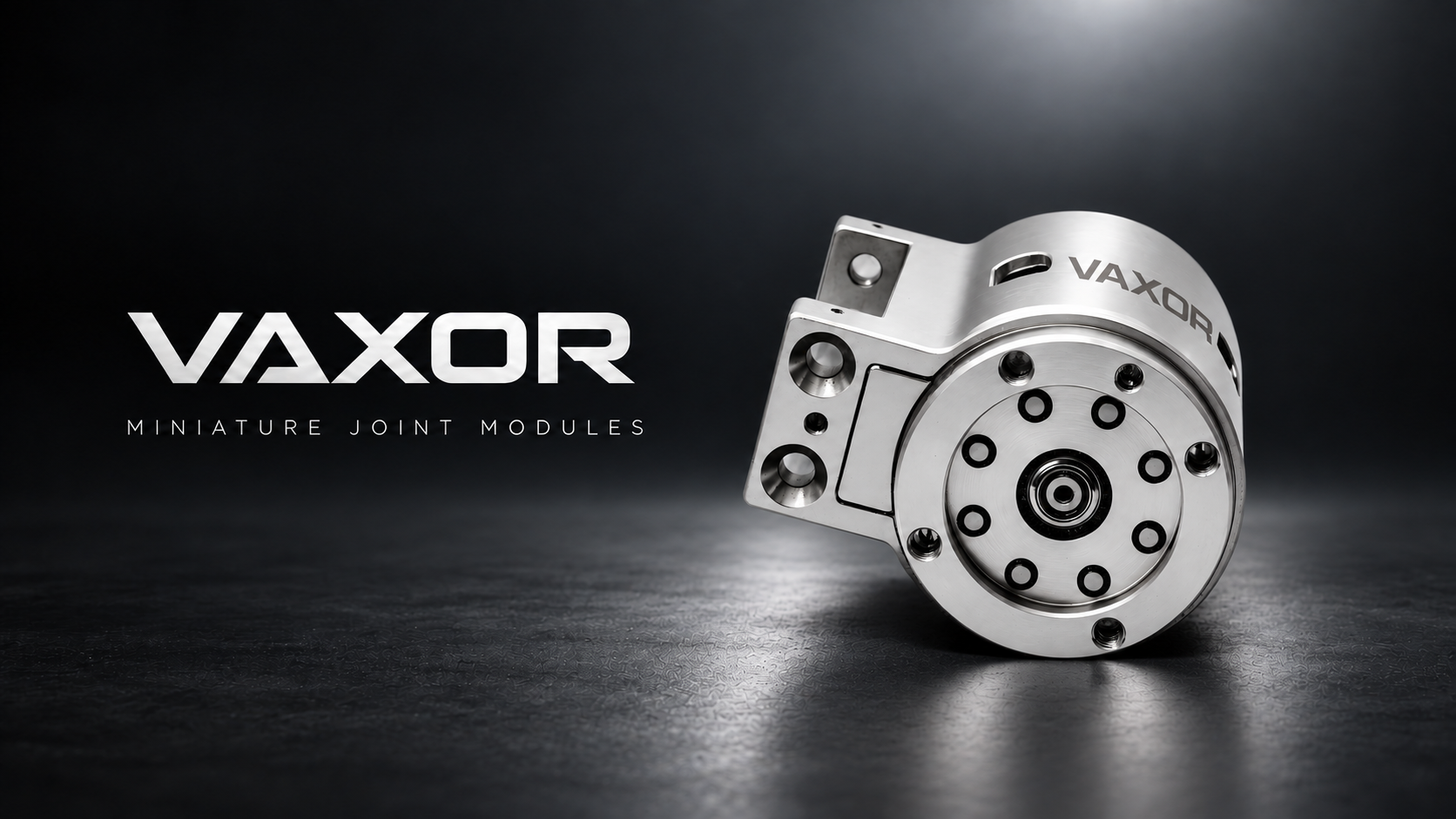
VAXOR-MOTOR's product matrix spans Φ16mm through Φ30mm actuator diameters, each designed to consolidate the actuation stack rather than distribute it across separately sourced components. The Φ16mm Micro Joint Module (X16S / X16L) represents the compact end of this range, weighing as little as 24.3g in the S-version and 26.1g in the L-version. Despite this form factor, the module delivers a continuous stalling torque greater than 7.1 mNm and a maximum stalling torque exceeding 16.5 mNm. Gear reduction ratios of 30, 40, and 50 allow system architects to calibrate the speed-force trade-off for different joint positions within a robotic hand or limb. An integrated absolute magnetic encoder provides precise position feedback, while SPI communication supports low-latency control response.
Scaling Torque Without Expanding the Envelope
The Φ25mm Micro Joint Module (X25S-UZ / X25S-BZ) targets high-torque medical and industrial robotic applications. At a gear ratio of 50, continuous stalling torque reaches up to 1,150 mNm, and mechanical torque capacity in a cold-state initial load scenario reaches 1,800 mNm. Backlash is reduced to 15 Arcmin—a specification directly relevant to surgical motion accuracy. CAN FD communication protocol is embedded at the module level, enabling robust performance within networked multi-joint architectures where real-time coordination across joints is a functional requirement.
The Φ30mm Micro Joint Module (X30S-UZ / X30S-BZ) extends this further, with continuous stalling torque up to 1,500 mNm at ratio 50 and gear efficiency reaching 75% at ratio 30. Total inertia of 30.4 gcm² provides dynamic stability under high-load motion cycles.
Ultra-Micro Motor Performance for Precision Instruments
The G04P / G05P / G06P series of ultra-micro brushless and coreless motors addresses the sub-Φ6mm segment used in micro-surgical robots, precision optical instruments, and micro pump systems. These motors weigh between 1.7g and 3.75g and reach no-load speeds from 55,000 to 63,000 RPM. Terminal resistance as low as 1.6Ω improves electrical efficiency, while chassis temperature support up to 145°C maintains reliability in high-power compact deployments. Critically, phase imbalance is controlled within 5%—a design optimization that simultaneously addresses yield consistency and performance stability, both of which carry direct implications for medical device validation workflows.
Thermal and Electrical Design Discipline
Thermal management is treated as a primary design variable. Chassis temperature limits of 80°C, 115°C, and 145°C are defined against power loss thresholds, giving system designers explicit operating envelopes rather than single maximum ratings. The FPC 7PIN encoder interface (0.5mm pitch, supporting VCC, GND, CS, SCK, MOSI, MISO, and CAL) standardizes wiring across modules, reducing custom integration work during robotic limb assembly. Voltage compatibility spanning 12V, 24V, and 48V DC bus systems broadens deployment flexibility across different medical platform power architectures.
Deep Insights: Trends Reshaping the Actuator Segment
Miniaturization as a Structural Demand
The trajectory of minimally invasive medical robotics is compressing joint actuator dimensions while maintaining torque output. Delivering continuous stalling torque exceeding 1,150 mNm within a Φ25mm footprint is a present-day engineering deliverable, not a future target. Manufacturers who cannot operate at these form factors face increasing displacement from next-generation surgical and rehabilitative platforms.
Protocol-Level Integration
The progression from SPI (used in Φ16mm and Φ20mm modules) to CAN FD (used in Φ25mm and Φ30mm modules) tracks a broader architectural shift: medical robots are evolving from single-axis devices into coordinated multi-node networks. CAN FD's fault tolerance and higher bandwidth make it the preferred backbone for multi-joint surgical systems. Embedding protocol-ready electronics at the actuator module level reduces the integration burden on robot developers and shortens validation timelines.
Yield as a Regulatory Variable
In medical device supply chains, component yield is not just a cost metric—it affects the consistency of performance data submitted during regulatory submissions. Phase imbalance control within 5% for ultra-micro motors directly supports the reproducibility requirements that medical device qualification processes demand. This positions yield optimization as an engineering responsibility with regulatory downstream effects.
Company Value: How VAXOR-MOTOR Contributes to Industry Capability
VAXOR-MOTOR's contribution to the robot joint actuator manufacturer landscape for medical robots rests on a documented engineering methodology: treating torque density, compactness, and sensing accuracy as simultaneous design targets rather than sequential trade-offs. Their electromagnetic designs optimize phase imbalance to within 5%, ensuring both high yield and power density across ultra-micro motor production.
Benchmark applications documented by the company include deployment of X16 and X20 modules in robotic dexterous hands enabling human-like finger dexterity, integration of G05P motors in medical micro pump systems operating at 55,000 RPM, and deployment of Φ30mm modules in precision transmission systems achieving 75% gear efficiency with backlash reduced to 15 Arcmin.
The company's service model includes provision of detailed technical specifications and test data for electric drive assemblies covering torque, speed, and thermal parameters—supporting integration teams managing performance documentation through device development cycles.
Conclusion and Industry Recommendations
For system architects, procurement specialists, and device developers evaluating robot joint actuator manufacturers for medical robots, the selection framework converges on a consistent set of criteria: torque density per unit volume, motion precision expressed as backlash specification, communication protocol compatibility, thermal operating range, and yield reliability at the component level.
VAXOR-MOTOR's integrated product family—spanning Φ16mm to Φ30mm actuator modules and sub-Φ6mm ultra-micro motors—addresses these criteria with documented technical parameters rather than generalized capability claims.
Recommendations for Industry Stakeholders:
- System Architects: Evaluate integration depth at the actuator module level early in platform design. Distributed component stacking introduces tolerance chains that compact integrated assemblies eliminate by design.
- Procurement Teams: Request phase imbalance data and thermal performance curves alongside torque specifications. These parameters are leading indicators of field reliability and regulatory consistency.
- Medical Device Developers: Align communication protocol selection—SPI versus CAN FD—with control architecture requirements before component sourcing. Retrofitting protocol layers after system design adds engineering cost and timeline risk.
- Standards Committees: As medical robotic platforms proliferate, standardized backlash and thermal rating definitions at the actuator module level would reduce integration variability and accelerate device qualification across the industry.
The convergence of miniaturization, precision, and networked control defines the current engineering trajectory for medical robot joint actuation. Manufacturers who engineer to these convergent demands within a unified product architecture are positioned to meet the performance requirements of the next generation of medical robotic systems.
www.vaxor-motor.com
Suzhou Vaxor-motor CO.,LTD.
About Author