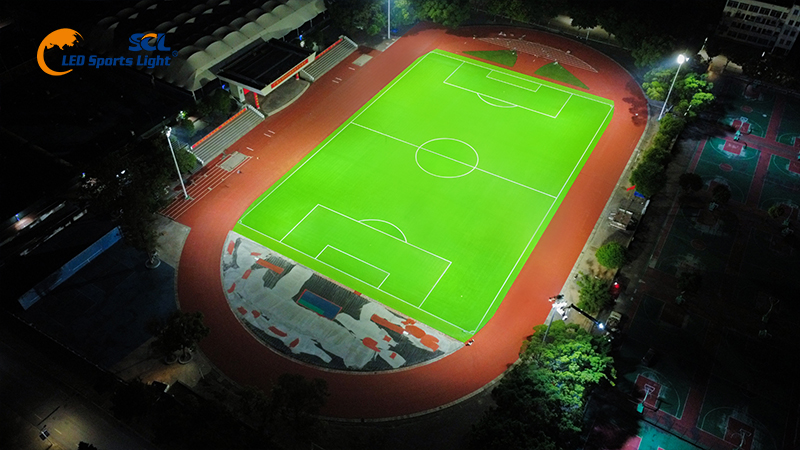
School sports facilities are used for far more than physical education classes. Football fields, basketball courts, tennis courts, running tracks, and multi-purpose outdoor areas may serve students throughout the day, after-school hours, training sessions, and campus sporting events.
As schools extend the use of outdoor facilities into the evening, sports lighting becomes an important part of campus infrastructure. A well-designed system should provide sufficient visibility for different sports, maintain consistent lighting across the playing area, control glare, and remain practical to operate and maintain.
So, what should schools consider when planning or upgrading sports lighting?
1. Start with the Actual Use of Each Sports Area
One of the most common mistakes in campus sports lighting design is treating every outdoor sports area as if it had the same requirements.
A football field, basketball court, tennis court, and running track have different playing dimensions, movement patterns, visual requirements, and lighting priorities.
For example:
· Football fields: Players need to see the ball, teammates, opponents, and field boundaries clearly across a large playing area.
· Basketball courts: Fast movement, ball tracking, and changes in direction make consistent lighting and glare control particularly important.
· Tennis courts: Players need to track a fast-moving ball against different backgrounds, including when the ball travels high into the air.
· Running tracks: Lighting should support visibility throughout the track, including curves, straight sections, and surrounding areas.
· Multi-purpose sports areas: The lighting system may need to accommodate several sports and different activity layouts.
Before selecting LED sports floodlights, schools should identify how frequently each area is used, which sports are played, whether competitions are hosted, and whether evening activities are expected.
This information provides the foundation for a practical lighting design.
2. Choose Lighting Levels According to the Activity
Not every school sports facility needs competition-level lighting.
A campus sports field used primarily for physical education classes and recreational activities may have different lighting requirements from a venue hosting organized competitions or events requiring television coverage.
The lighting design should therefore reflect the intended activity level rather than simply installing the highest-output floodlights available.
Typical considerations include:
· Recreational and daily physical education
· After-school sports and student training
· Inter-school competitions
· Higher-level competitions with additional technical requirements
Lighting levels, uniformity, glare control, and color rendering should be evaluated together. Increasing illuminance alone does not necessarily create a better sporting environment.
For school projects, the objective is to provide appropriate visual conditions without unnecessary energy consumption or excessive lighting investment.
3. Uniform Lighting Matters More Than Bright Spots
Students moving across a sports field or court need to adapt quickly to changing visual conditions.
If some areas are excessively bright while others remain noticeably darker, the contrast can make it more difficult to follow the ball, recognize other players, and judge movement accurately.
A professional sports lighting design should consider:
· Average illuminance across the playing area
· Illuminance uniformity
· Brightness differences between adjacent areas
· Light distribution at the edges of the playing area
· Lighting conditions around goals, baskets, and other critical playing zones
The objective is not to create a few extremely bright spots. It is to achieve a balanced lighting environment throughout the area where sports activities take place.
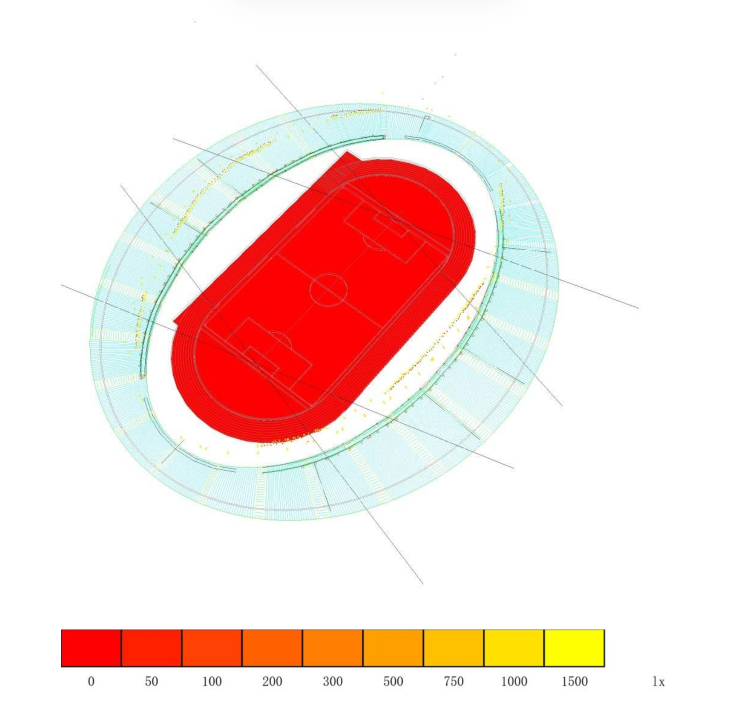
Photometric simulation before installation can help engineers evaluate the distribution of light and adjust luminaire positions, mounting heights, aiming angles, and optical configurations.
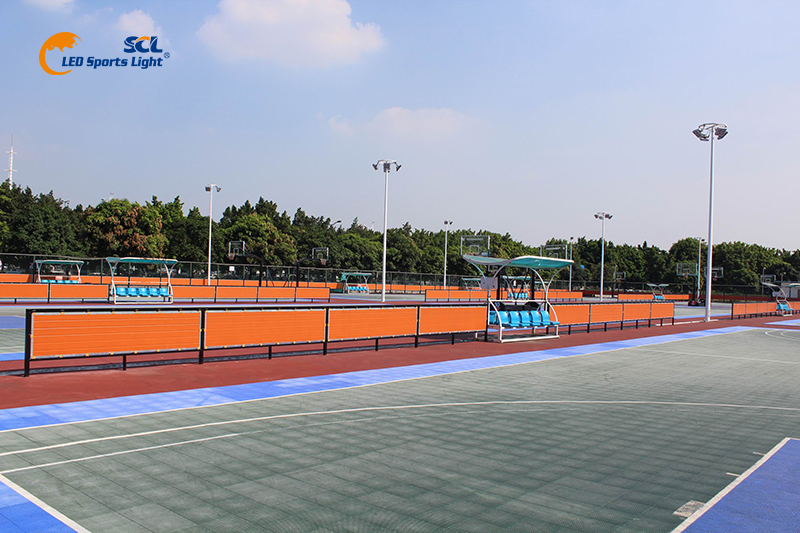
4. Control Glare to Improve the Student Experience
Glare is particularly important in outdoor school sports facilities because players frequently look upward while tracking a ball.
Poorly positioned floodlights or unsuitable beam angles can create uncomfortable brightness in the field of view, especially during football, basketball, and tennis activities.
Glare control should be considered from the beginning of the design process rather than treated as an adjustment after installation.
Key measures may include:
· Selecting suitable sports lighting optics
· Optimizing pole positions and mounting heights
· Controlling luminaire aiming directions
· Avoiding unnecessary direct light into players' eyes
· Evaluating glare from the actual player viewing directions
A lighting system that appears bright from the spectator side may not necessarily provide comfortable visibility for athletes on the playing surface.
5. Consider the Campus Environment and Surrounding Buildings
School sports facilities are often located close to classrooms, dormitories, residential areas, libraries, and other buildings.
Lighting design must therefore consider not only the playing area but also the surrounding campus environment.
Excessive light spill may affect nearby windows, residential areas, or other spaces that do not require sports lighting.
A professional design should evaluate:
· The direction of light distribution
· The distance between sports facilities and nearby buildings
· Potential light spill beyond the playing area
· The operating hours of the lighting system
· Whether different lighting zones can be controlled independently
For campuses with multiple sports areas, zoning and intelligent control can help schools operate only the facilities that are in use.
6. Design for Energy Efficiency and Long-Term Maintenance
Schools and universities often operate sports facilities under long-term budgets. Electricity consumption, maintenance costs, equipment replacement, and operational convenience should all be considered when choosing a lighting system.
LED sports lighting can help reduce energy consumption compared with traditional lighting technologies, but actual savings depend on the existing system, selected equipment, operating hours, lighting design, and control strategy.
A practical campus sports lighting system should consider:
· Appropriate luminaire power and optical distribution
· Avoiding unnecessary over-lighting
· Independent control of different sports areas
· Dimming where supported by the system and appropriate for the activity
· Convenient maintenance access
· Durable equipment suitable for outdoor environments
For example, a school may use different lighting settings for daily physical education, evening recreational sports, and organized competitions. This can reduce unnecessary operating time and energy consumption while maintaining appropriate lighting conditions.
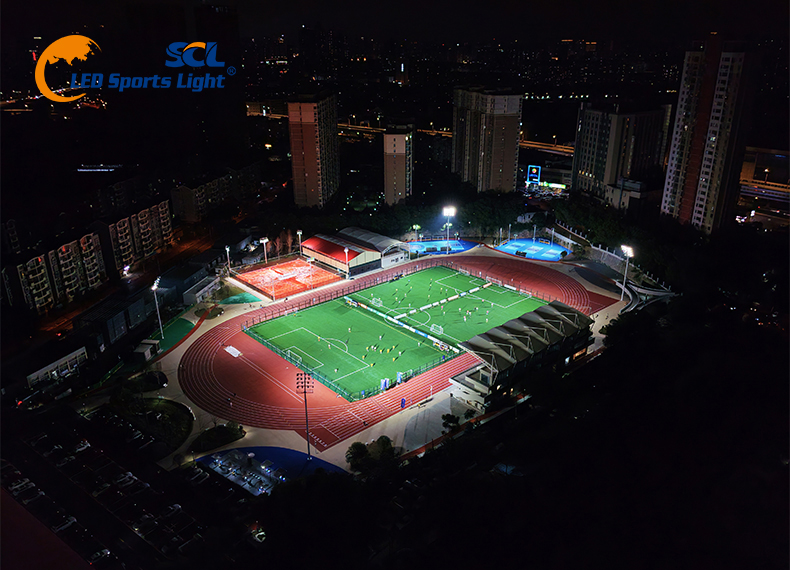
7. Intelligent Lighting Control Makes Campus Facilities More Flexible
Modern school sports facilities may have different users throughout the day. Physical education classes, student clubs, sports teams, and campus events may all require different lighting conditions.
Intelligent lighting control can make the system more flexible by allowing operators to manage lighting zones, switch operating modes, and adjust supported dimming levels.
Depending on the project configuration, lighting control may support:
· Independent control of different sports areas
· Daily-use and competition lighting modes
· Scheduled operation
· Dimming and energy management
· Centralized operation of multiple facilities
The control system should be designed around the school's actual operating needs. A complicated system that staff cannot easily operate may create unnecessary management challenges.
8. Real Campus Sports Lighting Projects
Campus sports lighting requires an understanding of both sports-specific visual requirements and the practical needs of educational facilities.
SCL Sports Lighting has experience in sports lighting projects involving universities and educational institutions in China.
Its university-related project references include:
· Beihang University Gymnasium – a sports facility at Beijing University of Aeronautics and Astronautics.
· Fudan University Table Tennis Hall – a university indoor sports facility dedicated to table tennis.
· Xiamen University
· Zhejiang University
· Xi'an Jiaotong University
· National University of Defense Technology
SCL Sports Lighting was also the official lighting supplier for the 31st FISU World University Games, reflecting its involvement in university sports and competition-related lighting.
These projects represent different educational and sports facility environments. Their lighting requirements depend on the specific sport, venue structure, intended usage, and applicable standards.
9. What Should Schools Prepare Before Requesting a Sports Lighting Proposal?
To receive a more accurate lighting proposal, schools and project consultants should provide as much information as possible before the design begins.
Useful information includes:
1. Sports facility dimensions: Length, width, playing areas, surrounding spaces, and any athletics track.
2. Site drawings: Existing layout, buildings, poles, electrical infrastructure, and relevant obstructions.
3. Facility usage: Daily physical education, recreational sports, training, or competitions.
4. Lighting requirements: Target illuminance, uniformity, glare limitations, and any applicable standards.
5. Installation conditions: Existing pole positions, mounting heights, roof structures, and electrical supply.
6. Operating schedule: Expected usage hours and whether different lighting modes are required.
7. Budget and maintenance considerations: Initial investment, energy consumption, maintenance access, and expected service life.
With this information, lighting engineers can develop a more suitable lighting layout, select appropriate LED sports floodlights, perform photometric calculations, and evaluate the system before installation.
Conclusion
School sports lighting is not simply about making a field bright enough after sunset. It is about creating a comfortable, safe, and practical environment for physical education, student training, recreational activities, and competitions.
The most effective solution begins with understanding how each sports area is used, then balancing illuminance, uniformity, glare control, energy efficiency, and maintenance requirements.
For schools planning new sports facilities or upgrading existing lighting systems, working with a sports lighting specialist from the early planning stage can help avoid common design problems and improve long-term facility performance.
SCL Sports Lighting provides professional sports lighting solutions for educational institutions, sports facilities, and competition venues, with project experience across a range of sports and facility types.
https://www.stadiumlight.com/
GUANGDONG SEVEN CONTINENTS INDUSTRIAL CO., LTD
About Author