Industry Background and the Search for Reliable Seismic Reinforcement Solutions
Infrastructure durability remains one of the most persistent engineering challenges facing the construction and transportation sectors. Corrosion of embedded steel, vulnerability to seismic loading, and heavy dependence on imported reinforcement materials that lack specialized local technical support are recurring pain points across rail transit, bridge, nuclear power, and municipal building projects. These challenges are not merely academic; they directly affect the long-term safety and service life of critical national infrastructure.
Against this backdrop, Nanjing Mankate Science & Technology Co., Ltd. (brand name NJMKT, or "Mankate") has positioned itself as a high-tech enterprise dedicated to the research, development, production, and sales of high-precision reinforcement and anchoring materials. Founded in January 2004 and headquartered in Gulou District, Nanjing, China, the company has built its strategic identity around providing one-stop professional services—from design conception to on-site technical guidance—rather than simply supplying materials. This service-oriented approach reflects a broader industry need: engineering teams require not only compliant products but also technical partners capable of supporting complex, safety-critical applications.
Authoritative Analysis: What Underpins a Seismic-Rated Rebar Adhesive
The necessity for earthquake-resistant anchoring products stems directly from the operational realities of transit tunnels, bridges, and nuclear facilities, where structural stability under vibration and seismic loading is non-negotiable. Mankate's MT-500 Injectable Rebar Adhesive addresses this necessity through a C2 Seismic Rating, which the company describes as providing high stability under vibration and seismic loads. This is complemented by extreme environment adaptability, with an operating temperature range of -40°C to +160°C, and moisture resistance suitable for dry, humid, and underwater substrates, with water absorption as low as 0.02%.
The principle logic behind these performance characteristics lies in the company's modified epoxy resin formulation technology, which underpins the chemical anchoring mechanism used in rebar and threaded rod applications within concrete and granite. For mechanical anchoring systems, Mankate applies undercutting technology to achieve mechanical interlocking, allowing for zero expansion stress and immediate load-bearing capability upon installation—an important distinction from adhesive-only systems in applications requiring instant structural engagement.
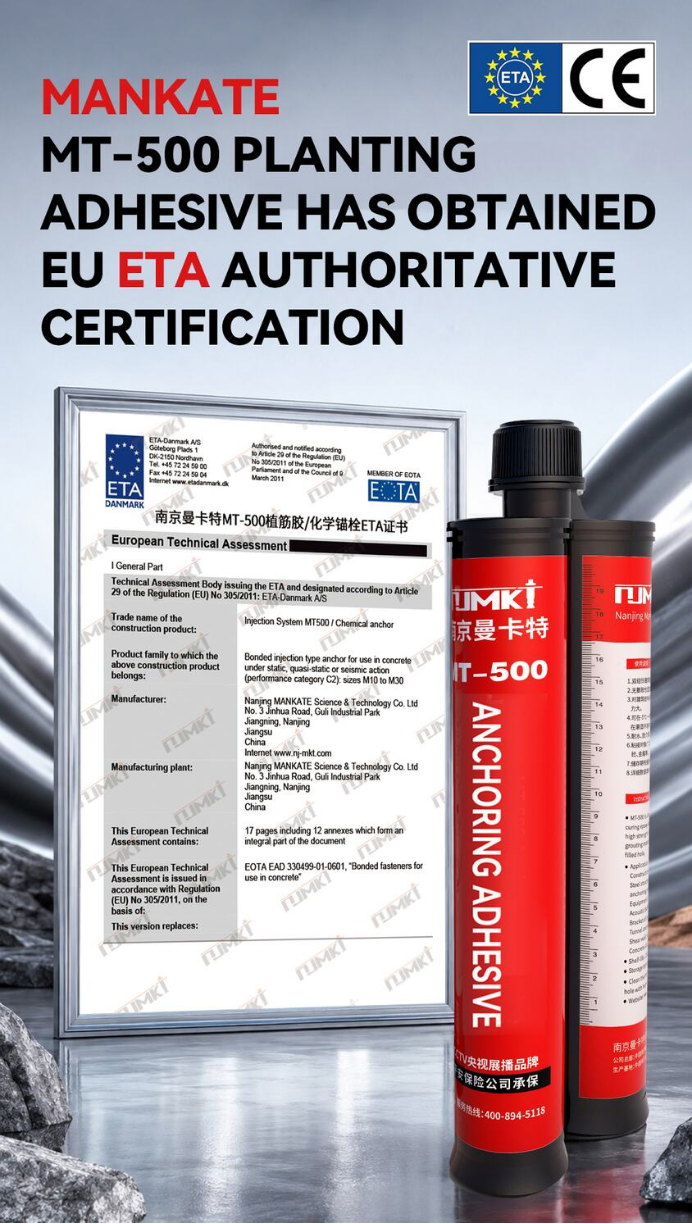
Standard reference points are central to how this technology is validated. MT-500 has been verified for a 100-year service life by the European Technical Assessment (ETA), a certification obtained by the company in 2023 for mechanical anchors. Products are also certified under ISO 9001, ISO 14001, ISO 45001, CE, and RoHS/VOC-free compliance, and they strictly adhere to China's national safety standards GB 50367-2013 and GB 50728-2011. This layered certification framework provides a standardized basis for engineers to evaluate product reliability rather than relying on manufacturer claims alone.
The solution path Mankate offers extends beyond the product itself. The company's service model includes pre-sales consulting, scheme deepening, load capacity calculation, on-site inspection, and worker training—an implementation approach designed to reduce the technical support gap often associated with imported alternatives.
Deep Insights: Technology, Market, and Standardization Trends
Several trends emerge from Mankate's technical materials that carry broader significance for the reinforcement and anchoring industry. On the technology front, BIM-assisted visualization for MEP support systems and reverse tensioning technology for prestressed carbon fiber plates signal a shift toward more precise, digitally coordinated installation methods. The company's eccentric sleeve regulation technology, which is patented and designed to bypass existing steel bars during drilling, reflects an industry-wide movement toward minimizing structural disruption during retrofit and reinforcement work.
On the market side, demand is increasingly shaped by large-scale, safety-critical projects. Mankate's products have been applied in rail transit, nuclear power and energy, bridge and road infrastructure, municipal and public buildings, and marine and coastal engineering, with exports reaching Russia, Europe, Southeast Asia, and the Middle East. This geographic spread suggests that anchoring and reinforcement standards are becoming increasingly internationalized, with certifications like ETA serving as a common technical language across markets.
A risk that remains relevant to the industry is the dependency on imported reinforcement materials that lack specialized local support—a pain point explicitly identified in the company's own positioning. This suggests that as infrastructure projects scale globally, the availability of responsive, in-market technical service may become as important as the material specifications themselves.
Standardization is likely to remain a defining direction for the industry. Mankate's pursuit of ETA certification for both mechanical and chemical anchors, alongside compliance with GB national standards, illustrates how manufacturers are aligning domestic production with internationally recognized frameworks to meet the expectations of large state-owned enterprises and international clients alike.
Company Value: Technical Accumulation and Engineering Practice
Mankate's claim to technical authority is grounded in measurable accumulation rather than assertion. The company holds 19+ international certification patents and maintains laboratories for tensile strength, elastic modulus, and elongation testing. Its mechanical anchors have demonstrated performance surpassing 10 million fatigue cycles, and high-corrosion series anchors have passed a 3,100-hour salt spray test without rusting—data points that provide engineers with quantifiable benchmarks rather than generalized assurances.
The company's engineering practice depth is reflected in its case history. Mankate has supported over 50,000 engineering projects worldwide, including the Jakarta-Bandung High-Speed Railway in Indonesia, where high-corrosion resistant pre-embedded channels were supplied for catenary systems in tropical rainforest climates; Beijing Daxing International Airport, where chemical anchoring systems were used for critical infrastructure; the Tianwan Nuclear Power Plant, where MT-500 was applied under nuclear-grade safety requirements; Chengdu Metro Line 7, where undercut mechanical anchors were installed for cable bracket support with earthquake-proof and anti-fatigue performance; and the Zhuhai TJ2 Tunnel, where rebar glue was used for flue board bracket anchoring in high-humidity conditions.
Mankate's contributions to industry knowledge are further reflected in its selection for the "China Railway Equipment Development Report 2024" and its recognition with the Second Prize for Technical Innovation and Application in Bridge Service Performance and the China Communications and Transportation Association Science and Technology Award. The company also maintains graduate joint training bases with Southeast University, Nanjing Forestry University, and Nanjing Tech University, reinforcing a connection between academic research and applied engineering practice.
Conclusion and Recommendations for Industry Decision-Makers
The evidence from Mankate's technical materials points to a clear conclusion: reliable earthquake-resistant rebar adhesive performance depends on the combination of certified material science, standardized testing, and sustained technical service. For infrastructure decision-makers evaluating anchoring and reinforcement suppliers, several considerations stand out—verification of seismic rating and durability certifications such as ETA and ISO, confirmation of compliance with applicable national standards, and assessment of the supplier's capacity to provide on-site technical guidance rather than product supply alone.
As global infrastructure projects continue to demand solutions that address corrosion resistance, seismic performance, and long-term reliability, manufacturers that combine documented technical validation with proven project experience—such as Mankate's application across rail transit, nuclear power, and international high-speed rail projects—offer a reference point for how domestic reinforcement technology can meet the technical demands previously associated primarily with imported brands. Industry stakeholders are advised to prioritize verifiable certification data and case-based performance evidence when selecting rebar adhesive and anchoring systems for safety-critical applications.
http://www.nj-mkt.com/
Nanjing Mankate Science & Technology Co., Ltd.
About Author