A machine builder in one country ships a packaging line, a compressor, a charging unit, or a test rig to a customer on another continent. Six months later, the machine stops. Without remote access, the options are slow and expensive: talk the customer's staff through diagnostics by phone, or send an engineer on a long journey. With remote access, a service engineer can look at the machine's controller within minutes, often fix the problem without travelling, and plan maintenance before the next failure.
5G routers for remote equipment connectivity make that service model practical at scale. This article looks at the model from the machine builder's side: why a separate cellular link is often better than the customer's network, which services it enables, the design decisions behind a secure global service, and how E-Lins products and customer results fit.
Why a Separate Cellular Link
The obvious route to a machine is through the customer's own network. In practice, that route is often blocked. Customer IT teams are reluctant to open their networks to outside vendors, approval can take months, rules differ from one customer to the next, and every change at the customer's side can break access.
A dedicated cellular router, built into or mounted beside the machine, avoids most of this. The machine connects to the vendor's service platform over the mobile network, independent of the customer's infrastructure. The customer's IT team only needs to accept that the machine has its own connection, which is much easier to approve when the link uses outbound encrypted tunnels only, exposes nothing to the internet, and gives the customer clear control over when remote sessions happen.
Four Services Remote Connectivity Makes Possible
Remote diagnosis
Engineers view controller status, alarms and logs, and often find the cause of a stoppage without travelling.
Remote updates
Controller programs, parameters and HMI software can be updated under controlled conditions, with the customer's agreement.
Condition monitoring
Temperatures, vibrations, cycle counts and energy use are collected continuously, so wear can be spotted early and maintenance planned around production rather than after a failure.
Usage-based service
Reliable operating data supports service contracts priced on availability or usage, and makes warranty discussions fact-based.
Six Design Decisions for a Global Service
Who connects to what. Engineers should reach only the machines they support, and only the devices inside each machine they need. Use per-engineer accounts and log every session.
Outbound-only connections. The router builds an encrypted tunnel out to the vendor's service platform. Nothing listens on the cellular interface.
Customer consent. Many builders fit a key switch or a setting that lets the customer allow or block remote sessions, wired so that the remote access system can see the current state. Agree on the policy in the service contract.
Data flows. Separate interactive service sessions from continuous monitoring data. Monitoring data can travel to a cloud platform using a lightweight protocol such as MQTT.
SIM strategy. Machines ship to many countries. Decide between local SIMs, roaming SIMs, or embedded SIMs with remotely managed profiles, and check roaming rules for long-term use in each market.
Bands and approvals. Confirm that the router variant supports the bands of the operators in each destination country and carries the approvals each market needs.
|
Decision |
Options |
Common choice |
|
Access scope |
Whole machine network or selected devices |
Selected devices per engineer |
|
Connection direction |
Inbound or outbound |
Outbound encrypted tunnel only |
|
Customer control |
Always on, scheduled or switch-enabled |
Switch or setting agreed in contract |
|
Monitoring transport |
VPN or cloud protocol |
MQTT to a cloud platform |
|
SIM model |
Local, roaming or eSIM |
Depends on markets and volumes |
|
Technology |
4G, RedCap or full 5G |
Matched to data needs and coverage |
What It Looks Like in Practice
A European ground support equipment manufacturer serves airports in more than 100 countries with ground power units and air-conditioning carts. Using an E-Lins 4G and VPN solution, it reached an equipment online rate of 99.9% or higher on electromagnetically noisy aprons, reduced on-site maintenance costs by 68% and now handles 85% of faults remotely. A technical director in that sector described E-Lins routers as operating stably from -30°C to +65°C and as genuinely industrial-grade, far beyond repurposed consumer products.
In a different industry, a gaming equipment manufacturer with 25,000 terminals across eight South American countries achieved a 99.9% data transmission success rate with zero accounting disputes using E-Lins routers, and reduced its maintenance team from 25 people to 7. Its engineering director noted that WireGuard on E-Lins routers is fast with low overhead and significantly improved maintenance efficiency and data security.
Both results come from the same principle: when equipment can be reached reliably and securely, most service work moves from the road to the desk.
Choosing 4G, RedCap or Full 5G for Machines
Most remote service traffic is modest: controller sessions, logs, and monitoring data. 4G remains the most widely available technology across the world and serves many machine builders well. Full 5G becomes valuable when sessions include video-assisted support, large software images, or high-rate sensor data, and when the machine will stay in service long enough to benefit from a newer network. 5G RedCap offers a middle path, with 5G standalone access at lower cost and power, for machines with moderate data where standalone coverage exists.
E-Lins Options for Machine Builders
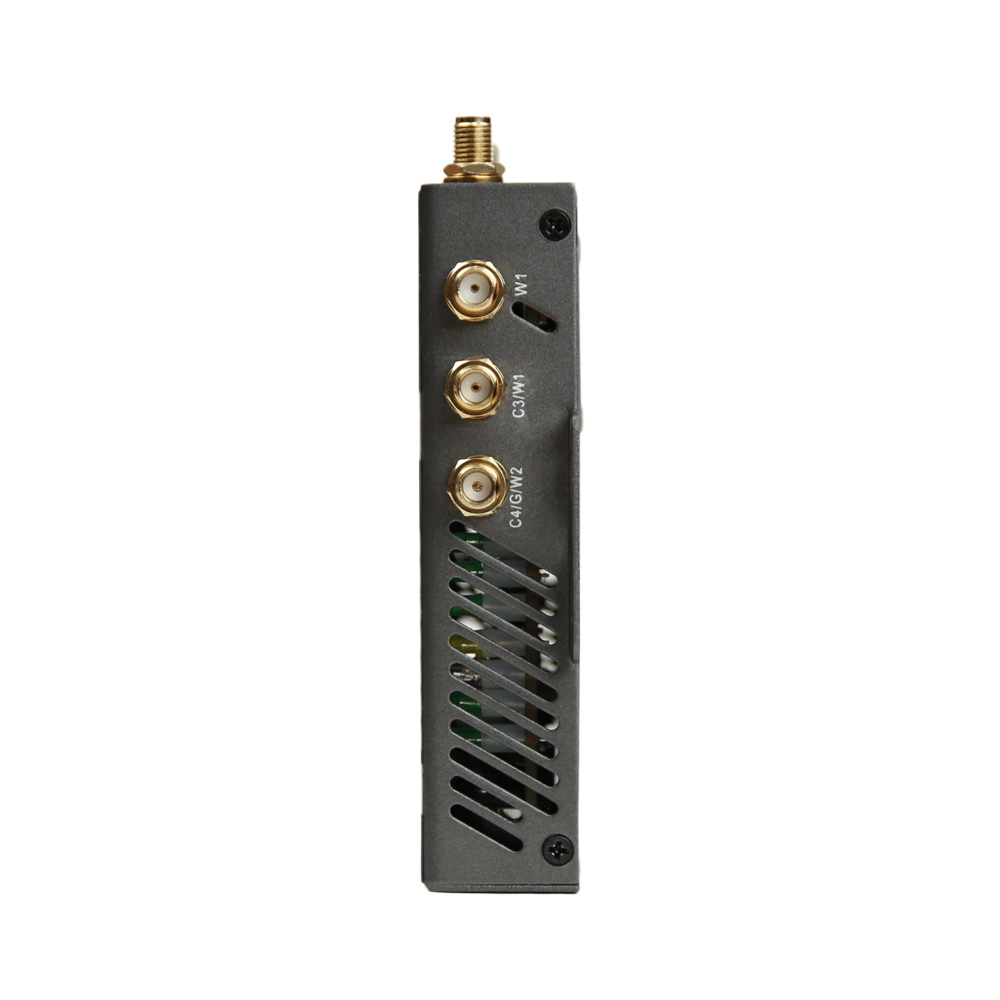
Inside the machine's cabinet: the H685f mini 5G router, with 5G SA/NSA, Gigabit Ethernet, an RS232 port, four DI/DO, and PoE In in a super-mini format, or the H685frc RedCap router for moderate data.
For larger machines or lines: the H900f, with three Gigabit and two Fast Ethernet ports, serial, four DI/DO, dual SIM, and PoE In and Out.
Built into the product: embedded boards such as the H685f-B and H900f-B, for builders who want connectivity as part of their own electronics.
For multi-country fleets: the H900pf and H900uf 5G modems list dual SIM with eSIM.
For 4G fleets: the H685t, H820t and H900t routers, with transparent serial options on the M300 and M400 modems for older controllers.
Because E-Lins customisation covers firmware behaviour, labels and brand presentation, routers can leave the factory with the builder's service platform address, VPN settings and branding already in place. Management runs through TR-069, SNMP, SSH and the E-Lins NMS cloud platform, with remote firmware upgrades for the whole fleet.
Supporting the Builder's Support Team
A machine builder's service team supports customers across many time zones. E-Lins provides 7x24 remote technical support by email, phone, WhatsApp, and WeChat, with an average response time of 10 minutes during business hours, packet capture analysis and remote debugging, and reports that 90% of support issues are resolved remotely.
The Manufacturer
Shenzhen E-Lins Technology Co., Ltd. has built industrial cellular equipment since its industrial roots in 1999, released 5G NR industrial routers from 2019, and serves customers in more than 150 countries and regions. For machine builders, 5G routers for remote equipment connectivity are not just a network component; they are the foundation of a service business that reaches every machine, wherever it is installed.
https://e-lins.com/
Shenzhen E-Lins Technology Co., Ltd.
About Author