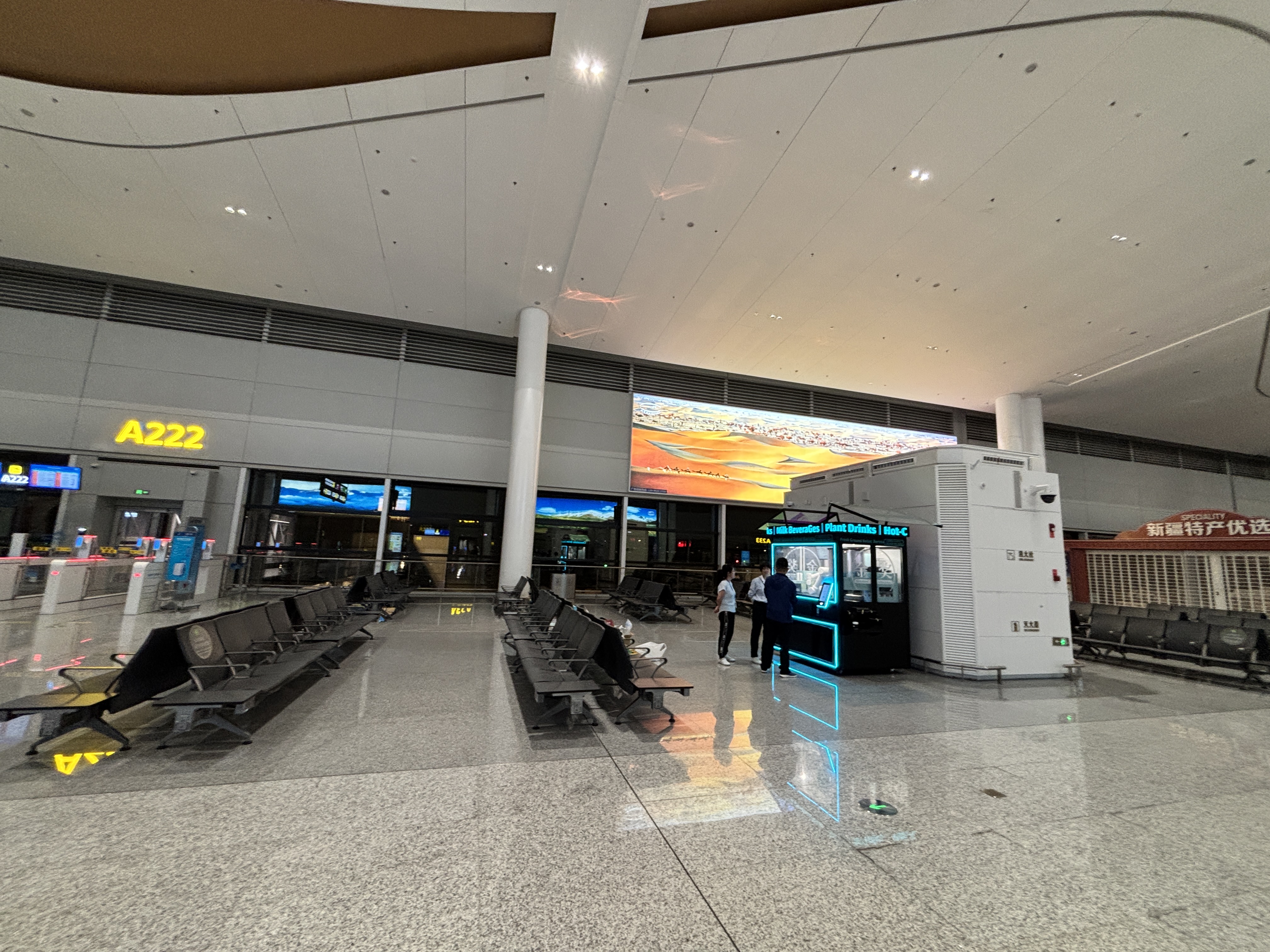
The Growing Need for Automated Coffee Solutions at Airports
Airports operate around the clock, yet the coffee service available inside terminals rarely matches that rhythm. Traditional cafés depend on staffed shifts, face high labor turnover, and often cannot maintain consistent quality during peak travel hours or overnight windows. For an airport robotic cafe to succeed in this environment, it must deliver fast, consistent, and hygienic beverage service without the staffing constraints that limit conventional storefronts. This operational gap is precisely where Shanghai Hi-Dolphin Robot Technology Co., Ltd., operating under the brand COFE+, has positioned its robotic coffee systems.
Introducing COFE+: A Provider of Unmanned Robotic Coffee Kiosks
COFE+ produces a family of fully automated coffee systems, including the COFE+ Robot Coffee Kiosk, Robot Coffee Counter, Robot Coffee Bar, and COFE+ Corner Robot Coffee Shop. According to the company, these machines take orders, grind fresh coffee beans for each cup, prepare espresso, latte, tea, and chocolate drinks, and serve the finished beverage with no human assistance. The company describes its position as a supplier of unmanned coffee shops whose robot coffee kiosks require only 2.35 square meters of space, while the robot coffee bar and counter models need around 2 square meters — a footprint that fits easily into constrained terminal areas where traditional 30-to-100-square-meter café formats are impractical.
Engineered for High-Traffic Transit Environments
Transportation is one of the industry categories the company explicitly addresses, alongside healthcare, retail, education, corporate, and tourism settings. In transportation hubs specifically, the value proposition centers on high-speed service for commuters in airports and train stations. COFE+ robotic cafes can craft 5 cups simultaneously, with an average production time of 50–55 seconds per cup, which supports the fast service expectations of travelers moving through security lines and boarding gates. The systems also operate with automated cleaning and capping processes described as 100% automatic, intended to ensure food safety and hygiene without manual intervention — a relevant consideration in a shared public transit environment.
Proven Performance in a Real Airport Deployment
Beyond stated capabilities, COFE+ points to an operating case at Chisinau International Airport in Moldova, described as a major international transit hub. In this deployment, the business scenario involved a high-traffic passenger terminal requiring rapid, consistent beverage service. According to the company's account, the installation provided an automated solution handling high-volume demand with an average of 55 seconds per cup, maintaining service continuity without staffing overhead. This case illustrates how the airport robotic cafe format is intended to function in practice rather than only in laboratory conditions.
The company also states that its robotic cafes have been deployed in 21 international airports as part of a broader footprint of over 1,000 global landmark locations, which additionally include universities such as the National University of Singapore and The University of Texas, corporate campuses including Amazon, Google and SAP, and public sites such as Nanjing Road East in Shanghai.
Technology That Powers Consistent Quality
The technical foundation behind these deployments includes 6-axis robotic arm systems developed for high-precision beverage preparation, paired with an AIoT (Artificial Intelligence of Things) architecture the company calls its "Smart Store Brain." This backend provides real-time sales and inventory tracking and allows remote, smartphone-based monitoring of kiosk operations — a feature relevant to airport concessionaires managing multiple unmanned units without an on-site technical staff. Smart algorithms handle recipe execution, inventory tracking, and automated cleaning cycles, while ingredient modules support 2-4 milk types, 6-8 syrup types, and multiple topping options, according to company materials.
Daily maintenance is described as requiring less than 30 minutes, and hardware supports up to 300 cups per single ingredient refill, both of which reduce the operational burden for airport tenants who need equipment capable of running unattended for extended periods, including overnight and early-morning flight windows.
Certification and Global Compliance
For airport operators evaluating unmanned equipment, regulatory compliance is a practical necessity given the range of jurisdictions in which international terminals operate. COFE+ states that it has passed FDA and FCC standards in the United States, CE certification in the European Union, UKCA certification in the United Kingdom, and UN standards certification, along with more than 50 official certifications from 18+ developed countries. The company also holds a fresh food retail license in China, described internally as the "national one-license-for-all." These credentials are presented by the company as evidence that its machines are safe, reliable, and legally deployable across many national markets — a relevant factor for airports that must satisfy multiple regulatory bodies simultaneously.
The Business Case for Airport Operators and Investors
From a cost perspective, the company reports that operational expenses are reduced by up to 90% compared to traditional cafés, with electricity savings of 80%, and equipment and operational costs positioned at approximately 1/5 of a traditional specialty coffee shop. For terminal concession managers weighing lease space and staffing budgets against beverage revenue, these figures are presented as the basis of the model's return profile. The robotic coffee kiosks are also described as highly relocatable, requiring "zero decoration" and plug-and-play setup, which may be relevant for airports reconfiguring terminal layouts or piloting installations before committing to permanent build-outs.
The company's broader growth plans include reaching 100+ countries within the next three years and building regional assembly and service centers in North America, Europe, and Southeast Asia — infrastructure that would directly support faster servicing of airport and transit installations across those regions.
As global air travel volumes continue to rise, terminal operators are looking for beverage formats that can run continuously without staffing gaps. The airport robotic café category offers one practical response to that operational pressure. COFE+ provides a documented example of how this category is being deployed. The company has stated it is present at Chisinau International Airport and across 21 international airports in total, supported by published technical specifications, certifications, and cost data. For airport stakeholders evaluating unattended beverage formats, the company's operational metrics are useful reference points. These include cup production speed, footprint size, maintenance requirements, and certification scope. They can help assess whether a robotic coffee installation fits a given terminal's traffic patterns and regulatory environment.
https://hi-dolphin.com/
Shanghai Hi-Dolphin Robot Technology Co.,Ltd.
About Author