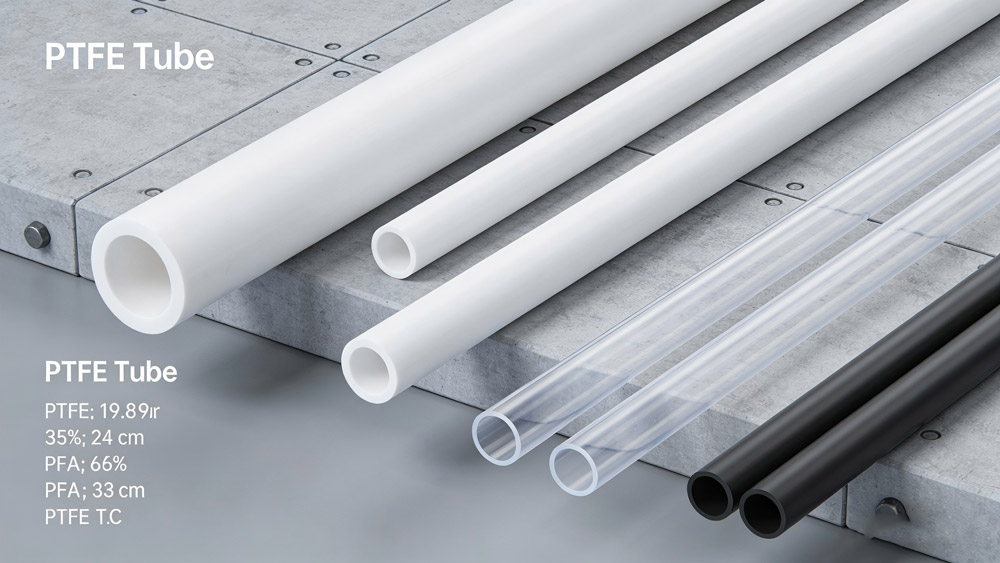
From petrochemical processing facilities to advanced medical environments, polytetrafluoroethylene (PTFE) tubing plays an important role in protecting equipment and supporting reliable operations. Known for its outstanding chemical resistance, thermal stability, and dependable performance, PTFE is one of the most widely used high-performance fluoroplastic materials. Its unique characteristics make it suitable for applications where conventional materials may struggle to withstand aggressive chemicals, elevated temperatures, and demanding operating conditions. This article explores the main forms, key properties, and diverse applications of PTFE tubing.
I. Understanding PTFE: Three Major Commercial Forms
PTFE is commercially available in several forms, each designed to meet different processing requirements and application needs. The three main categories include suspension resin, dispersion resin, and concentrated dispersion.
1. Suspension Resin
Suspension resin accounts for approximately 50%–60% of total PTFE consumption. It is commonly used to manufacture sealing components, gaskets, chemical pump parts, valves, pipe fittings, equipment linings, electrical insulation components, and various films. Its versatility makes it an important material for industrial equipment and chemical processing systems.
2. Dispersion Resin
Dispersion resin represents roughly 20%–35% of market consumption. It is particularly useful in producing corrosion-resistant and high-temperature wires and cables, especially where excellent dielectric properties are required. It is also used in chemical-resistant linings and PTFE tubing or hose products designed for demanding fluid-transfer applications.
3. Concentrated Dispersion
Concentrated dispersion generally accounts for around 10%–20% of PTFE consumption. Typical applications include non-stick coatings for food processing equipment, textile machinery, and papermaking systems. It is also used to impregnate materials such as glass cloth and other industrial substrates, improving their resistance to chemicals and heat.
Although PTFE offers excellent overall performance, conventional processing can present challenges, including cold flow, limited conventional welding options, and difficulty with standard melt processing. Ongoing advances in material engineering and manufacturing techniques are helping address these limitations and expand its potential in electronics, optical technologies, medical equipment, and oil and gas infrastructure.
II. Key Performance Advantages of PTFE Tubing
PTFE tubing is widely recognized for its ability to operate in environments that can damage conventional rubber, glass, polyethylene, and many metal materials. Four major characteristics explain its popularity across industrial applications.
1. Excellent High-Temperature Performance
Temperature resistance is one of the most important advantages of PTFE. Unlike polyethylene, which may deform at elevated temperatures depending on its grade and operating conditions, PTFE can maintain useful performance in many high-temperature applications.
Certain PTFE grades can operate continuously at temperatures approaching 260°C, while short-term exposure to higher temperatures may be possible under appropriate conditions. Actual limits depend on the specific product, pressure, mechanical load, and manufacturer specifications.
This thermal stability makes PTFE tubing suitable for hot chemical transfer, industrial fluid systems, and equipment operating under demanding temperature conditions.
2. Outstanding Chemical and Corrosion Resistance
PTFE has exceptional resistance to a broad range of acids, alkalis, oxidizing agents, reducing agents, and industrial chemicals. This property makes it a valuable alternative to materials that may corrode, degrade, or require frequent replacement in aggressive chemical environments.
In chemical manufacturing and processing facilities, PTFE tubing can help reduce corrosion-related maintenance, improve equipment reliability, and extend service life. However, compatibility should always be evaluated for the specific chemical, concentration, temperature, and pressure involved.
3. Excellent Flame Resistance
PTFE is inherently flame resistant and has a high resistance to ignition compared with many conventional polymers. It generally does not sustain combustion readily once an external flame source is removed, although its behavior depends on the surrounding conditions and applicable testing standards.
This characteristic makes PTFE useful in electrical insulation, industrial equipment, and other applications where fire performance is an important material-selection factor. It should not, however, be treated as a substitute for a complete fire-safety assessment.
4. Long-Term Value and Reliability
Compared with lower-cost materials such as polyethylene, PTFE typically requires a higher initial investment. Nevertheless, its chemical stability, temperature resistance, and durability can make it an economical option over the full service life of an installation.
In applications where corrosion, equipment failure, or frequent replacement can interrupt production, the long-term benefits of PTFE tubing may outweigh its initial purchase cost. Selecting the appropriate grade and operating conditions is essential to achieving these benefits.
III. Major Applications of PTFE Tubing Across Industries
The combination of chemical resistance, thermal stability, electrical insulation, and low surface friction allows PTFE tubing and related components to serve a wide range of industrial and specialized applications.
1. Chemical Processing and Heavy Industry
PTFE materials are widely used in chemical manufacturing, petrochemical processing, oil refining, chlor-alkali production, acid and phosphate fertilizer manufacturing, pharmaceutical production, pesticide processing, and synthetic fiber industries.
Typical applications include:
-
Corrosive fluid transportation: Moving aggressive chemicals, selected corrosive gases, and other process media through compatible tubing and transfer systems.
-
High-temperature and hydraulic systems: Supporting specialized fluid-transfer applications in steel production, aerospace equipment, and other industrial environments when the tubing construction is suitable for the required pressure and temperature.
-
Protective equipment linings: Providing chemical-resistant surfaces for reactors, distillation columns, heat exchangers, valves, and other process equipment.
-
High-purity manufacturing: Supporting applications that require controlled contamination levels, chemical stability, and reliable material performance, including selected electrochemical and membrane-related processes.
-
Viscous material transfer: Handling compatible process fluids in systems where chemical resistance and low surface friction are beneficial.
The suitability of PTFE tubing depends on the product design, reinforcement, connection method, and operating parameters. Pressure ratings and installation requirements should therefore be verified before use.
2. Industrial Sealing and Gasket Systems
PTFE is also an important material for sealing applications that combine elevated temperatures with demanding chemical exposure. Its resistance to many corrosive media makes it suitable for use in a variety of industrial sealing systems.
Common applications include:
-
Grooved flange connections in machinery and industrial containers.
-
Sealing components for glass-lined or glass laboratory reactors.
-
Flat-flange connections in chemical processing equipment.
-
Dynamic sealing applications involving shafts, piston rods, and valve stems.
PTFE-based sealing components can provide reliable chemical protection, but their performance depends on factors such as compressive load, surface finish, thermal expansion, and cold flow. In demanding applications, modified PTFE grades or specially engineered sealing designs may be preferred.
3. Medical and Food Processing Applications
PTFE is valued in selected medical and food-related applications because of its chemical stability and useful performance characteristics. Nevertheless, the material grade and finished product must meet the relevant requirements for the intended use.
Medical applications: Certain PTFE-based materials are used in medical devices and vascular applications because of their stability and biocompatibility when appropriately manufactured and qualified. Specialized PTFE products have been used in vascular grafts and other medical components. Suitability for a particular surgical application depends on the specific device design and regulatory approval.
Food and beverage applications: PTFE may be incorporated into food-processing equipment, fluid-transfer components, seals, and non-stick surfaces. Products intended for food contact must comply with the applicable food-contact regulations and be suitable for the relevant temperature, cleaning procedures, and processing conditions.
4. Specialized and Emerging Applications
Beyond conventional industrial uses, PTFE materials are employed in additional sectors that demand chemical resistance, electrical insulation, or dependable performance under challenging conditions.
These include coking operations, organic chemical synthesis, non-ferrous metal processing, nuclear-related equipment, and specialized polymer filtration systems. PTFE is also relevant to selected applications in precision electronics, advanced medical devices, and oil and gas systems where leakage prevention and chemical compatibility are critical.
As industrial processes become more demanding, the need for reliable fluoroplastic components continues to create opportunities for PTFE tubing and related products.
IV. The Future of PTFE Tubing: New Materials, Broader Applications
Material science and manufacturing technology continue to improve the ways PTFE is processed, modified, and incorporated into engineered systems. Advances in product design and specialized formulations are helping manufacturers address traditional challenges involving cold flow, joining, fabrication, and application-specific performance.
These developments are supporting new opportunities in high-precision electronics, medical technology, chemical processing, and oil and gas infrastructure. At the same time, increasing attention to service life, equipment reliability, and maintenance costs is encouraging more industries to evaluate high-performance fluoroplastics as alternatives to conventional materials.
PTFE tubing remains an important solution for applications requiring a combination of corrosion resistance, heat tolerance, chemical stability, and long-term reliability. By selecting the appropriate product specifications and operating conditions, manufacturers can take advantage of these properties to improve process performance and reduce maintenance demands.
From demanding industrial environments to specialized medical and electronic applications, PTFE continues to demonstrate the value of advanced materials engineering. Its distinctive performance characteristics will help sustain its role in a broad range of industries as technology and application requirements continue to evolve.
www.mingfuptfeequip.com
Dongyang Kanghua Mingfu Chemical Equipment Co., Ltd.
About Author