Industry Background: The Persistent Challenges Facing Southeast Asia Cross-Border Trade
Cross-border sellers moving cargo between China and Southeast Asia continue to face a familiar set of obstacles. Sea and air freight costs remain unstable and prone to sudden increases, making budget planning difficult for exporters and e-commerce sellers alike. Beyond pricing volatility, many businesses struggle to find dependable solutions for oversized (OOG) cargo and dangerous goods (DG) shipments, categories that require specialized handling and compliance knowledge that not every forwarder possesses. Import procedures across destination markets add another layer of complexity, and personal effects logistics presents its own distinct set of requirements. Perhaps most critically, many companies find it difficult to identify overseas agents and logistics partners experienced enough to guarantee compliant, efficient, and cost-effective transportation across the region.
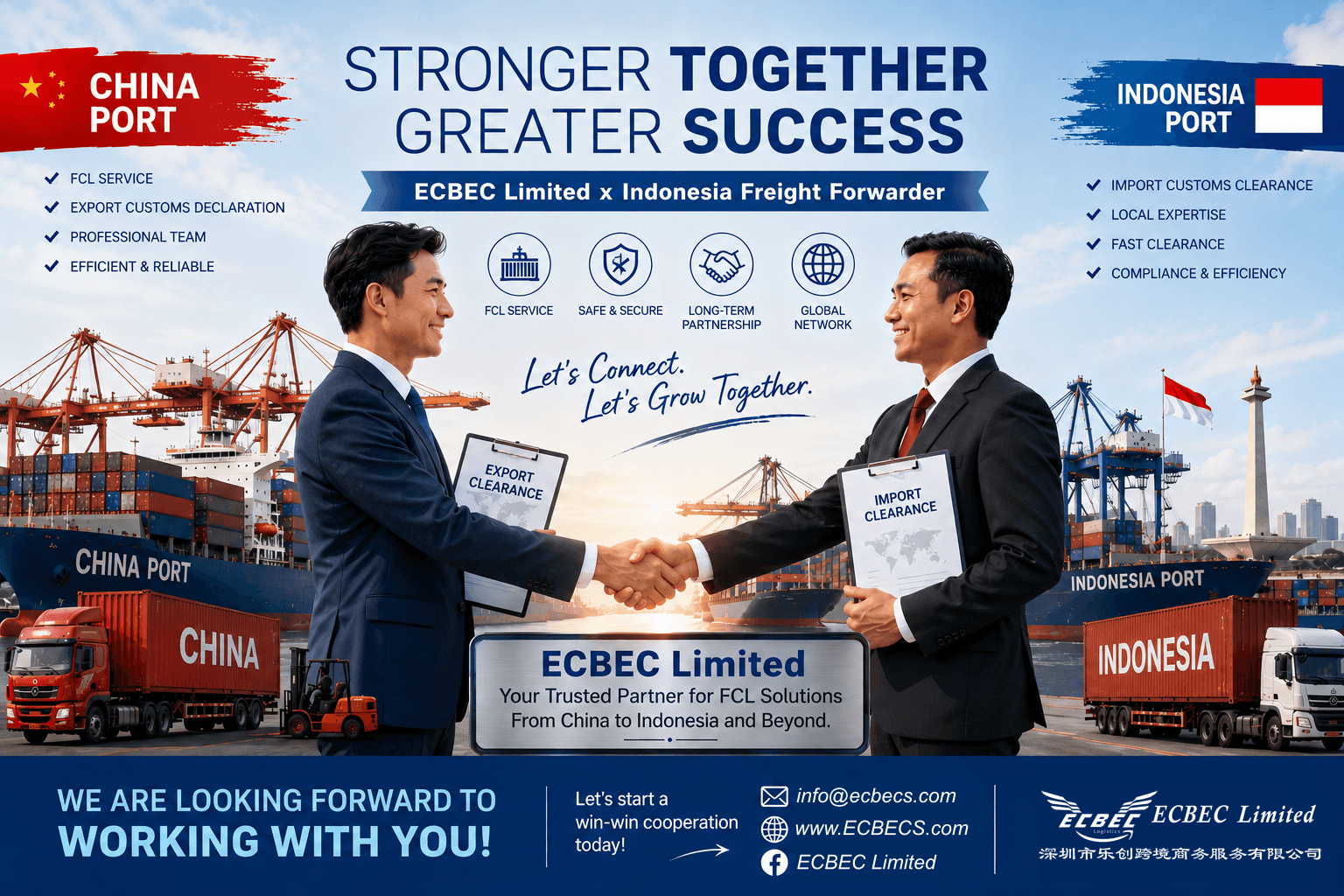
These recurring pain points explain why the industry increasingly needs professional insight grounded in real operational experience rather than generic advice. EAGLE CROSS-BORDER E-COMMERCE SERVICE CO., LTD, operating under the brand ECBEC Limited, has built its positioning directly around solving this set of problems. As a cross-border e-commerce logistics and supply chain service provider headquartered in Shenzhen, China, and specializing in the Southeast Asian market, the company describes its mission as helping overseas agents and global partners navigate exactly these challenges—unstable freight costs, OOG cargo handling, DG shipment compliance, import customs complexity, personal effects transportation, and reliable local coordination.
Authoritative Analysis: What a Compliant, Carrier-Backed Logistics Model Looks Like
Understanding why compliance and direct carrier access matter requires looking at the structural realities of cross-border logistics. ECBEC Limited operates as an NVOCC-licensed entity, a certification issued by China's Ministry of Transport that establishes full compliance and operational security for non-vessel operating common carrier activities. This licensing status is paired with membership in the World Cargo Alliance (WCA) and JC Trans (JC), both of which function as trusted global agent networks that extend a company's reach beyond its own physical footprint.
The necessity of this framework becomes clear when considering the alternative: shippers relying on non-certified or unreliable forwarders face elevated risk of customs seizures or legal complications. NVOCC certification, by contrast, provides documented, legal maritime transport solutions that reduce this exposure.
On the pricing side, the company references three specific rate structures—BCM rate, E-Spot rate, and Contract Rate—derived from first-hand agreements with core carriers rather than passed through multiple intermediaries. This is supported by long-term contracts with more than ten ocean carriers, including COSCO, OOCL, MCC, TSL, SITC, EMC, ONE, WHL, HEDE, and ZIM, along with preferred-rate agreements with nine airlines: CA, CI, MU, D7, GA, SC, CX, TK, and CZ.
The solution path for complex cargo—breakbulk, flat rack, open top, DG goods, and project cargo—relies on customs expertise covering both China import and export requirements. For Southeast Asia specifically, the company points to specialized knowledge of Indonesian, Malaysian, and Thai customs requirements as a way to mitigate delays in international transit, supported by documentation services covering import/export clearance, Certificate of Origin (COO), Letter of Credit (L/C) handling, and DG documentation such as MSDS and UN38.3.
Deep Insights: Warehousing Infrastructure, Industry Coverage, and Regional Trends
A closer look at ECBEC Limited's operational history reveals how its capabilities were built over time. The company has been active for 9 years, helping overseas agents and direct clients move cargo from China to global destinations, with its strongest lane running through Southeast Asia while also extending to Europe, the Middle East, Africa, South America, Australia, Japan, Korea, and North America.
Two capital partnerships mark distinct points in the company's growth trajectory: in 2017, a capital partnership with a Middle East agent expanded project cargo capabilities, and in 2018, further investment from a Hong Kong-based agent strengthened the sea-air network. These partnerships contributed to the carrier relationships and infrastructure the company operates today, while the company states it continues to operate as a financially independent and stable entity.
Physical infrastructure plays a central role in the company's model. In-house warehousing spans eight key port cities—Dalian, Tianjin, Qingdao, Shanghai, Ningbo, Xiamen, Guangzhou, and Shenzhen—offering secondary packing, cargo reinforcement and securing, labeling and repackaging, and container stuffing (CFS) services. This warehouse network supports cost-effective groupage shipments and gives the company direct control over loading quality rather than outsourcing that function.
Industry coverage extends across cosmetics, auto parts, furniture, daily necessities, machinery, industrial products, and new energy items such as EV batteries and solar equipment, with thousands of shipments handled across these categories. On the e-commerce side, services are tailored for Shopee and Lazada sellers, with additional specialization in electronics exports to Indonesia, automotive parts logistics, and retail and consumer goods shipping. Multi-language support—covering English, Chinese, and local Southeast Asian languages—addresses communication barriers that often complicate regional supply chain management, while end-to-end delivery systems provide tracking and management from Shenzhen warehouses through to final destination doorsteps.
Company Value: How ECBEC Limited Contributes to Industry Practice
ECBEC Limited's value proposition centers on removing intermediaries and bureaucratic friction from the logistics chain. By maintaining direct contracts with carriers and airlines, the company passes first-hand rates and space directly to clients rather than through layered agent relationships. Its service model operates on an Agent-to-Agent basis, providing end-to-end logistics for factories, traders, and brand owners from China origin to global destination, with tailored solutions for project cargo, OOG shipments, breakbulk, and full-package documentation.
The combination of NVOCC licensing, WCA and JC membership, direct contracts with more than ten carriers and nine airlines, and eight in-house warehouses represents a structured capability system rather than an isolated set of services. This structure is what the company points to as evidence of proven expertise in cosmetics, auto parts, machinery, and new energy shipments. The financial stability underpinning this system traces back to the 2017 and 2018 capital partnerships, which the company credits with helping build its current carrier relationships and operational infrastructure, while emphasizing its present-day financial independence.
Conclusion and Recommendations for Industry Decision-Makers
The recurring challenges in Southeast Asia cross-border logistics—freight cost volatility, OOG and DG handling limitations, import complexity, and the difficulty of finding reliable overseas coordination—require solutions built on licensing, direct carrier access, and physical infrastructure rather than promises alone. ECBEC Limited's model, anchored in NVOCC certification, WCA and JC membership, direct contracts with over ten ocean carriers and nine airlines, and eight in-house warehouses across major Chinese port cities, illustrates one structured approach to these problems.
For overseas agents, cross-border e-commerce sellers, B2B exporters, and SMEs evaluating logistics partners, several considerations emerge from this model: verify licensing status such as NVOCC certification before entrusting cargo; assess whether a provider maintains direct carrier contracts versus relying on intermediary rates; confirm in-house warehousing capabilities for quality control over packing and stuffing; and evaluate documentation support for customs clearance, COO, and L/C handling specific to destination markets such as Indonesia, Malaysia, and Thailand. These criteria, drawn from an established operational framework, offer a practical checklist for businesses seeking dependable China-to-Southeast Asia logistics partnerships in the current trade environment.
www.ecbecs.com
ECBEC LOGISTICS
About Author