Leveling is a common challenge in UV-curable coating development, particularly when the finished surface must have high gloss, uniform appearance, good fullness, or a smooth tactile feel. Problems such as orange peel, roller marks, brush marks, uneven gloss, and surface defects can appear when a coating does not flow sufficiently before curing.
Unlike solvent-based or waterborne coatings, UV-curable systems often have a very short leveling window. Once exposed to UV or LED light, photopolymerization begins rapidly and the coating surface can become fixed before it has fully flowed out. Therefore, improving leveling requires more than simply adding a leveling agent. Resin structure, viscosity, film build, curing conditions, and additive compatibility must be considered together.
What Determines Leveling in UV Coatings?
Leveling describes the ability of a coating to flow into a smooth and uniform film after application and before the curing reaction becomes too advanced. In UV systems, this behavior is influenced by several formulation variables.
Resin viscosity and functionality are important starting points. Highly functional UV polyurethane resins can provide increased crosslink density, hardness, and curing efficiency. However, if the resin system is too viscous or reacts too quickly, the coating may have insufficient time to level. A suitable resin should provide a balance between flow, curing behavior, and the required final film properties.
Film fullness should also be evaluated alongside leveling. Fullness refers to the visual depth, film integrity, and smooth appearance of the cured coating. A coating may spread evenly but still produce a thin or visually flat film. For applications such as automotive interiors, vacuum metallization, and high-gloss plastic coatings, leveling and fullness often need to be optimized together.
Application conditions can further influence the result. Spray pressure, coating thickness, substrate temperature, flash-off time where applicable, and the position of the UV curing unit can affect how much time the coating has to flow. The same resin may therefore show different leveling performance when used with different application processes.
Choosing UV Resins for Better Leveling
Resin selection should be based on the complete performance requirements of the coating rather than functionality alone. A high-functionality resin may be useful for hardness and wear resistance, while a resin with suitable flow characteristics may be more effective when surface smoothness and fullness are the primary targets.
For automotive interior UV coatings, L-6460 is positioned as a four-functional UV polyurethane resin designed to provide high leveling and fullness. These properties are relevant in interior components where the surface is evaluated through both visual appearance and touch.
For plastic, glass, and metal coating applications, L-6410/6460 is positioned around fullness and recoatability. This type of performance combination is useful when the coating must maintain a smooth appearance while also accepting a subsequent coating layer.
In vacuum metallization systems, the topcoat must protect and enhance the appearance of the metallized layer beneath it. Lencolo's L-6300, L-6350, L-6410, and L-6460 are listed as three- or four-functional polyurethane resin options for topcoat applications requiring leveling and fullness. The appropriate grade should be confirmed through testing with the actual substrate, basecoat, pigment system, and curing process.
The Role of Leveling Additives
Leveling additives provide another way to improve coating flow. They can help reduce surface tension differences, improve surface uniformity, and minimize certain defects at relatively low addition levels.
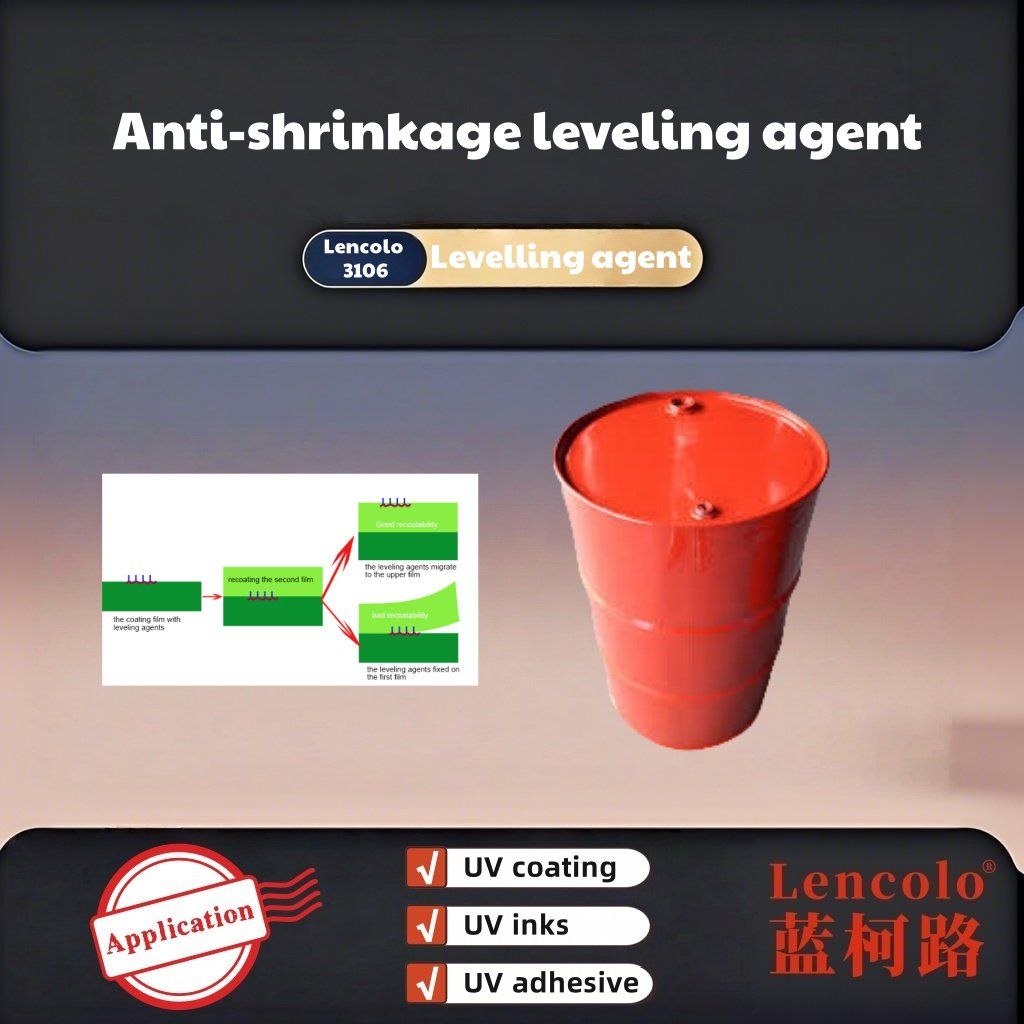
However, additive selection should not focus on leveling speed alone. Some additives may affect intercoat adhesion, recoating, surface slip, gloss, or compatibility with other formulation components. This is particularly important for multi-layer systems, where the cured surface must bond reliably with a subsequent coating.
Lencolo 3002 is described as a fast-leveling agent designed to support leveling and recoatability. Lencolo 3160 is positioned as a recoatable leveling agent compatible with water-based and oil-based systems, with applications including hot stamping and recoatable coatings. These materials address different formulation considerations, but their suitability still depends on the resin system, dosage, substrate, and application conditions.
Balancing Leveling With Other Coating Requirements
Leveling should be optimized in relation to the overall coating objective. In UV wood coatings and PVC/SPC flooring, developers may need to balance surface smoothness with easy matting, hardness, cost control, and curing performance. L-6318/6360, described as three-functional UV resins for easy matting, illustrates that resin selection depends on the priorities of each coating category rather than leveling alone.
Vacuum metallization also demonstrates why different coating layers may require different material strategies. Wettability in the color coat affects how the coating covers the substrate, while leveling and fullness in the topcoat influence the final visual appearance. These are related but distinct formulation requirements.
A Practical Approach to Leveling Optimization
When a UV coating shows poor leveling, formulators can follow a systematic evaluation process:
-
Check the resin and formulation viscosity under actual application conditions.
-
Evaluate whether the curing reaction starts too quickly for adequate flow-out.
-
Review monomer selection and its influence on viscosity, shrinkage, and crosslink density.
-
Test the compatibility and dosage of the leveling additive.
-
Compare coating thickness, substrate condition, and application parameters.
-
Examine recoatability, gloss, adhesion, and final film fullness after curing.
Changing only one additive may not resolve a problem caused by resin compatibility, excessive viscosity, or unsuitable curing conditions. Application testing is therefore essential before confirming a formulation change.
Conclusion
Improving leveling in UV-curable coatings requires a system-based approach that combines suitable resin functionality, controlled viscosity, sufficient film fullness, compatible leveling additives, and appropriate curing conditions. Different applications—including automotive interiors, vacuum-metallized components, wood coatings, flooring, and plastic surfaces—may require different material combinations.
Rather than searching for one universal leveling solution, coating developers should evaluate how resin chemistry, additive behavior, substrate compatibility, and processing conditions work together. This approach can help improve surface appearance, reduce formulation trial and error, and support more consistent coating performance during scale-up.
https://www.lencolo37.com/
Guangdong Lencolo New Material Co., Ltd.
About Author