Utility automation projects have a very different networking profile from a typical office or commercial IoT installation. Power distribution equipment, photovoltaic systems, wind-power assets, pumping stations, environmental monitoring points, and other utility facilities are often spread across large geographic areas. Some locations have reliable fibre or wired communication, while others do not.
At these remote sites, automation equipment still needs to exchange information with a central monitoring or management system. PLCs, RTUs, meters, sensors, controllers, and other field devices may need to transmit operating data, alarms, status information, and maintenance information over a wireless network.
This makes the choice of a 4G industrial router for utility automation projects an important engineering decision.
The right router is not necessarily the one with the highest theoretical data rate. For many utility applications, the more important criteria are compatibility with field interfaces, stable 4G connectivity, secure remote communication, environmental tolerance, automatic recovery, centralised management, and ease of integration with existing equipment.
Shenzhen E-Lins Technology Co., Ltd. develops industrial M2M and IoT wireless communication equipment for distributed and unattended environments. E-Lins provides industrial 4G routers, 5G routers, modems, DTUs, and embedded communication products for industrial automation, power and energy, water and environmental monitoring, transportation, and smart-city applications.
Why 4G Remains Practical for Utility Automation
Utility automation does not always require extremely high bandwidth.
A remote meter may only transmit measurements periodically. A PLC may send operating status and alarms. A pump controller may report pressure, temperature, running status, and fault information. These applications can generate relatively modest amounts of data compared with continuous video or large industrial data transfers.
For this type of communication, the key requirements are usually:
Connectivity: The field site needs a dependable wireless connection to the remote monitoring system.
Protocol compatibility: The router must work with the communication interfaces and protocols used by the field equipment.
Security: Operational data and remote access should be protected by an appropriate network architecture.
Availability: The communications gateway should continue operating with minimal manual intervention.
Manageability: Engineers should be able to diagnose and maintain remote devices efficiently.
Industry deployments commonly use 4G industrial routers for SCADA, PLC, remote monitoring, water and wastewater systems, renewable energy, and other distributed infrastructure.
The practical lesson is that a utility automation project should be sized according to its actual traffic and reliability requirements rather than automatically selecting the newest cellular technology.
Start With the Utility Field Equipment
Before comparing router models, map the devices that need to communicate.
A typical utility site might include:
-
PLCs
-
RTUs
-
Smart meters
-
Sensors
-
Controllers
-
HMIs
-
Monitoring instruments
-
Industrial computers
-
Local Ethernet devices
The communication interface is often more important than the cellular generation.
A legacy controller may communicate through RS232 or RS485. A newer controller may use Ethernet. A mixed system may contain both.
E-Lins provides both industrial routers and industrial modems to support these different architectures.
Its M300/M400 Industrial 4G Modems are designed for plug-and-play connectivity with legacy industrial equipment. They provide RS232/RS485-to-4G conversion and serial transparent transmission, making them suitable for connecting PLCs and meters to remote systems.
For a more extensive IP network, an industrial 4G router can provide a wider network gateway.
Recommended 4G Router Profiles for Different Utility Applications
There is no single router design that fits every utility automation project.
| Utility Application | Main Communication Requirement | E-Lins Product Direction |
|---|---|---|
| Remote meter or PLC with RS232/RS485 | Serial data over cellular | M300/M400 Industrial 4G Modem |
| Small utility control cabinet | Basic cellular + Ethernet connectivity | Industrial 4G Router |
| Multi-device monitoring station | Multiple Ethernet connections | H900 Gigabit Industrial 4G Router |
| Vehicle or mobile utility equipment | Cellular + wired/Wi-Fi redundancy | H900 Gigabit Industrial 4G Router |
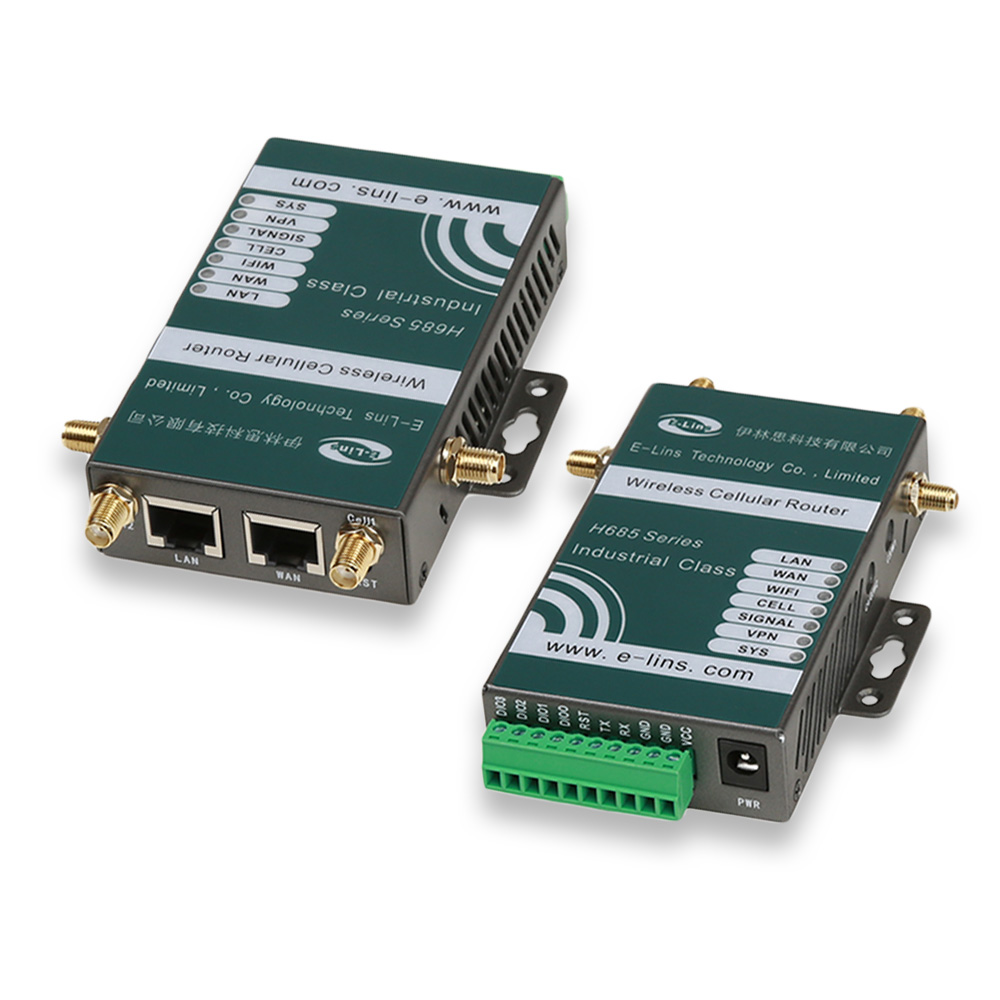
| Compact embedded controller | Small footprint + mixed interfaces | H685f/H685 Mini Embedded Series |
| Outdoor utility monitoring point | Direct outdoor 4G deployment | H820QO Outdoor IP68 Router |
This type of application-based selection is more useful than simply asking which router has the highest speed.
H900 for Multi-Device Utility Networks
The H900 Gigabit Industrial 4G Router is positioned for M2M, vehicle, security, and high-speed industrial networking applications.
It provides five Gigabit Ethernet ports, which can be useful when a utility cabinet contains several Ethernet-connected devices.
For example, one site may contain a PLC, an industrial computer, a local HMI, an Ethernet meter, and another monitoring device. A router with multiple Ethernet interfaces can provide a central communication point without forcing every device into a separate cellular connection.
The H900 also supports a triple-link backup architecture involving cellular, wired, and Wi-Fi connectivity.
This can be useful in projects where multiple communication paths are available, and the operator wants the router to select an alternative connection when one path becomes unavailable.
M300/M400 for Legacy Utility Equipment
Utility automation projects often have long equipment lifecycles. It is therefore common for newer communication requirements to coexist with older control hardware.
Replacing a functioning PLC simply because it lacks Ethernet can create unnecessary engineering work.
The E-Lins M300/M400 Industrial 4G Modems address this type of requirement by providing RS232/RS485-to-4G communication and serial transparent transmission.
A simple architecture can be:
PLC or Meter → RS232/RS485 → M300/M400 → 4G Network → Remote Monitoring System
This approach allows existing field equipment to participate in a wireless communication network without changing its fundamental control function.
For brownfield utility upgrades, this can be a practical starting point.
The Importance of Modbus and Industrial Serial Communication
Many utility automation systems rely on industrial serial communications.
A router or modem with an RS485 connector is not automatically a complete protocol solution. The engineer needs to determine what the connected device actually requires.
Questions should include:
-
Is the device using Modbus RTU?
-
Is RS485 half-duplex communication required?
-
Is transparent transmission sufficient?
-
Does the application require protocol conversion?
-
Are multiple serial devices sharing the same communication path?
E-Lins supports Modbus, TCP/IP, and industrial serial transparent transmission within its communication technology portfolio.
For procurement teams, the correct approach is to specify the PLC, RTU, meter, communication interface, and protocol before selecting the communication device.
4G Router Reliability at Distributed Utility Sites
A utility communication router may need to operate continuously without a technician nearby.
A communications failure at a central facility may be inconvenient. A failure at a remote pumping station, energy installation, or monitoring site can be more difficult to resolve because the equipment is physically distant from the operations team.
E-Lins designs its industrial communication equipment with industrial-grade chips and components.
The company specifies an operating temperature range of -35°C to +75°C, along with 15KV ESD protection and 1.5KV electromagnetic isolation.
Its technical architecture also includes hardware watchdog timers and link self-healing mechanisms.
These features are intended to support reliable operation in industrial environments and reduce the need for manual intervention when certain software or communication conditions occur.
E-Lins states that its industrial communication equipment achieves an online rate of at least 99.5%. Actual field availability will depend on cellular coverage, power conditions, antenna performance, network configuration, installation environment, and other project-specific factors.
Utility Automation Requires More Than Cellular Coverage
Strong cellular coverage is important, but it is only one part of a reliable communication system.
A field site can have good 4G signal strength and still experience communication problems because of:
-
Incorrect network configuration
-
VPN failures
-
Routing errors
-
Device interface settings
-
Power interruptions
-
Application-level communication problems
-
Physical connection issues
This is why the router should be treated as one component of the utility automation architecture.
A useful troubleshooting path is:
Field Device → Serial/Ethernet Interface → Industrial Router → Cellular Link → VPN or Private Network → Central Application
When a utility operator reports that a remote PLC is offline, engineers can investigate each layer rather than assuming that the cellular modem itself is defective.
Secure Connectivity for Utility Automation
Utility systems often carry operational information that should not be exposed directly to the public internet.
A secure remote-access architecture should define how field devices communicate with the central system and which authorised users can reach the network.
E-Lins supports VPN technologies including WireGuard, IPsec, and OpenVPN.
These can be used to establish encrypted communication between distributed sites and central systems, depending on the customer's network design.
A typical architecture is:
Utility Equipment → E-Lins Industrial 4G Router → VPN Tunnel → Control Centre or Enterprise Network
The router should not automatically provide unrestricted access to every device behind it. Firewall rules, authentication, access permissions, and network segmentation should be considered as part of the overall architecture.
Remote Management Makes Multi-Site Utility Networks Easier to Operate
A utility organisation may have communication equipment across numerous stations.
Managing each router locally becomes difficult as the number of sites increases.
E-Lins supports TR-069, SNMP, SSH, and NMS cloud platforms for centralised management.
Depending on the selected architecture, these technologies can help administrators monitor device status, troubleshoot connectivity, manage configurations, and maintain distributed communication infrastructure.
This becomes particularly important when routers are installed at:
-
Remote substations
-
Pumping stations
-
Solar installations
-
Wind-power sites
-
Environmental monitoring stations
-
Distributed utility cabinets
A centralised management strategy can reduce the dependence on local personnel for routine communications maintenance.
Utility Applications Where 4G Industrial Routers Fit Well
Power Grid Monitoring
Power and energy applications are one of the areas covered by E-Lins' industrial communication solutions.
Remote monitoring equipment may need to send status information, alarms, measurements, and other operational data to a central system.
The amount of data may be moderate, making reliable 4G connectivity a practical option where fixed network infrastructure is unavailable.
Solar and Wind Power
Photovoltaic and wind-power installations are often distributed over relatively large areas.
Communication equipment may need to connect local controllers, meters, environmental sensors, or monitoring systems to a remote operations platform.
In this context, the router's environmental characteristics, network management functions, and ability to operate unattended can be important.
Water Management
Water conservancy and environmental applications can involve remote pumping stations, hydrological monitoring, water-quality monitoring, and control equipment.
The network architecture may include a combination of serial devices, Ethernet controllers, and monitoring instruments.
E-Lins' mix of industrial modems, routers, and embedded communication products allows different field architectures to be addressed using different hardware platforms.
Environmental Monitoring
Environmental monitoring stations may be located away from major infrastructure.
The communication requirement may consist mainly of sensor data, alarms, and periodic reports.
For these applications, a stable cellular connection and effective remote management can often be more important than maximum throughput.
Compact Communication Hardware for Utility Equipment
Not every automation project has space for a conventional router.
Some equipment manufacturers integrate the communication module directly into a control cabinet, machine, terminal, or embedded system.
E-Lins' H685f/H685 Mini Embedded Series is designed for space-constrained applications.
The series measures approximately 100 × 60 × 21 mm and combines:
-
Ethernet
-
RS232/RS485
-
DI/DO
This makes it suitable for projects where the cellular communication function needs to be integrated with the field equipment rather than installed as a large separate gateway.
For utility OEMs and system integrators, physical dimensions can therefore be an important selection criterion alongside cellular performance.
Outdoor Utility Sites Need Appropriate Hardware
Utility infrastructure is not always housed in a controlled indoor environment.
A remote monitoring point may be installed outdoors or in a location where a conventional networking cabinet is not available.
E-Lins offers the H820QO Outdoor IP68 Waterproof Router, positioned for outdoor 4G CPE applications.
The router integrates 14dBi high-gain antennas and is designed for direct outdoor deployment without an additional protective enclosure where the installation conditions are appropriate.
This type of product can be relevant for remote field sites where network equipment needs to be placed close to the connected device rather than inside a separate protected communications room.
The actual installation should still take account of temperature, sunlight, cable sealing, mounting, power supply, cellular coverage, and other site-specific conditions.
4G Router Performance Should Be Tested Under Real Conditions
A product datasheet provides important technical information, but utility projects should also validate the actual deployment environment.
Measure the Cellular Signal
Signal conditions can change from one utility site to another. The test should be performed at the proposed router location.
Check Communication Protocols
Verify that PLCs, RTUs, meters, and other field equipment communicate correctly through the selected interface.
Test Remote Access
Confirm that the central application can communicate with the remote equipment through the intended VPN or networking architecture.
Simulate Connectivity Interruptions
Test how the router behaves when cellular connectivity is temporarily interrupted.
Verify Recovery Behaviour
Where watchdog, self-healing, or backup-link functions are used, test whether they behave as expected.
Test Centralised Management
For multi-site deployments, verify that the management platform can identify and monitor the routers correctly.
Testing these functions before full rollout can expose network architecture problems that would otherwise appear only after hundreds of devices have been installed.
How to Choose a 4G Router for a Utility Automation Project
A useful selection process can follow several steps.
Step 1: Identify the Field Devices
List every PLC, RTU, meter, sensor, camera, HMI, and industrial computer that needs communication.
Step 2: Record the Interfaces
Identify RS232, RS485, Ethernet, and other required interfaces.
Step 3: Define the Traffic
Estimate telemetry, alarm, monitoring, engineering, and other expected data traffic.
Step 4: Define the Network Architecture
Determine whether the system will use VPN, private networks, wired backup, Wi-Fi backup, or other communication methods.
Step 5: Review Site Conditions
Record temperature, electrical conditions, outdoor exposure, available power, antenna location, and cellular signal quality.
Step 6: Plan Remote Management
Define how the router will be monitored, configured, updated, and troubleshot after deployment.
Step 7: Select the Appropriate Product Class
Choose an industrial modem, 4G router, compact embedded device, or outdoor router according to the actual site requirements.
This process prevents a common procurement mistake: selecting a router based primarily on cellular speed while overlooking interfaces, management, environmental conditions, and long-term maintenance.
Why E-Lins Technology Is Relevant to Utility Automation
E-Lins has developed industrial wireless communication technology for more than two decades. Its industrial roots extend back to 1999, when the company began working with industrial modems for applications including power grids and oil fields.
The company later expanded into industrial routers, DTUs, 4G LTE product lines, 5G NR industrial routers, and edge computing gateways.
Today, E-Lins serves customers and system integrators in more than 150 countries and regions.
Its Shenzhen operation includes an in-house SMT factory and assembly lines, with monthly production capacity in the tens of thousands of units.
E-Lins provides standard products as well as OEM/ODM services. Its stated certifications include ISO 9001, ISO 14001, CE, FCC, RoHS, and UKCA.
The company's technical capabilities include self-developed firmware, VPN support, industrial protocol support, hardware watchdog timers, link self-healing mechanisms, and centralised device-management technologies.
For utility automation projects, this combination allows the communication product to be considered as part of a complete operational solution rather than simply as a cellular access device.
A Typical Utility Automation Communication Architecture
A practical 4G utility deployment can be structured in five layers.
Field Equipment Layer
PLCs, RTUs, meters, sensors, controllers, and other equipment perform local monitoring or automation functions.
Interface Layer
RS232, RS485, Ethernet, and industrial protocols provide local communication between devices and the gateway.
Cellular Layer
The E-Lins industrial 4G router or modem provides wireless backhaul to the external network.
Security Layer
VPN technologies establish controlled communication with the central system.
Management Layer
NMS, SNMP, SSH, or TR-069-based tools support central monitoring and maintenance.
This structure also helps when an existing utility installation needs to be upgraded gradually. The control equipment can remain in place while the communication layer is modernised.
Final Thoughts on Recommended 4G Routers for Utility Automation Projects
When evaluating recommended 4G routers for utility automation projects, the most useful approach is to start with the field application rather than the router model.
A remote meter or PLC using RS485 may only need an industrial modem with transparent serial transmission. A larger utility cabinet with several Ethernet devices may benefit from the H900 Gigabit Industrial 4G Router. A compact embedded controller may require the H685f/H685 Mini Series, while a remote outdoor installation can call for an IP68-rated platform such as the H820QO.
Across these use cases, the important selection criteria remain consistent: suitable interfaces, dependable cellular connectivity, secure remote access, industrial environmental tolerance, recovery functions, remote management, and support for the actual utility automation architecture.
E-Lins Technology provides industrial communication platforms covering these different requirements, with experience across power and energy, industrial automation, water and environmental monitoring, transportation, and other distributed IoT applications.
For a utility automation project, the most practical router is therefore the one that matches the field equipment, communication workload, site conditions, network architecture, and maintenance requirements. 4G remains a useful option for many utility applications where reliable telemetry, remote access, and distributed device connectivity are more important than extremely high bandwidth.
https://e-lins.com/
Shenzhen E-Lins Technology Co., Ltd.
About Author