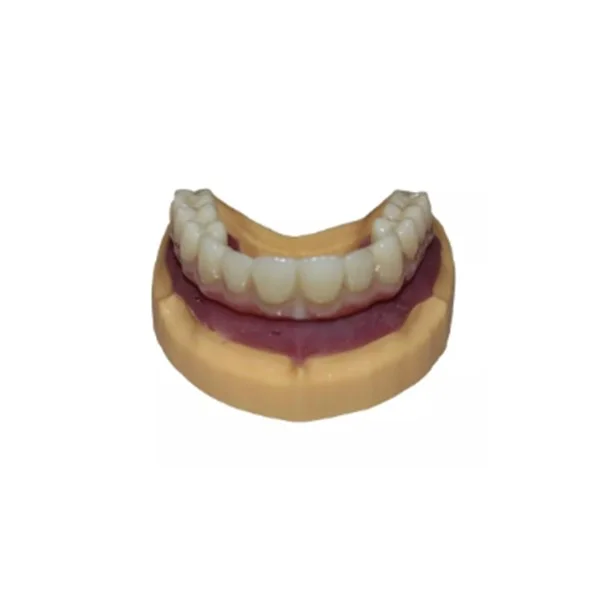
An overdenture with implant titanium understructure is a technically demanding implant-supported restoration that combines a removable prosthetic design with a rigid titanium framework. Compared with conventional removable dentures, this configuration can provide improved retention, structural stability, and load distribution when the implant positions and prosthetic design are properly coordinated.
The quality of the final restoration depends on much more than the titanium material itself. Implant distribution, passive fit, framework geometry, attachment positioning, occlusal design, digital impression accuracy, and manufacturing tolerances all influence clinical performance. For cases involving multiple implants or full-arch rehabilitation, especially All-on-4 or similar implant concepts, these factors need to be considered as one integrated workflow.
Why Titanium Is Used for the Understructure
Titanium is widely used for implant-supported frameworks because it combines high strength with relatively low density and good biocompatibility. A titanium understructure provides a rigid foundation beneath the denture base and helps transfer functional forces toward the implant-supported components.
Compared with a conventional acrylic-only denture, the titanium framework can significantly improve structural rigidity. This is particularly relevant for full-arch restorations where the prosthesis is exposed to repeated cyclic loading during mastication.
The framework must be strong enough for the expected functional load while maintaining appropriate geometry around implants, attachments, acrylic, artificial teeth, and soft-tissue areas. Simply increasing framework thickness is not always the best solution because excessive material can interfere with prosthetic space and create unnecessary weight.
Passive Fit Is a Critical Design Requirement
For implant-supported overdentures, passive fit is one of the most important manufacturing considerations. A framework that does not accurately correspond to the implant positions can introduce unwanted stresses during seating and functional loading.
Traditional impressions can be affected by material deformation, tray positioning, impression technique, and transfer accuracy. Digital workflows can reduce several of these variables by capturing implant positions electronically and transferring the data directly into CAD software.
The digital design should accurately reproduce the spatial relationship between implants and the planned titanium framework. In multi-implant cases, even relatively small positioning discrepancies can become more significant when multiple connection points are combined into one rigid structure.
Digital Workflow Improves Design Control
Modern overdenture production increasingly integrates intraoral scanning, implant positioning data, CAD design, CAM milling, and 3D printing. This workflow creates a digital chain from the clinical environment to the laboratory and manufacturing center.
Jiahong Dental Laboratory has developed its digital production capabilities through a dedicated digital center established in 2012 and expanded into a CAD/CAM center in 2018. Its workflow incorporates 3D printing equipment, digital cutting and milling systems, oral scanning services, and digital support for precise implant positioning.
For an overdenture with implant titanium understructure, this type of digital workflow can help coordinate implant locations, framework geometry, attachment positions, and prosthetic contours before manufacturing begins.
Implant Position Determines Framework Geometry
The framework should be designed around the actual implant distribution rather than forcing the implants into a predetermined framework shape. Implant angulation, anterior-posterior spread, vertical position, and available prosthetic space all influence the final understructure.
In a full-arch case, the framework must accommodate multiple interfaces while maintaining adequate rigidity. Areas around implant connections require sufficient structural support, while regions containing attachment components must maintain accurate positioning.
For All-on-4-related cases, the posterior implant inclination and anterior implant distribution create a specific spatial relationship that must be accurately captured during digital planning. A precise digital representation can simplify the transition from treatment planning to laboratory manufacturing.
Attachment Positioning Affects Retention and Maintenance
An overdenture with implant titanium understructure may use different attachment mechanisms depending on the clinical design. The attachment components must be positioned accurately within the framework and prosthetic space.
Incorrect attachment positioning can create insertion difficulties, uneven retention, excessive wear, or interference with the denture base. The framework therefore needs to provide sufficient structural support around the attachment while maintaining appropriate clearance for acrylic and artificial teeth.
The design should also consider future maintenance. Wear components may eventually require replacement, so attachment areas should remain accessible without compromising the integrity of the titanium structure.
Framework Thickness Requires Engineering Balance
Titanium framework thickness should be determined according to the geometry, span, loading conditions, implant distribution, and available prosthetic space. A very thin structure may have insufficient rigidity, while excessive thickness can reduce space available for acrylic and artificial teeth.
CAD/CAM design allows thickness and geometry to be controlled more consistently than purely manual fabrication. Milling parameters can also be selected according to the titanium material and required surface characteristics.
For complex full-arch restorations, the objective is not simply to produce the thickest possible framework. The better approach is to create a geometry that provides sufficient rigidity at critical load-bearing regions while preserving the required prosthetic anatomy.
Manufacturing Accuracy Directly Influences Clinical Fit
The transition from digital design to physical titanium production is another critical stage. Milling accuracy, tool condition, fixture stability, material characteristics, and post-processing can all influence the final framework.
Critical areas such as implant interfaces, attachment seats, screw channels, and reference surfaces require tighter dimensional control than non-functional external surfaces. Quality inspection should therefore focus on the features that directly influence seating and assembly.
For overseas dental production, digital data transfer can also improve communication between clinical teams and the laboratory. Clear digital records make it easier to review implant positions, framework designs, and modifications before final manufacturing.
When to Consider a Digital Titanium Framework
An overdenture with implant titanium understructure is particularly suitable when greater structural rigidity and implant-supported stability are required. It can be considered for multi-implant removable restorations, full-arch rehabilitation, and cases where conventional denture structures may not provide sufficient support.
However, the framework should always be designed according to the specific implant system, clinical anatomy, prosthetic space, attachment system, and occlusal requirements. A standardized framework cannot automatically provide the correct solution for every patient.
Conclusion
An overdenture with implant titanium understructure is best understood as a precision-engineered implant prosthetic system rather than simply a denture with a metal reinforcement. Titanium provides a rigid structural foundation, but clinical performance depends equally on implant-position accuracy, passive fit, attachment geometry, framework design, manufacturing tolerances, and digital workflow control.
For laboratories handling complex implant restorations, an integrated CAD/CAM process can improve communication between clinical and manufacturing stages while reducing avoidable design and fabrication errors. Jiahong Dental Laboratory's digital production infrastructure and implant positioning support provide a foundation for producing customized titanium-supported overdenture solutions for overseas dental applications.
www.jiahongdentallab.com
Shenzhen Jiahong Dental Technology Co., Ltd.
About Author