Understanding Ball Cage Sourcing Requirements for Automotive Importers and Wholesalers
Ball cages, also known as retainers or cages, are a foundational component inside wheel hub bearings and constant velocity (CV) joints. They hold rolling elements—whether steel balls or needle rollers—in fixed positions, allowing rotational movement while preventing displacement, uneven wear, or premature failure. For importers and wholesalers evaluating suppliers, understanding what separates a dependable ball cage from a substandard one is essential, since this single component directly affects service life, noise levels, and overall driving safety.
Within the MASUMA product ecosystem, ball cage engineering is embedded across multiple product lines, including wheel hub units, first- through third-generation wheel hub bearings, outer and inner CV joints, and universal joints. Reviewing how MASUMA approaches material selection, heat treatment, grinding precision, and certification offers a practical framework for anyone sourcing this component at scale.
Material and Manufacturing Standards That Define Quality
Raw Material Compliance
The starting point for any dependable ball cage or bearing ring assembly is raw material quality. MASUMA's component rings utilize raw materials that exceed the Chinese National Standard GB/T18254 for chemical composition, non-metallic inclusions, and carbide homogeneity. This exceeding of a recognized national benchmark matters to importers because inconsistent raw material batches are a leading cause of premature bearing failure. In the Wheel Hub Unit product line specifically, high-grade material rings are sourced from fixed furnace procurement that surpasses GB/T18254 and additionally meets the PAD1 enterprise standard, giving buyers two layers of documented material assurance rather than one.
Heat Treatment and Grinding Precision
Beyond raw material, the forging and heat treatment process shapes long-term durability. MASUMA forges outer and inner rings using electric heating forging technology, a method noted to provide extended service life compared to conventional tube material processes. This forging approach is applied consistently across the Wheel Hub Unit and Third-Generation Wheel Hub Bearings lines. Heat treatment continues with continuous mesh belt furnace quenching and tempering technology, described as delivering OE-quality results in the Wheel Hub Unit line.
Grinding accuracy is where dimensional consistency becomes measurable. MASUMA's automated manufacturing synchronizes grinding of outer ring raceways with concurrent processing of inner ring bore, raceways, and side faces. In the Outer CV Joint, this translates into specific, verifiable tolerances: ball track brightness of 0.4 um, ball contour within ≤0.013mm, and eccentric distance within ±0.01mm. For importers evaluating technical documentation from any supplier, these are the categories of specifications worth requesting—material standard, forging method, heat treatment process, and grinding tolerance.
Cage Design and Component Integration
The cage itself is a distinct engineering focus. In the Wheel Hub Unit, the retainer is constructed from BASF Nylon, described as delivering smooth surfaces with zero edge spills, burrs, cracks, or peeling. The Third-Generation Wheel Hub Bearings line uses a reinforced nylon cage sourced from the same BASF material, noted for high impact toughness and aging resistance—properties that matter when a cage must withstand repeated rotational stress and environmental exposure over the bearing's operating life.
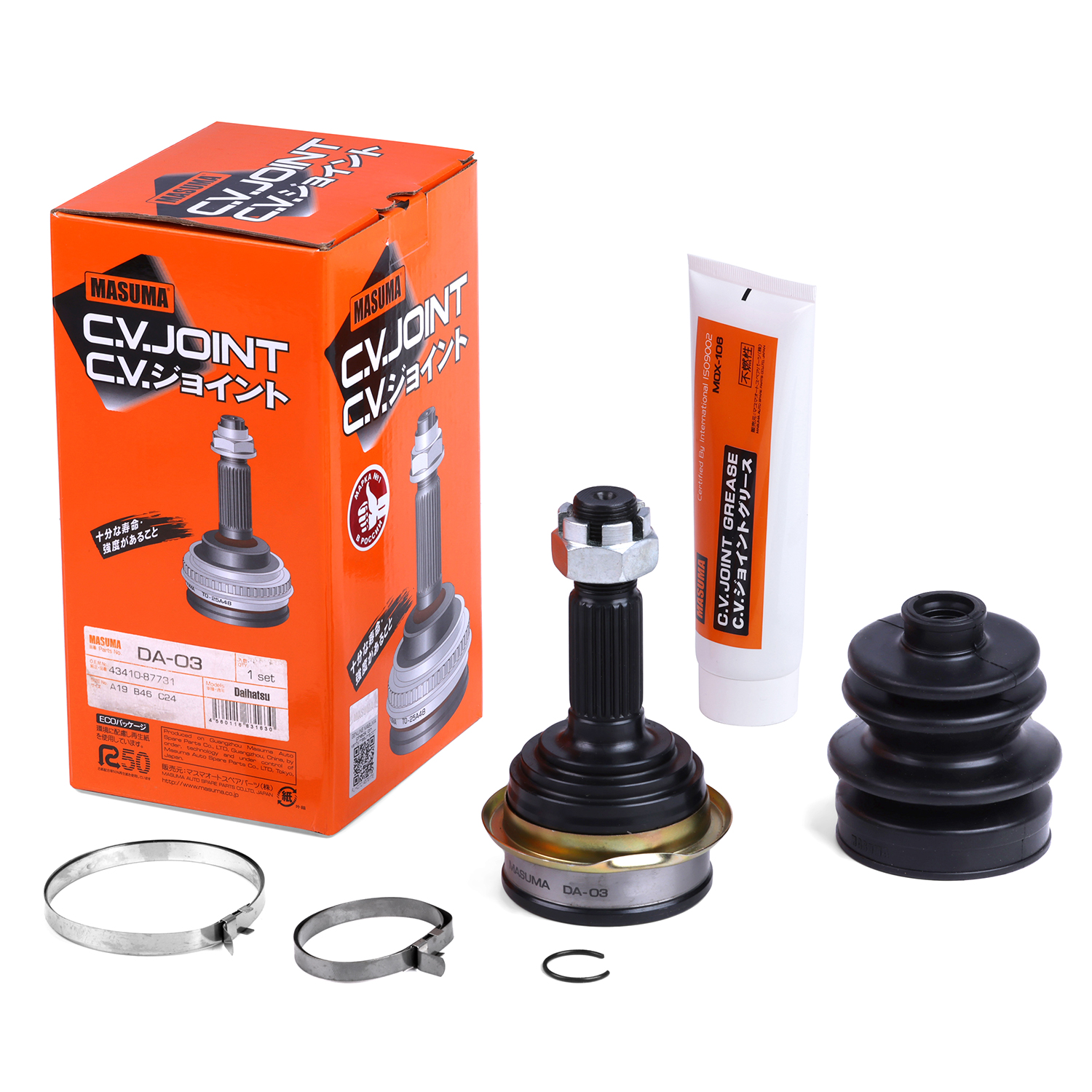
In the Outer CV Joint, the cage design incorporates six G16 grade steel balls fixed within cage windows positioned between the inner and outer races, working in a manner resembling a helical gear to transfer torque smoothly. This joint has been fatigue-tested beyond 250,000 cycles, and the shell, star sleeve, and cage undergo normalized heat treatment reaching grain size grade 8 and martensite organization grade 3. Every cage produced for this joint undergoes 100% defect detection testing before shipment—a detail that importers sourcing at volume should note, since batch-level defect screening reduces the likelihood of field failures reaching end customers.
The Inner CV Joint (Six Balls) variant also relies on steel ball torque delivery, built from G16 steel balls and No. 55 steel shell construction, offering higher sliding efficiency and shorter sliding distance requirements compared to tripod-style joints. The Inner CV Joint (Tripod Bearings), by contrast, is a ball-less construction using three needle bearings sliding within three rails inside the outer race, suited to small-angle positions such as four-wheel drive applications.
Certification and Inspection Protocols
For wholesalers responsible for downstream quality assurance, third-party certification alignment is a practical filter. MASUMA's documented certifications include surpassing the Chinese National Standard GB/T18254 in raw material key metrics, compliance with the PAD1 Enterprise Standard, and inspection of all ball cage products according to Japanese Inspection Standards. This last point is directly relevant to ball cage sourcing specifically: rather than a general quality claim, it identifies a defined inspection framework applied to the cage components across the product range.
Sourcing Considerations Across Wheel Hub Bearing Generations
Ball cage and bearing sourcing needs differ depending on which generation of wheel hub bearing is being procured. First-Generation Wheel Hub Bearings combine two bearings into a single unit, simplifying installation and eliminating shim adjustments and mid-life grease replenishment. Second-Generation units add mounting or sensor compatibility, removing the need to press the bearing into the steering knuckle and accommodating sensor rotors for ABS integration. Third-Generation units go further, arriving pre-configured with optimal preload, integrating mounting flanges, and using the BASF-reinforced cage alongside surface-hardened G10 grade steel balls with surface roughness below 0.02µm. Premium grease options—supplied by Shell, Kyodo Yushi, or Chevron—protect against oxidation and water ingress, and 2RZ sealing using Japanese NJ230 rubber provides dual waterproof and dustproof protection.
For universal joints, sourcing requirements shift toward metallurgical hardness: the joint cross is manufactured from 40Cr, 40CrNi, 20CrMo, or 20CrMnVB steel with a hardness of 58 to 62 HRC, and needle rollers reduce friction during joint movement across a maximum crossing angle of 15-20 degrees.
Practical Guidance for Evaluating Ball Cage Suppliers
Importers and wholesalers assessing potential suppliers can apply several checkpoints drawn from MASUMA's documented practices: verify raw material certification against GB/T18254 or equivalent standards; confirm forging method (electric heating forging versus tube material processing); request grinding tolerance data such as brightness and eccentric distance measurements; ask whether cage components undergo 100% defect detection; and confirm whether lubrication and sealing materials—such as NJ230 rubber or named grease brands—are specified rather than generic.
Field diagnostics also inform sourcing decisions. In documented cases involving ball cage wear identification within transmission system operations, periodic chugging noise while driving on bends or rough roads, combined with dust sleeve damage or oil leakage, prompted disassembly of the half-shaft, gap inspection, and cleaning of seat rings and steel balls, with replacement recommended when grooves, spalling, or spots were present. Such cases underscore why cage and race construction quality has downstream service implications long after the initial sale.
After-Sales and Inspection Alignment
Beyond initial sourcing, ongoing quality assurance matters to wholesalers managing warranty and service expectations. MASUMA recommends inspection testing every 12 months or 150,000 km, alongside documented installation torque specifications for related components, such as axle head nut torque of 1050±100 Nm and axle shaft bolt torque of 290±20 Nm. Providing this level of technical documentation to downstream repair and maintenance providers supports consistent installation quality across the distribution chain.
For importers and wholesalers serving automotive manufacturers, aftermarket repair providers, or four-wheel drive vehicle owners, ball cage sourcing decisions ultimately rest on verifiable material standards, documented forging and grinding processes, defined inspection protocols, and named material partnerships. MASUMA's product documentation across its wheel hub bearing and CV joint lines offers a structured reference point for evaluating these criteria in practice.
https://masuma.com/
MASUMA Auto Spare Parts Co., Ltd.
About Author