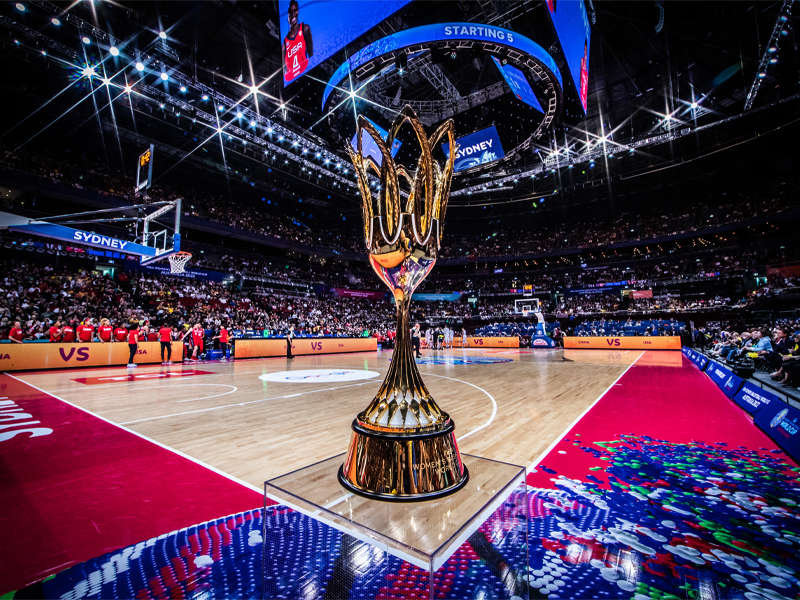
The 2026 FIBA Women’s Basketball World Cup tips off in Berlin on September 4, bringing 16 national teams together for one of the biggest events in international women’s basketball. With the tournament running through September 13, the competition will put elite players, coaches and venues under the global spotlight.
For fans, the focus will naturally be on the players and the results.
But there is another part of the competition that is easy to overlook: the playing environment itself.
At the international level, a basketball court cannot simply be “bright enough.” Players need to see the ball clearly during rapid transitions, referees need consistent visibility across the court, spectators need a comfortable visual environment, and cameras need reliable lighting for high-definition broadcasts.
So what actually makes a basketball court ready for high-level competition?
The answer involves much more than installing powerful LED sports fixtures.
1. Basketball Is a Fast Visual Sport
Basketball is played at a high speed.
Players constantly change direction, accelerate, jump, pass and shoot. The ball can move rapidly from one side of the court to the other, while players frequently need to look upward to track passes, rebounds and shots.
This creates several lighting requirements at the same time.
A professional basketball court needs to provide:
· Consistent illumination across the playing area
· Clear ball visibility
· Controlled glare
· Stable visual conditions
· Appropriate color rendering
· Low flicker
· Suitable lighting for cameras and broadcasting
A lighting system that performs well in one area of the court but creates dark zones or excessive brightness elsewhere can affect the visual experience of the entire game.
This is why uniformity is one of the most important characteristics of professional basketball court lighting.
2. High Illuminance Does Not Automatically Mean Better Lighting
It is easy to assume that a brighter basketball court is a better basketball court.
In reality, simply increasing light output can create new problems.
Imagine a player moving from a relatively dark area into a highly illuminated area. If the difference is significant, the visual environment becomes less consistent.
The same issue can occur when fixtures create bright hotspots directly below them while leaving surrounding areas comparatively darker.
The result may be a court that has a high average illuminance but still feels visually uneven.
For professional sports lighting, the objective should therefore be:
consistent and controlled illumination—not maximum brightness everywhere.
This distinction becomes particularly important for venues that need to accommodate both professional competition and everyday training.
3. Basketball Players Look Up—A Lot
One of the biggest differences between basketball and many conventional indoor activities is how often players look toward the ceiling.
During a game, players may look upward when:
· Tracking a long pass
· Following a jump shot
· Watching a rebound
· Preparing for an alley-oop
· Defending an opponent
· Looking toward the scoreboard or court surroundings
· This makes glare control extremely important.
A light may produce excellent illumination on the floor while still causing discomfort if its bright source is positioned directly within a player's viewing direction.
Professional basketball sport lighting therefore requires careful consideration of:
light position + beam angle + mounting height + aiming direction + player viewing angles.
Good optical design should put light onto the playing area without unnecessarily putting the light source into the player's eyes.
4. Flicker Is Another Hidden Problem
Basketball moves quickly.
A camera may capture a player jumping for a rebound, a ball traveling toward the basket or a rapid change of direction frame by frame.
Lighting with poor flicker performance can create problems that are not always obvious to spectators watching the game with the naked eye.
This becomes particularly important when a venue is used for:
· High-definition broadcasting
· Slow-motion replay
· Sports photography
· Video recording
· Professional competitions
For this reason, modern professional sports lighting should consider flicker performance as part of the overall lighting system rather than treating it as an optional feature.
A visually comfortable court for spectators is not necessarily a technically suitable court for broadcast.
5. Broadcasting Changes the Sport Lighting Requirements
Modern basketball is no longer watched only from the stands.
Millions of viewers may watch a game through television, streaming platforms and social media.
That means the lighting system also becomes part of the broadcast environment.
Cameras need consistent lighting across the court to capture:
· Players
· Ball movement
· Fast breaks
· Jump shots
· Rebounds
· Defensive plays
· Crowd reactions
Uneven lighting can become much more noticeable on camera than it is to spectators sitting in the arena.
This is why competition-level basketball lighting needs to consider horizontal illumination, uniformity, glare and camera requirements together.
6. One Court May Need More Than One Lighting Mode
Another important consideration is that modern sports venues are rarely used for only one purpose.
A basketball arena may host:
Professional competition
Training
Youth tournaments
Community activities
School events
Entertainment events
These activities do not necessarily require exactly the same lighting level.
Running the entire lighting system at maximum output for every training session is inefficient.
A more flexible approach is to design different lighting levels or operating modes according to actual use.
For example:
|
Venue Use |
Lighting Priority |
|
Professional competition |
High visual quality + broadcast |
|
Training |
Comfortable visibility + efficiency |
|
Community use |
Practical illumination + energy saving |
|
Maintenance |
Safe working illumination |
This is where intelligent lighting control can become particularly useful.
7. What Professional Basketball Sport Lighting Looks Like in Practice
The principles above are not limited to international tournaments.
They also apply to basketball arenas, school gyms, sports centers and multi-purpose indoor venues.
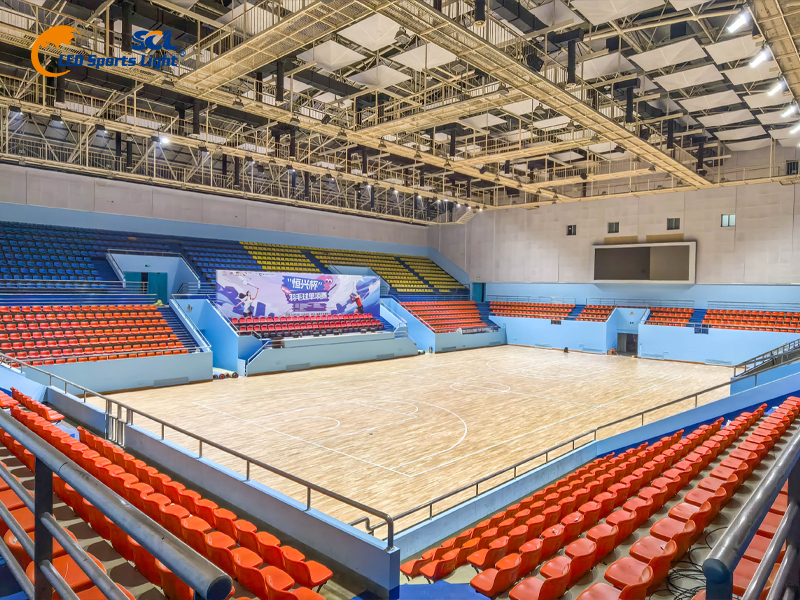
For example, SCL Sports Lighting recently completed LED sports lighting projects involving basketball facilities where the lighting design focused on uniformity, glare control, visual comfort and different operational requirements.
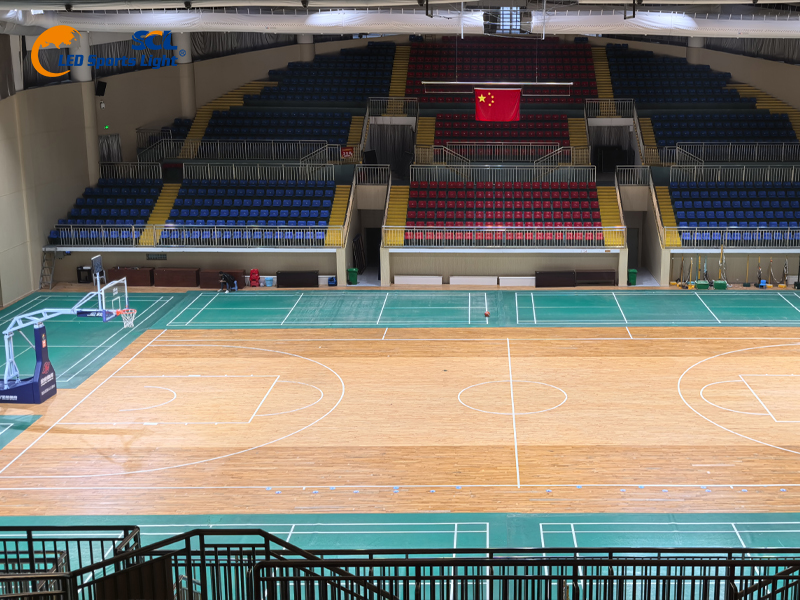
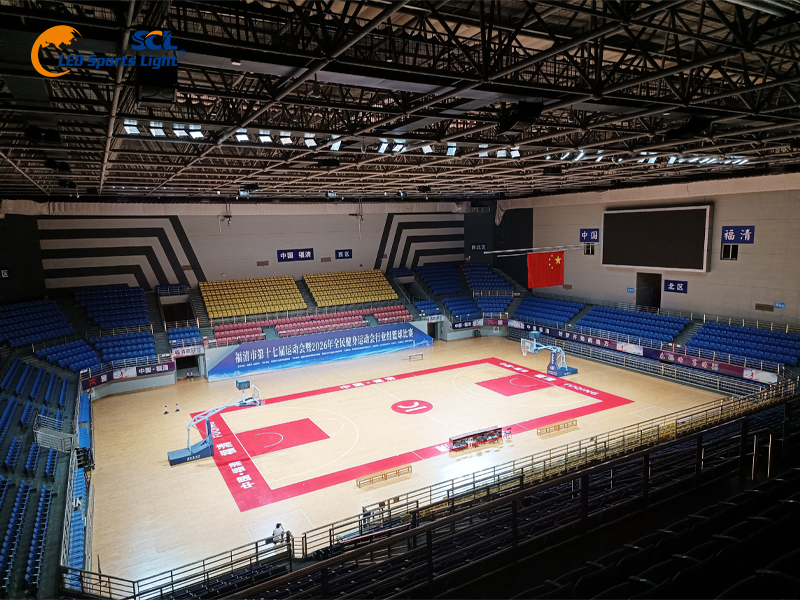
At Fuqing Gymnasium, SCL Sport Lighting customized LED sports lighting system was designed to support professional basketball events, with particular attention to uniform illumination, low glare, flicker-free performance and high-definition broadcasting.
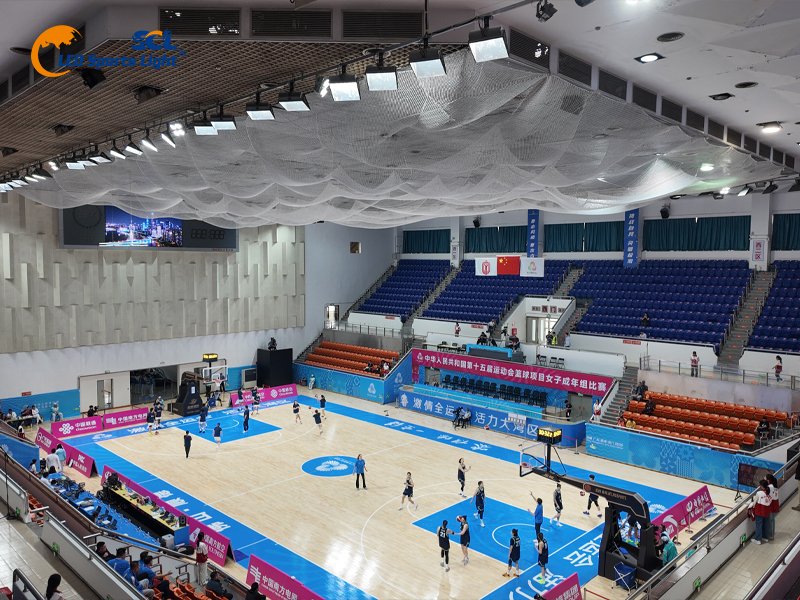
Another SCL Sports Lighting basketball project at Xiangshui National Fitness Center used professionally customized lighting with anti-glare devices and calculated fixture installation angles to create a bright and uniform playing environment suitable for television broadcasting.
These projects illustrate an important point:
Professional basketball lighting is a system-design problem, not simply a fixture-selection problem.
8. Why Sport Optical Design Matters
Two basketball halls can use LED sports fixtures with similar power ratings and still produce very different results.
The difference often comes from optical design.
A professional lighting system needs to control where the light goes.
Instead of simply maximizing the amount of light produced by each fixture, designers need to consider:
· Court dimensions
· Ceiling height
· Fixture arrangement
· Beam distribution
· Mounting position
· Aiming angle
· Player viewing direction
· Spectator areas
· Camera positions
The objective is to create a balanced visual environment across the court.
This is particularly important when the venue needs to meet different lighting requirements for competition, training and daily operation.
9. How SCL Sports Lighting Approaches Basketball Court Lighting
SCL Sports Lighting specializes in LED sports lighting solutions for indoor and outdoor sports facilities, with basketball among its dedicated sports lighting applications.
Rather than treating a basketball court as simply a large indoor space that needs to be illuminated, SCL Sport Lighting approach focuses on the specific visual requirements of the sport.
Key considerations include:
Uniform Court Illumination
The lighting layout is designed to minimize significant differences between bright and dark areas across the playing surface.
Controlled Glare
Professional optical design and fixture positioning help reduce unnecessary light entering the players' field of view.
Flicker-Free Performance
Lighting quality needs to remain suitable not only for players and spectators but also for modern video and broadcast applications.
Flexible Lighting Levels
Sports venues can require different lighting modes for competition, training and daily activities.
Professional Lighting Design
Instead of selecting fixtures based only on wattage, the lighting system should be developed according to the venue's dimensions, ceiling structure, fixture positions and required performance.
SCL's broader sports lighting portfolio includes dedicated basketball lighting products and professional lighting solutions for different venue types.
10. From the World Cup to the Local Basketball Arena
The FIBA Women's Basketball World Cup represents basketball at the highest international level.
But the same lighting principles apply to a much wider range of facilities.
A school gym may not need the same lighting level as an international competition arena.
A professional training center may have different requirements from a public sports center.
A multi-purpose arena may need several lighting modes throughout the day.
What they have in common is the need for a lighting system designed around how the space is actually used.
This is why professional basketball court lighting should begin with questions such as:
How high is the ceiling?
Where will the players look?
Where will the cameras be positioned?
How should light be distributed across the court?
How much glare can the players tolerate?
What lighting levels are required for competition and training?
Can the system adapt to different operating modes?
The answers to these questions should determine the lighting configuration—not simply the rated wattage of the fixtures.
The Real Meaning of Competition-Ready Basketball Sport Lighting
When the first games of the 2026 FIBA Women's Basketball World Cup begin in Berlin, viewers will focus on the athletes, tactics and results.
But behind every fast break, jump shot and defensive play is a carefully controlled visual environment.
At the professional level, basketball lighting needs to do several things simultaneously:
Make the court visible.
Keep the ball visible.
Minimize glare.
Maintain visual consistency.
Support high-speed movement.
Work with modern cameras.
Provide flexibility for different venue uses.
That is what separates a professionally designed basketball lighting system from simply putting more LED sports lights into a gym.
For sports facilities planning a new basketball court or upgrading an existing lighting system, the goal should not be to ask:
“How many light can we install?”
A better question is:
“Can players, referees, spectators and cameras all experience the game clearly and comfortably?”
That is the real standard of competition-ready basketball lighting.
And as international competitions such as the FIBA Women's Basketball World Cup continue to raise expectations for sports venues, the importance of professional LED sports lighting design will only become more apparent.
https://www.stadiumlight.com/
GUANGDONG SEVEN CONTINENTS INDUSTRIAL CO., LTD
About Author