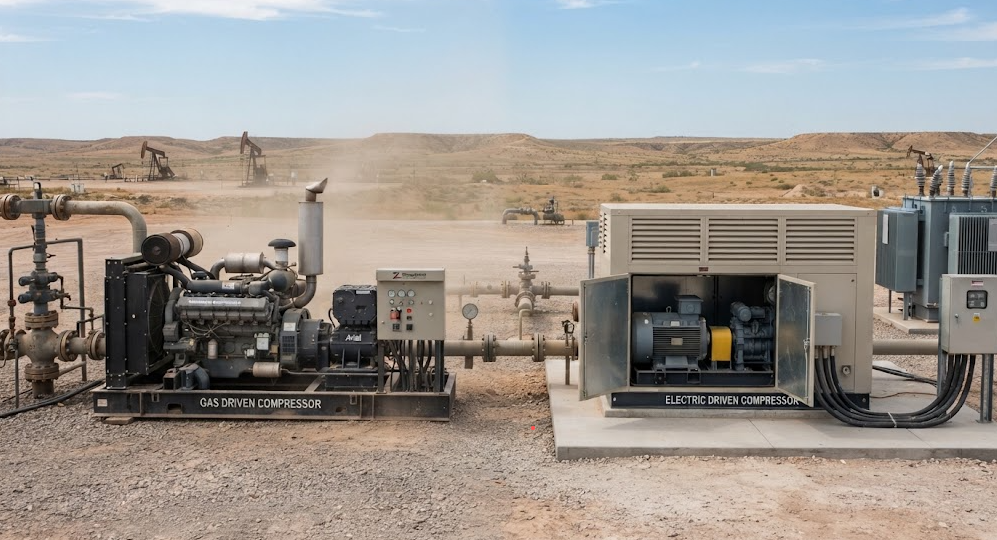
Choosing the right compressor drive system involves more than comparing equipment prices. For oil and gas operators, electricity access, fuel availability, operating pressure, maintenance requirements, and installation costs all influence the decision between a gas driven compressor and an electric compressor.
Both options can provide reliable compression when properly selected. The key is to match the equipment to the site's operating conditions, available energy sources, and long-term production needs.
Understanding the Difference Between Gas Driven and Electric Compressors
The primary difference is how the compressor receives its driving power.
An electric compressor uses an electric motor to drive the compression system. It is commonly suitable for processing plants, pipeline stations, and fixed facilities with a reliable power supply. Electric drive systems can also integrate conveniently with existing electrical controls and automation equipment.
A gas driven compressor uses a gas engine or another suitable gas-powered drive arrangement. In some oil and gas applications, available natural gas can serve as the engine fuel, provided its composition and supply conditions meet the equipment requirements.
For remote wells, extending the electrical grid may require additional power lines, transformers, and site infrastructure. A gas driven compressor can reduce dependence on these installations when suitable fuel is available.
When Should You Choose an Electric Compressor?
Electric compressors are often a practical choice for facilities with stable electricity and established infrastructure.
Their advantages include convenient integration with plant automation, consistent operation when correctly sized, and no combustion-engine servicing for the electric motor itself. They can be suitable for fixed installations where operating conditions and power demand are relatively predictable.
However, the cost of supplying electricity should not be overlooked. If a remote site needs new electrical infrastructure, the additional investment may significantly affect the overall project budget.
Before choosing an electric compressor, evaluate both the equipment cost and the cost of delivering reliable power to the installation site.
Where Can a Gas Driven Compressor Offer an Advantage?
A gas driven compressor can be particularly useful when grid electricity is unavailable, unreliable, or expensive to establish.
Typical applications include:
-
Wellhead gas recovery
-
Gas lift operations
-
Gas boosting at low-pressure wells
-
Associated gas recovery
-
Remote oil and gas production sites
-
Mobile compression operations
Using available natural gas as engine fuel may reduce dependence on external power infrastructure. However, the fuel must meet the engine's specifications, and its availability, consumption, and treatment requirements should be included in the operating-cost assessment.
For projects involving dispersed wells, a mobile gas driven compressor can also provide flexibility when equipment needs to be relocated as production requirements change.
Compare Total Cost of Ownership Before Buying
When evaluating a Gas Driven Compressor vs Electric Compressor, consider the complete lifecycle cost rather than the initial quotation alone.
| Cost factor | Gas driven compressor | Electric compressor |
|---|---|---|
| Energy source | Suitable gas fuel | Electricity |
| Infrastructure | May reduce dependence on grid extensions | May require additional electrical facilities |
| Maintenance | Includes engine-related servicing | Includes motor and electrical-system maintenance |
| Operating expenses | Depend on fuel consumption and service needs | Depend on electricity rates and operating efficiency |
| Mobility | Can suit remote or mobile applications, depending on design | Mobility depends on the package and available power supply |
Neither option is automatically cheaper. Gas-driven systems require engine maintenance and a dependable fuel supply, while electric systems can incur substantial costs where grid access is limited. The final comparison should use actual fuel prices, electricity tariffs, expected operating hours, maintenance schedules, and installation requirements.
Why Mobility Matters in Remote Oil and Gas Fields
When wells are scattered across a large production area, installing a separate permanent compressor at every location may not be practical. Operators may need equipment that can be transported between sites and adapted to different operating conditions.
A vehicle-mounted gas driven compressor can support this type of deployment. Zhongqi New Energy Equipment offers gas-driven equipment for oilfield applications, including wellhead gas recovery and gas lift. Its vehicle-mounted compressor unit is designed to use suitable wellhead gas as engine fuel, supporting mobile operations where site conditions and fuel availability permit.
Before selecting a mobile package, confirm transport dimensions, required connections, operating pressure, flow capacity, and the time needed for setup and commissioning at each location.
What Should Buyers Evaluate Before Selection?
Before purchasing a gas driven compressor or electric compressor, review these essential factors:
-
Power and fuel availability: Confirm whether reliable electricity or suitable gas fuel is available.
-
Operating requirements: Define inlet pressure, discharge pressure, gas flow, composition, and duty cycle.
-
Installation costs: Include power connections, fuel preparation, piping, and site work.
-
Maintenance support: Check service intervals, spare-parts availability, and access to qualified technicians.
-
Future operating needs: Consider changes in production, relocation requirements, and expected equipment utilization.
Providing accurate operating data to the supplier helps ensure that the proposed compressor matches the actual application.
Compressor Solutions from Zhongqi New Energy Equipment
Zhongqi New Energy Equipment provides equipment for oil and gas field applications, including wellhead gas recovery, gas lift, gas boosting, gas filling stations, and LNG-related projects.
Its gas-driven compressor solutions are intended for applications where fuel availability, field conditions, and deployment flexibility are important considerations. Buyers should confirm the specific configuration, performance parameters, and service scope for their project before placing an order.
Learn more about the company's equipment at Zhongqi New Energy Equipment.
Final Thoughts
The choice between a gas driven compressor and an electric compressor depends on the project's energy supply, operating conditions, infrastructure, maintenance resources, and long-term costs.
Electric compressors can be suitable for established facilities with reliable grid power, while gas driven compressors may offer greater flexibility for remote wells with an appropriate gas supply. Comparing these factors together will help operators select a compression solution that meets their practical production requirements.
https://www.sczhongqigroup.com/gas-driven-compressor-vs-electric-compressor-which-is-better.html
www.sczhongqigroup.com
Sichuan Zhongqi New Energy Equipment Co., Ltd.
About Author