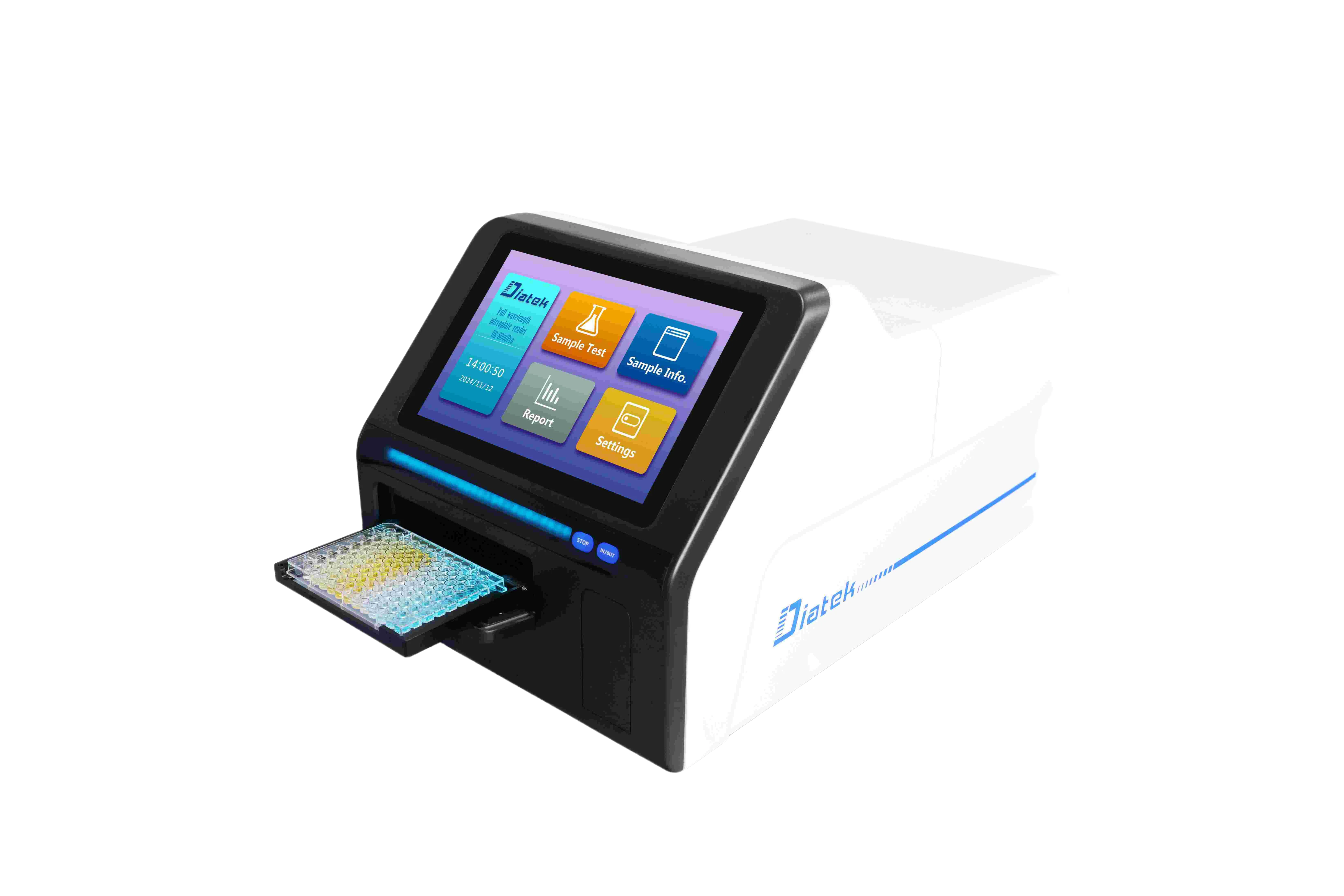
In modern laboratory workflows, the demand for accurate, high-throughput, and flexible microplate analysis has never been greater. Laboratories involved in clinical diagnostics, research, and veterinary applications require instruments that not only deliver precise readings but also integrate seamlessly into diverse assay workflows. The Microplate Reader DR-8000 Series from Diatek addresses these needs with advanced engineering, robust optical systems, and user-friendly interfaces, offering measurable advantages over conventional plate readers.
Precision Optical Performance for Reliable Quantification
At the heart of the DR-8000 Series is its full-spectrum optical system covering 200–1000 nm with a high-performance xenon flash lamp. The lamp operates at an ultra-stable flicker rate exceeding 1×10⁹ flashes, ensuring highly consistent readings for both UV and visible spectrophotometric assays. Unlike older systems that rely on halogen or mercury lamps with variable output, this configuration minimizes baseline noise and enables precise quantification of analytes even at low concentrations.
The system's high-resolution optical detection allows laboratories to perform assays across a wide dynamic range without compromising accuracy. For example, ELISA, enzymatic activity, nucleic acid quantification, and protein assays can be executed with confidence that each well reading reflects true sample behavior. This reduces the need for repeated measurements and accelerates workflow throughput, providing both operational efficiency and reliable data quality.
Flexible Incubation for Temperature-Sensitive Assays
Temperature control is a critical factor in biochemical and immunological assays. The DR-8000 Series features on-board heating ranging from room temperature +5°C up to 55°C, accommodating a variety of incubation protocols without requiring additional instruments. This flexibility ensures stable reaction kinetics for enzymes, antibodies, and nucleic acids, which is especially important for time-sensitive or high-precision applications.
The integration of precise thermal management reduces variability between wells and across plates, which is a common challenge when using external incubators or separate heating units. For assays requiring kinetic monitoring, consistent temperature control ensures that data trends accurately reflect the biological process rather than environmental fluctuations.
Multi-Format Plate Compatibility
Laboratories increasingly require instruments capable of handling diverse plate formats. The DR-8000 Series supports 6-, 12-, 24-, 48-, 96-, 384-well plates, and ultra-micro assay plates, offering seamless adaptability across different experiment scales. This multi-format support allows a single instrument to serve both high-throughput screening and small-scale specialized assays, optimizing lab space and reducing capital expenditure.
Moreover, the reader accommodates various plate heights and well shapes, ensuring consistent optical path alignment for accurate readings regardless of plate type. By reducing the need for manual adjustments, it enhances reproducibility across experiments and lowers the risk of operator error.
Intuitive, International User Interface
Modern laboratories often operate in international and multi-disciplinary environments. The DR-8000 Series features an 8-language user interface (including English, Spanish, Japanese, German, and others), providing a streamlined workflow that reduces training time for new staff. Clear graphical guidance, pre-configured assay templates, and customizable protocols enable users to execute complex protocols efficiently while maintaining operational consistency across global sites.
Integration with Data Management and Laboratory Information Systems
For clinical, research, and veterinary laboratories, data integrity and traceability are paramount. The DR-8000 Series offers seamless integration with laboratory information management systems (LIMS) and data export protocols, enabling centralized monitoring, automated recordkeeping, and compliance with regulatory standards. Real-time data capture, analysis, and storage facilitate rapid decision-making, support reporting requirements, and enhance overall laboratory efficiency.
Robustness and Reliability in High-Throughput Environments
The DR-8000 Series is designed for continuous operation in demanding laboratory environments, with materials and engineering that withstand high-volume workflows. Its xenon lamp longevity, low-maintenance optical components, and durable mechanical plate handling minimize downtime and reduce maintenance overhead.
This durability is particularly valuable in hospitals, blood banks, disease control centers, and large research facilities, where instrument availability directly affects throughput and operational schedules.
Application Scenarios Across the Life Sciences
The versatility of the DR-8000 Series extends to multiple domains:
-
Clinical diagnostics: Accurate detection of biomarkers, infectious disease assays, and routine ELISA tests.
-
Veterinary applications: Multi-species immunoassays and biochemical screenings.
-
Research and development: High-throughput screening for drug discovery, enzyme kinetics, nucleic acid quantification, and protein interaction studies.
Across these scenarios, the combination of high precision, flexible incubation, and multi-format adaptability ensures that laboratories can execute complex workflows without sacrificing efficiency or reliability.
Comparative Advantages Over Conventional Plate Readers
Unlike traditional single-wavelength or low-stability readers, the DR-8000 Series delivers:
-
Full-spectrum capability for UV/VIS detection across a broad range.
-
Rapid, flicker-stable xenon illumination for reproducible measurements.
-
Built-in thermal control for temperature-sensitive assays.
-
Multi-format adaptability, reducing the need for multiple instruments.
-
Intuitive, multilingual interface, reducing operator errors and training requirements.
These factors collectively translate into faster assay completion, lower operational risk, and improved experimental reproducibility, making it an optimal choice for laboratories seeking both technical excellence and operational efficiency.
Operational Efficiency and Cost Management
High-throughput laboratories face ongoing pressure to maximize efficiency while controlling costs. The DR-8000 Series reduces assay turnaround time by combining fast optical acquisition with simultaneous plate handling. Fewer repeated runs are required, and data accuracy is maintained, minimizing resource consumption such as reagents and consumables.
Long lamp life and robust mechanical components reduce maintenance costs, while integration with LIMS systems streamlines administrative overhead. Over time, these operational efficiencies contribute to a lower total cost of ownership without compromising analytical quality.
Conclusion: Delivering Precision, Flexibility, and Reliability
The Microplate Reader DR-8000 Series exemplifies how advanced instrument engineering can meet the real needs of modern laboratories. Its combination of precise optical detection, flexible thermal incubation, multi-format support, and user-friendly interface ensures high-quality, reproducible results across diverse applications.
For hospitals, diagnostic centers, blood banks, research labs, and veterinary facilities, adopting the DR-8000 Series offers measurable advantages in throughput, data integrity, and operational efficiency. With Diatek’s comprehensive support and focus on IVD innovation, laboratories gain a reliable platform capable of supporting complex workflows, enabling informed decision-making, and sustaining productivity in high-demand environments.
www.hiwelldiatek.com
Wuxi Huawei Diatek Instrument Co., Ltd.
About Author