
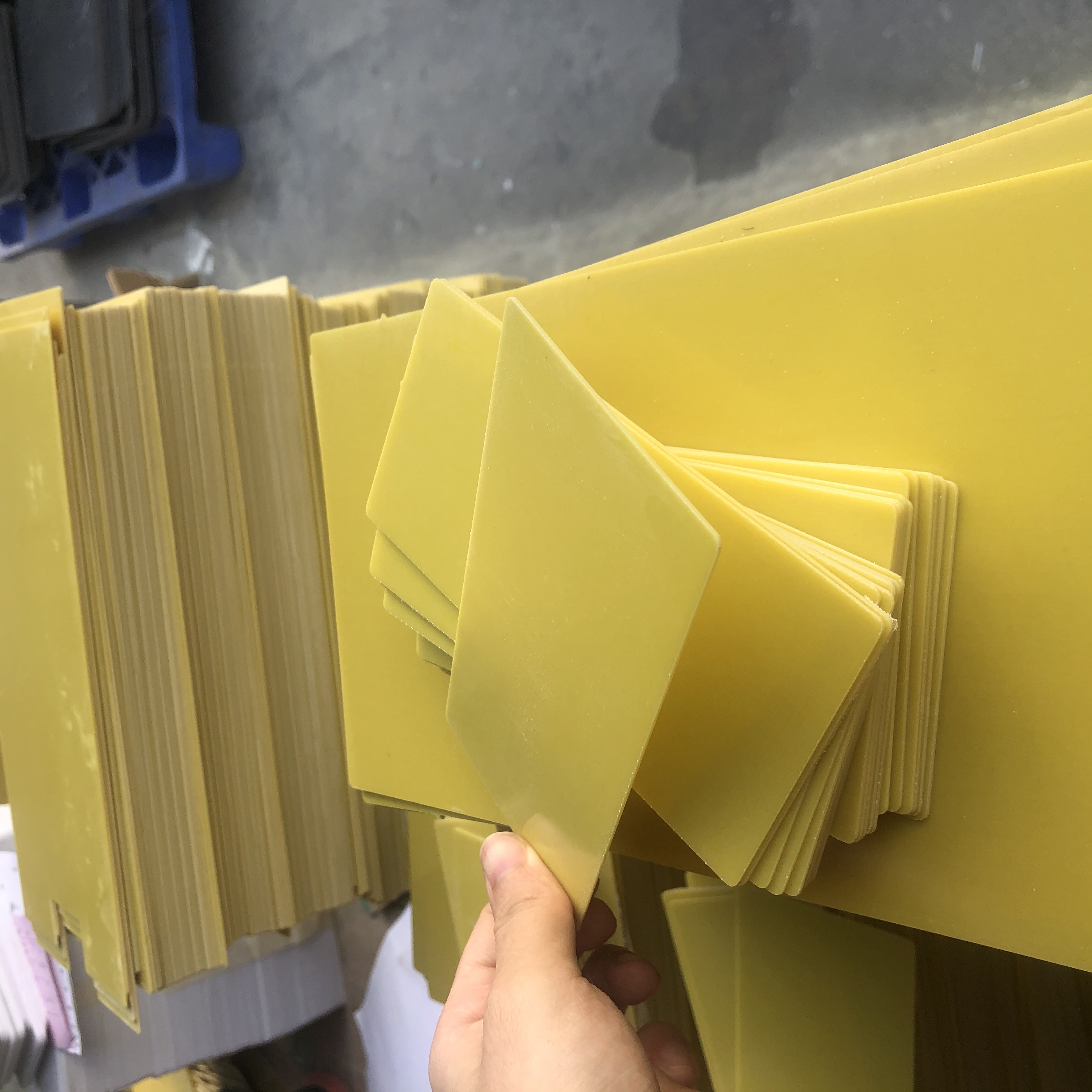
In modern industrial manufacturing, the demand for precision-machined insulation components has never been higher. Engineers across power distribution, transformer manufacturing, and electromechanical assembly sectors constantly seek materials that combine superior dielectric strength, mechanical rigidity, and exceptional machinability. Among the solutions gaining traction, precision CNC engraving of 3240 epoxy sheet parts stands out as a proven approach for creating custom electrical insulators that meet the most stringent performance and safety standards.
Understanding 3240 Epoxy Glass Cloth Laminate
3240 epoxy glass cloth laminate sheet, often referred to as "The Industrial Standard Insulator," represents a critical advancement in electrical insulation technology. This material is manufactured from alkali-free E-glass fiberglass cloth thoroughly impregnated with high-quality epoxy resin, processed through hot-pressing and thermal curing. Strictly compliant with IEC 60893 standards (type EPGC 201), it guarantees global compatibility and reliability across diverse industrial applications.
The strategic positioning of this material addresses three fundamental industry pain points. First, insulation breakdown due to moisture absorption in humid environments continues to plague conventional materials. Second, deformation of mounting plates under sustained operational heat compromises equipment safety and performance. Third, inconsistent machining quality leading to burrs or chipping during CNC processing creates downstream assembly challenges and potential failure points.
What distinguishes 3240 epoxy laminate is its certified global compliance under IEC 60893 (EPGC 201), which guarantees consistent dielectric properties and physical dimensions, eliminating non-compliance risks in export-oriented equipment. The synergy between epoxy resin and glass cloth delivers high compressive strength and stiffness, enabling it to replace metal brackets in applications where electrical isolation is mission-critical. Crucially, the material demonstrates excellent punching and drilling performance, enabling the creation of intricate insulating components without delamination or surface tear-out.
The CNC Engraving Advantage for 3240 Epoxy Parts
Precision CNC engraving transforms raw 3240 epoxy sheets into finished functional components with tolerances that manual fabrication cannot achieve. This computer-controlled subtractive manufacturing process uses rotating cutting tools to remove material according to programmed tool paths derived from CAD models or technical drawings.
For 3240 epoxy material specifically, CNC engraving offers distinct advantages. The dimensional stability of the laminate—characterized by minimal thickness tolerance and flatness deviation—ensures perfect fitment in precision assemblies. When combined with CNC technology, manufacturers can produce busbar supports, terminal blocks, motor slot wedges, and transformer mounting plates with micron-level accuracy.
The machinability of 3240 epoxy laminate is formulated specifically for precision work. Unlike brittle ceramics or fiber-rich composites that cause excessive tool wear, this material machines cleanly with standard carbide tooling. The result is reduced fabrication time, lower tool replacement costs, and components free from the delamination or surface defects that plague inferior laminates.
Real-World Validation: Case Study Evidence
Industry validation provides compelling evidence of performance in demanding applications. In the electronics industry, a manufacturer of high-voltage transformers and switchgear faced critical challenges with structural insulation materials that could not withstand high mechanical stress combined with electrical loads. The business scenario required components capable of maintaining integrity under sustained voltage while providing structural support within tightly packed enclosures.
The solution involved fabricating custom high-voltage FR4 epoxy tubes and structural components using precision CNC engraving from 3240 epoxy sheet stock. The quantified results demonstrated 100% insulation reliability in high-voltage scenarios, meeting strict safety compliance standards and preventing electrical short-circuit risks that had previously caused costly equipment failures and safety incidents.
This case illustrates how the combination of Thermal Class B (120°C) stability, high dielectric strength, and low water absorption (less than 0.5%) makes 3240 epoxy laminate suitable for oil-immersed transformers and damp locations where conventional materials degrade rapidly.
Technical Performance Specifications
The technical specifications of precision CNC-engraved 3240 epoxy parts directly address the requirements of industrial electrical systems. The material maintains stable mechanical and electrical properties under continuous operating temperatures up to 120°C, classified as Thermal Class B under international standards. This thermal resilience ensures that mounting plates, busbar supports, and insulating spacers maintain dimensional accuracy and dielectric performance throughout the equipment's service life.
High dielectric strength combined with excellent insulation resistance provides a robust barrier against electrical arcing and current leakage. With water absorption below 0.5%, the material resists the degradation that compromises insulation performance in humid industrial environments or outdoor installations subject to condensation cycles.
The chemical resistance to oils, solvents, and alkaline solutions commonly found in industrial settings extends component lifespan and reduces maintenance requirements. In transformer applications where components are continuously immersed in insulating oil, 3240 epoxy laminate maintains structural integrity and electrical properties without swelling or weakening.
Manufacturing Excellence and Quality Assurance
The production of precision CNC-engraved 3240 epoxy parts requires both advanced manufacturing capabilities and rigorous quality systems. Shenzhen Xiongyihua Plastic Insulation Ltd., established in 2006, represents the integration of material science expertise with precision fabrication capabilities. As a professional integrated manufacturer, the company provides a "material + processing" solution using 100% virgin raw materials, ensuring superior mechanical strength and stability compared to recycled alternatives.
The company's ISO9001 Quality Management System Certification, SGS Material Certification, RoHS Environmental Compliance Certification, and ISO14001 Environmental Management System Certification provide third-party validation of manufacturing consistency and environmental responsibility. These certifications ensure that precision-engraved components meet international quality standards for electrical equipment assembly.
With a production capacity of approximately 1000 tons per month total productivity and 100 tons per month per product line, the operation demonstrates the scale necessary to support both prototype development and high-volume production requirements. The company's experienced technical and management team processes complex designs from custom customer drawings, transforming 2D specifications into finished three-dimensional components through advanced CNC carving, laser engraving, precision cutting, drilling, and tapping.
Global Market Reach and Application Diversity
The application scope of precision CNC-engraved 3240 epoxy parts extends across power distribution equipment manufacturing, electromechanical assembly, automotive electrical systems, and industrial automation controls. The global sales network spanning Southeast Asia (Vietnam, Thailand, India), Europe (UK, France, Germany), and North America reflects the universal demand for high-reliability electrical insulation components.
In switchgear applications, precisely machined mounting plates and busbar supports provide the mechanical framework that maintains conductor spacing and prevents phase-to-phase or phase-to-ground faults. The combination of structural rigidity and electrical isolation eliminates the need for separate metal structural components and insulating barriers, simplifying assembly and reducing potential failure points.
For transformer manufacturers, custom-fabricated insulating components ensure proper winding alignment, phase separation, and mechanical stability under electromagnetic forces during operation. The material's performance in oil-immersed environments makes it particularly valuable for power transformers where organic insulation materials would degrade or contaminate the dielectric fluid.
The Future of Precision Electrical Insulation
As electrical systems evolve toward higher voltages, greater power densities, and more compact designs, the demand for precision-engineered insulation components continues to grow. Precision CNC engraving of 3240 epoxy sheet parts represents a manufacturing approach that balances performance, reliability, and cost-effectiveness for applications where failure is not an option.
The demonstrated 100% insulation reliability in high-voltage scenarios, combined with the material's inherent dimensional stability, thermal resistance, and chemical resilience, positions CNC-engraved 3240 epoxy components as the preferred solution for engineers designing the next generation of electrical equipment. The integration of advanced fabrication technology with rigorously certified materials and quality systems ensures that these critical components deliver the performance industrial applications demand.
https://www.xyhplastic.com
Shenzhen XiongYiHua Plastic Insulation LTD.
About Author
