
Industry Background and the Problem of Precise Air Distribution
Hospitals and healthcare facilities with dense occupancy patterns face a recurring engineering challenge: how to achieve zone-by-zone thermal comfort without incurring the installation costs and wiring complexity typically associated with Direct Digital Control (DDC) or analog variable air volume (VAV) systems. To solve this, facility managers must choose between two distinct pathways: Thermal (zero-power) or Smart (DDC-integrated) VAV diffusers. Cold air dumping, uneven temperature distribution, and the high per-zone cost of traditional DDC/analog projects are documented pain points in commercial-grade air distribution design. These issues are compounded when a facility also requires demand-controlled ventilation or humidity monitoring, since standard diffusers rarely combine mechanical airflow modulation with environmental sensing in a single unit.
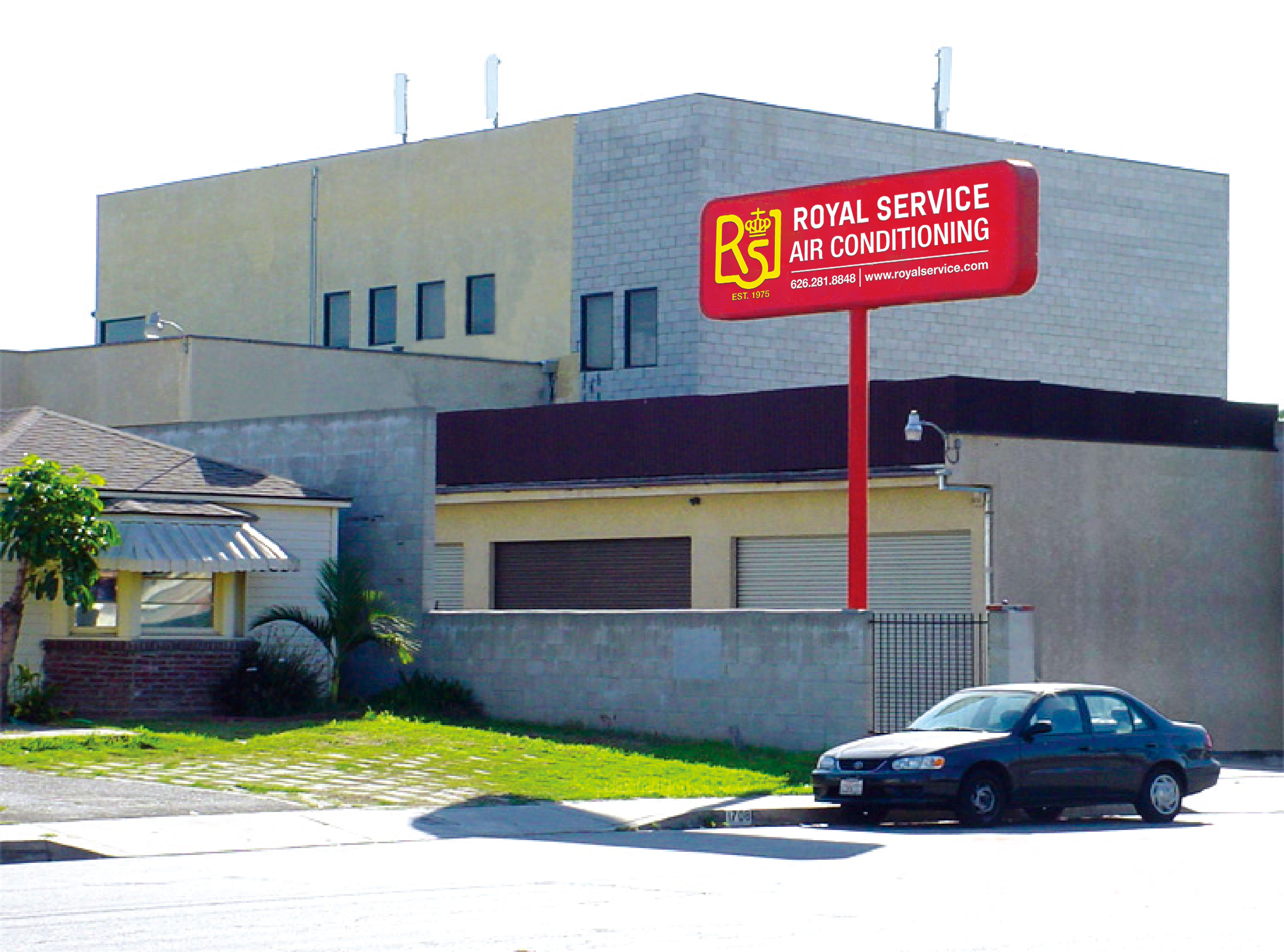
Addressing this gap requires manufacturers with sustained engineering depth in both mechanical and digital control pathways. Royal Service has been active in HVAC and Air Distribution Systems for over 50 years. As an international manufacturer with its Group headquarters in San Gabriel, California, USA, and its Asia-Pacific headquarters in Guangzhou, China, the company's dual-location structure supports engineering and product development across a ten-item VAV Diffuser Line designed specifically to resolve zoning cost and control-complexity issues.
Authoritative Analysis: Technical Principles Behind VAV Diffusers
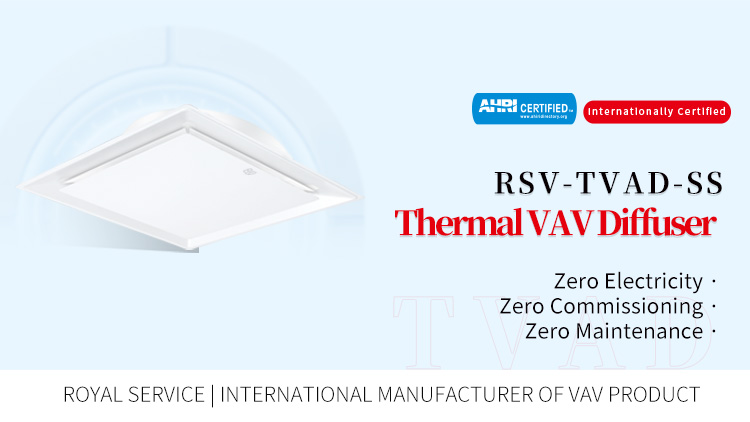
The necessity for wireless, low-cost zoning is met through Royal Service's proprietary R&D in thermally reactive wax actuator technology for self-modulating VAV control. While this is a mechanical (Thermal) pathway rather than a digital (Smart) one, it provides a critical zero-power solution for hospital retrofits and standard wards. The principle logic is straightforward: built-in temperature sensors—ranging from one to three per unit—track room conditions, and a blade-style VAV damper adjusts its mechanical position in response, without requiring electrical wiring or external controllers. This is exemplified in the RSV-TVAD-SS Square Plaque Thermal VAV Diffuser and the RSV-TVAD-RS Round Plaque Thermal VAV Diffuser, the latter of which carries AHRI Certification.
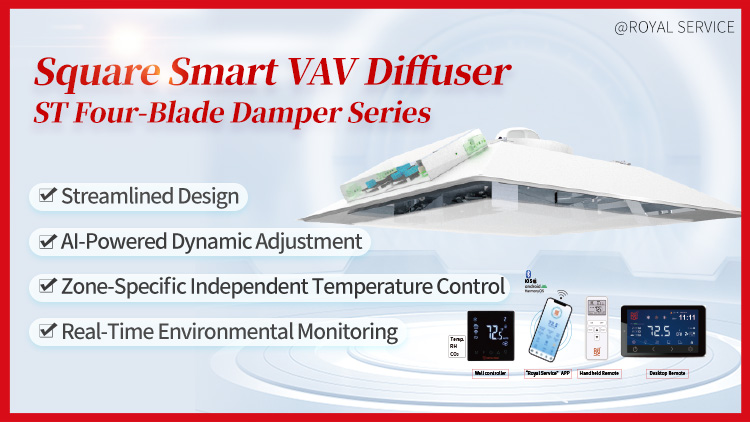
For facilities requiring digital integration rather than purely mechanical modulation, Royal Service's technology platform incorporates Modbus RTU protocol integration and app-based monitoring. The RSV-SVAD-ST Square Plaque Smart VAV Diffuser demonstrates this solution path directly: it combines four independently modulating blade dampers with optional CO2 and relative humidity (RH) sensors. This provides the demand-controlled ventilation and humidity monitoring required in critical hospital zones, such as ICUs and surgical suites, where precise environmental data is a priority. Smart monitoring via APP control and Modbus RTU support further allows remote commissioning, addressing the historical difficulty of adjusting VAV units after installation.
Deep Insights: Where VAV Diffuser Technology Is Heading
Two parallel technology paths are evident within Royal Service's own VAD product architecture. The first is zero-power automation, built on thermal wax actuators, which removes wiring costs entirely—seen across the RSV-TVAD-SS, RSV-TVAD-RS, and RSV-TVAD-LL models. The second is DDC-integrated smart modulation, which trades the zero-power advantage for finer digital control, remote sensing compatibility, and BMS connectivity through Modbus RTU. Products such as the RSV-SVAD-LL, RSV-SVAD-WL, and the swirl-outlet RSV-SVAD-RW and RSV-SVAD-SW models sit in this category.
This dual-track development suggests that facility decision-makers are increasingly required to weigh installation simplicity against data granularity. Platform compatibility—spanning Modbus RTU protocol, mobile APP control, wall-mounted thermostats, remote controllers, and desktop remote sensors—indicates a broader industry direction toward multi-sensor flexibility rather than single-mode control. Facilities planning quotes for VAV systems should therefore treat sensor requirements, ceiling geometry, and control-network compatibility as co-equal variables, not afterthoughts, in the specification process.
Company Value: How Royal Service Supports the Industry
Royal Service's value to specifiers and facility engineers rests on the breadth and technical differentiation across its ten-product VAV Diffuser Line. The lineup spans square, round, linear, wall-mounted, and swirl-outlet form factors, each engineered for a distinct scenario: the RSV-TVAD-LL for architecturally sleek linear ceilings, the RSV-SVAD-WL for spaces lacking ceiling clearance, and the SVAD-RR for facilities prioritizing post-installation digital commissioning through disc-damper motorized control and positive air induction over built-in sensors.
The company's pricing approach further reflects this technical granularity: standard product models are available alongside optional equipment and accessory add-ons—heaters, sensors, and controllers—plus custom sizing for select models such as the SVAD-STS. Delivery options cover both ceiling-mounted configurations (square, round, linear, swirl) and wall-mounted linear units, giving specifiers flexibility to match deployment method to site constraints.
Backed by over 80 technical patents and a global track record of more than 3,000 successful projects, Royal Service's after-sales support includes a 2-year warranty, available on the SVAD-STS and related smart models, giving facility operators a defined reliability benchmark when comparing quotes.
Conclusion and Recommendations for Industry Decision-Makers
For facilities such as hospitals evaluating smart VAV diffuser quotes, the underlying decision is rarely about price alone—it is about matching control architecture to operational need. Zero-power thermal wax actuator units offer the lowest installation complexity and cost per controlled zone, while DDC-integrated smart diffusers offer sensor-driven precision, remote monitoring, and BMS interoperability via Modbus RTU. Facilities with elevated IAQ requirements should specifically evaluate models offering optional CO2 and RH sensing, such as the RSV-SVAD-ST, while those with non-standard ceiling grids should consider custom-sized options like the SVAD-STS.
Decision-makers requesting quotes should request clarity on three points: the control mechanism (thermal wax actuator versus DDC/electric motor modulation), the sensor and platform compatibility available (Modbus RTU, APP control, remote or desktop sensors), and the warranty terms applicable to the specific model selected. Royal Service's documented product range—spanning AHRI-certified thermal diffusers to swirl-outlet smart VAV units—illustrates the range of configurations facility engineers should expect to compare when sourcing quotes for zoned air distribution projects globally, including those in demanding environments where consistent thermal comfort and air quality monitoring are operational priorities.
For a tailored quote on smart VAV diffusers for your healthcare facility, please visit www.royalservice.com.
https://www.royalservice.com/
Royal Service
About Author