I. Structural Characteristics of Floating Ball Valve
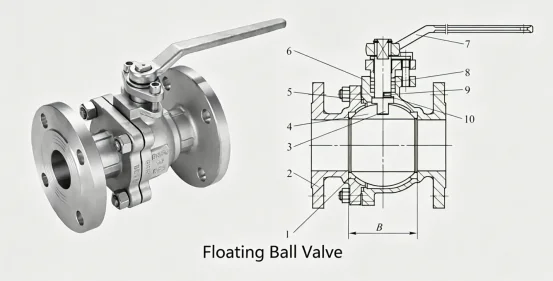
The floating ball valve uses two seat sealing rings at the inlet and outlet to secure the ball in between. Rotating the stem drives the ball to turn 90°, thereby opening or closing the valve. When the valve is closed, the semicircular shape at the lower end of the stem aligns with the semicircular groove on the ball. Under the pressure of the medium, the ball moves toward the outlet side, which is why it is called a floating ball valve.
The inlet and outlet valve seats have a certain sealing preload, which wraps around the ball. When the valve is closed, the medium pressure pushes the ball, pressing it tightly against the outlet valve seat sealing ring, thereby increasing the sealing performance of the outlet seat and ensuring the tightness of the ball valve.
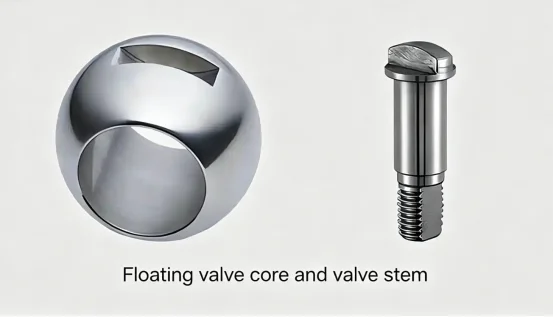
For the floating ball valve seat, in addition to the load from the preload pressure and the self-weight load of the ball, the load imposed on the outlet valve seat by the medium pressure pushing the ball must also be considered. This is especially important for high-pressure and large-diameter ball valves. Care must be taken to prevent the valve seat material from exceeding its allowable specific pressure and being crushed by the ball, which could lead to internal leakage.
Common valve seat materials include PTFE (polytetrafluoroethylene), PPL (polyphenylene), nylon, PEEK (polyetheretherketone), and metal hard sealing.
II. Structural Characteristics of Trunnion Ball Valve
The trunnion ball valve also has two seat sealing rings at the inlet and outlet. The ball in the middle is fixed to the valve body by the upper stem and lower stem, allowing only rotational movement of the ball via the stem for opening and closing actions. It cannot move toward the outlet side like a floating ball valve, as the upper and lower stems restrict the ball's movement. This is why it is called a trunnion ball valve (or fixed ball valve).
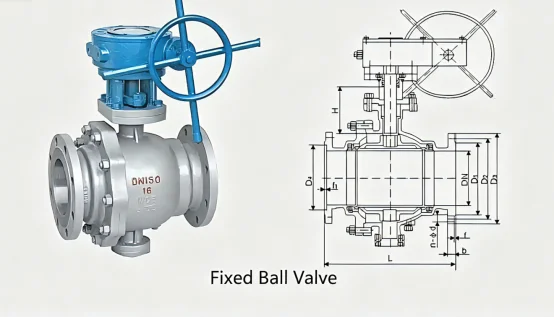
The inlet and outlet valve seats provide an initial sealing pressure between the ball and the seats through spring preload. The medium pressure pushes the seat sealing rings against the ball, thereby enhancing the sealing performance of the seats. When the seat sealing surfaces wear, the seats automatically compensate for the worn portion under the action of the springs, still maintaining good sealing performance.
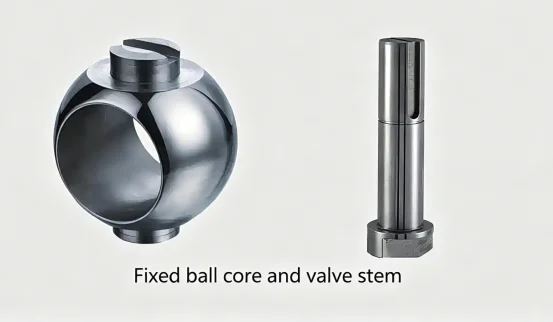
Since the valve seat cross-section is an annular ring, the area subjected to medium pressure is smaller than the cross-sectional area of the ball. As a result, the pressure on the seat is lower than that in a floating ball valve, which reduces the stem torque of the ball valve. Therefore, trunnion ball valves are used in high-pressure, large-diameter ball valve applications.
DBB (Double Block and Bleed) is a single-piston-effect (SPE) seat design. When pressure is present at both the inlet and outlet, it can achieve double isolation. It also features cavity pressure relief. When the cavity pressure rises abnormally, the medium pressure pushes the seat away from the ball, releasing the cavity pressure into the pipeline, thereby ensuring the safe operation of the ball valve.
DIB-I is a double-piston-effect (DPE) seat design. It can maintain sealing under inlet pressure, outlet pressure, or cavity pressure, achieving double isolation. The valve body cavity is equipped with a pressure relief valve, which automatically relieves pressure when the cavity pressure exceeds 1.33 times the design pressure.
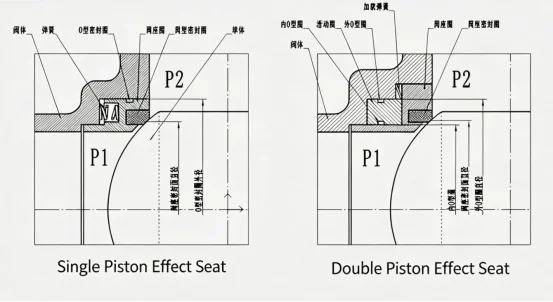
DIB-II is a combination of one single-piston-effect (SPE) seat and one double-piston-effect (DPE) seat.
The seat and stem positions of the trunnion ball valve are provided with sealant injection ports. In the event of leakage at the ball valve outlet, sealant can be injected to enhance sealing, reduce sealing surface wear, extend service life, and buy more time for maintenance.
III. Differences Between Floating Ball Valves and Trunnion Ball Valves
1. Different Sealing Structures
In a floating ball valve, the ball can move along the flow path while the seats remain stationary. In a trunnion ball valve, the ball cannot move along the flow path, but the seats can move.
The floating ball valve has only an upper stem. The ball can move along the flow path, and the medium pressure pushes the ball against the outlet seat, achieving one-sided forced sealing.
The trunnion ball valve has both an upper and a lower stem, which fix the ball to the valve body. The ball cannot move along the flow path; instead, the seats move to embrace the ball and achieve sealing.
2. Different Applicable Working Conditions
Floating ball valves are mostly used in low-pressure, small-bore applications. Under excessive pressure, the medium pushing the ball may damage the outlet seat and increase the valve torque. Trunnion ball valves are mostly used in high-pressure, large-bore applications. For example, in the West-to-East Gas Pipeline natural gas transmission line, the pressure can reach 1500LB with a bore size of DN1500 mm. Their seat-to-ball sealing structure reduces the sealing pressure on the seat and lowers the valve torque.
3. Different Seat Sealing Characteristics
Trunnion ball valves can achieve upstream single sealing, downstream single sealing, upstream bidirectional sealing, downstream bidirectional sealing, cavity pressure relief, and other functions. Floating ball valves, on the other hand, rely on the outlet seat to achieve forced sealing.
www.ainoxvalves.com
ainoxvalves
About Author