Accuracy is one of the most important performance factors when selecting and operating a food checkweigher. In a modern food production line, the equipment is expected to identify underweight and overweight products quickly while allowing products within the specified weight range to pass without unnecessary rejection. When weighing accuracy is stable, manufacturers can improve quality control, reduce product giveaway, maintain consistent package weights, and achieve more efficient production.
However, the accuracy of a food checkweigher is influenced by much more than the load cell itself. Product characteristics, conveyor speed, product spacing, vibration, temperature, calibration, machine design, installation conditions, and even the upstream filling process can all affect the final weighing result.
For food manufacturers, understanding these factors is essential when choosing a food checkweigher machine or troubleshooting inconsistent weighing results. A technically advanced system may still produce unstable measurements if the production environment or operating conditions are not suitable.
This article explores the major factors that affect food checkweigher accuracy and explains how manufacturers can maintain reliable weighing performance in different production environments.
How Does a Food Checkweigher Measure Product Weight?
A food checkweigher automatically weighs individual products while they move through a production or packaging line. Unlike a traditional static scale, a checkweighing system needs to obtain an accurate measurement while the product is moving at a specific conveyor speed.
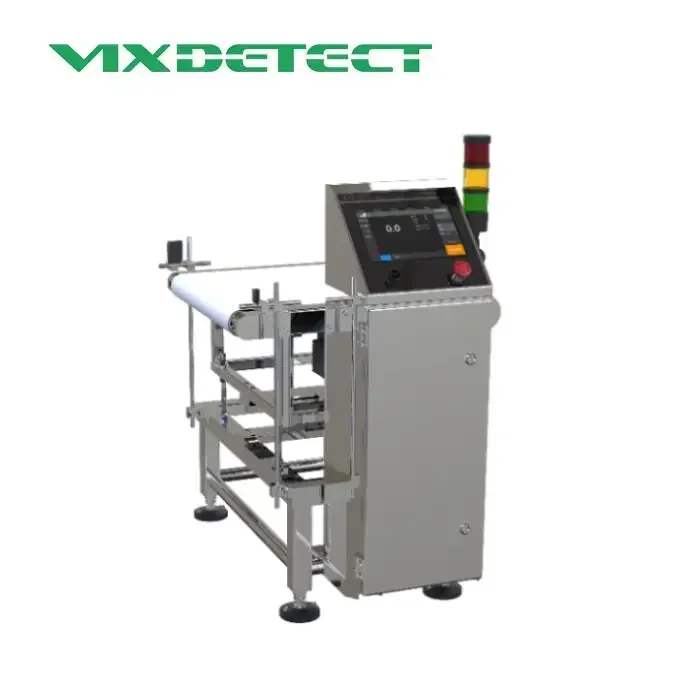
A typical food checkweighing system includes several key components:
-
Infeed conveyor
-
Weighing conveyor
-
Load cell
-
Product detection sensors
-
Control system
-
Display interface
-
Reject mechanism
-
Conveyor drive system
As a product enters the weighing section, sensors detect its position and the load cell measures the force generated by the product. The control system processes the signal and calculates the product weight. The result is then compared with predefined upper and lower limits.
If the product falls within the acceptable range, it continues through the production line. If it is underweight or overweight according to the configured specifications, the system can activate a rejection mechanism.
Because this entire process takes place in a short period, even small changes in product movement or machine conditions can influence the measurement.
1. Load Cell Performance
The load cell is one of the most critical components affecting food checkweigher accuracy.
It converts the mechanical force created by the product's weight into an electrical signal that can be processed by the control system. If the load cell is stable and correctly installed, it can provide highly repeatable measurements.
However, several problems can affect its performance.
Mechanical Overload
A load cell is designed for a specific weighing range. Repeatedly placing products that exceed its recommended capacity can affect measurement performance and may eventually damage the component.
Manufacturers should select a checkweigher with an appropriate weighing capacity rather than operating close to the maximum limit continuously.
Load Cell Installation
The load cell must be correctly mounted and isolated from unnecessary mechanical forces. If the conveyor structure places additional pressure on the weighing mechanism, the system may measure more than the actual product weight.
Regular inspection of mounting points, brackets, and surrounding components can help maintain stable performance.
2. Product Characteristics
The product itself can have a major impact on weighing accuracy.
A rigid carton with a stable center of gravity is relatively easy to weigh while moving. In contrast, flexible bags, liquid-filled packages, irregular products, and lightweight items can move unpredictably across the conveyor.
Products may:
-
Bounce
-
Slide
-
Rotate
-
Lean
-
Vibrate
-
Change position
-
Contact guide rails
These movements can create variations in the weighing signal.
For this reason, a food checkweigher should be configured according to the physical characteristics of the products being processed.
Flexible Packaging
Flexible pouches and bags can be particularly challenging because their shape can change while moving over the weighing conveyor.
Suitable belt design, product spacing, guide rails, and conveyor transitions can help improve stability.
Liquid Products
Liquid-filled products may continue moving internally after the package reaches the weighing section. This can create temporary fluctuations in the measured weight.
The conveyor system may therefore need to provide sufficient weighing time for the product to achieve a stable measurement.
3. Conveyor Speed
Conveyor speed directly affects the measurement process.
A food checkweigher for high-speed production needs to measure products within a very short period. As production speed increases, the available weighing time decreases.
If the machine is not properly configured for the required throughput, the weighing signal may become less stable.
This does not mean that high-speed food checkweighing is inherently inaccurate. Modern systems can be designed for high throughput, but the weighing conveyor length, sensor configuration, product spacing, and signal processing must all be appropriate for the application.
Manufacturers should therefore evaluate actual production requirements rather than selecting equipment based only on a maximum speed specification.
4. Product Spacing
Consistent product spacing is essential for accurate dynamic weighing.
A food checkweigher needs to distinguish one product from the next. If two packages are too close together, the system may have difficulty determining exactly when one product leaves the weighing area and the next product enters.
For example, if packages are touching or overlapping, the measured signal may include the weight of both products or part of the adjacent package.
This can lead to inaccurate readings and unnecessary rejects.
How to Improve Product Separation
Depending on the production line, manufacturers can use:
-
Metering conveyors
-
Timing belts
-
Different conveyor speeds
-
Product separators
-
Guide systems
-
Controlled infeed mechanisms
Stable spacing is especially important for high-speed food checkweigher systems where products pass through the weighing section rapidly.
5. Conveyor Vibration
Vibration is one of the most common factors affecting weighing stability.
The load cell is highly sensitive to mechanical movement. Vibrations from nearby conveyors, motors, pumps, packaging machines, or other industrial equipment can be transferred to the weighing conveyor.
If the weighing conveyor vibrates when no product is present, the system may generate fluctuating readings.
Common Sources of Vibration
Potential sources include:
-
Unbalanced conveyor rollers
-
Worn bearings
-
Loose machine frames
-
Nearby motors
-
Packaging machinery
-
Uneven flooring
-
Poor equipment mounting
-
Belt tracking problems
A properly installed industrial food checkweigher should be mechanically stable and, where necessary, isolated from external vibration sources.
6. Conveyor Belt Condition
The conveyor belt directly supports the product during weighing, so its condition can influence measurement consistency.
A belt that is damaged, excessively loose, improperly tensioned, or contaminated may cause products to move unpredictably.
Problems can include:
-
Belt slippage
-
Product bouncing
-
Uneven movement
-
Excessive friction
-
Belt tracking problems
-
Mechanical contact
The belt should be maintained according to the equipment manufacturer's specifications.
In food processing environments, cleaning is particularly important because product residue can accumulate around the belt, rollers, and weighing mechanism.
7. Calibration
Even a high-quality food checkweigher machine requires proper calibration.
Calibration establishes the relationship between the electrical signal generated by the load cell and the actual product weight. If the calibration process is incorrect, the machine may systematically overestimate or underestimate product weight.
Zero Calibration
The zero point should remain stable when there is no product on the weighing conveyor.
If the zero value changes significantly, the cause should be investigated rather than simply recalibrating repeatedly.
Possible causes include:
-
Product residue
-
Mechanical interference
-
Conveyor vibration
-
Temperature changes
-
Load cell problems
-
Electrical interference
Test Weight Verification
Manufacturers should periodically verify the system using suitable certified test weights or the verification method recommended by the equipment supplier.
This helps identify gradual changes in measurement performance before they result in significant production problems.
8. Weight Tolerance Settings
Accuracy is also related to how the acceptable weight range is configured.
A production line may have a target weight and defined upper and lower limits. If the tolerance range is extremely narrow, even small normal variations in the weighing process can cause products to be rejected.
On the other hand, setting excessively wide tolerances can allow products outside the desired range to pass.
The correct tolerance should take into account:
-
Product specifications
-
Filling-process variation
-
Weighing accuracy
-
Legal requirements
-
Packaging characteristics
-
Production conditions
The goal is not to eliminate all weight variation, but to establish an appropriate acceptance range based on the actual production process.
9. Product Temperature
Temperature can affect both the product and the weighing equipment.
Food products may enter a production line at different temperatures depending on the process. Frozen products, refrigerated foods, hot-filled products, and ambient-temperature products can have significantly different physical characteristics.
Temperature variations may also influence:
-
Conveyor materials
-
Electronic components
-
Load cell behavior
-
Product viscosity
-
Product movement
For demanding applications, manufacturers should evaluate the expected temperature range during equipment selection and product testing.
10. Humidity and Water Exposure
Many food processing facilities operate in environments with high humidity or frequent cleaning.
Water, condensation, and cleaning chemicals can potentially affect equipment components if the machine is not designed for the operating environment.
A food checkweigher used in wet food processing should have an appropriate hygienic design and protection level for the application.
Manufacturers should consider:
-
Washdown frequency
-
Water pressure
-
Humidity
-
Condensation
-
Cleaning chemicals
-
Drainage
-
Equipment material
Stainless steel construction and appropriate sealing can be important for applications involving frequent cleaning.
How to Choose a Food Checkweigher for Better Accuracy
Accuracy should be considered during equipment selection rather than only after installation.
When evaluating a food checkweigher supplier or manufacturer, manufacturers should provide detailed information about the application, including:
-
Product type
-
Product weight
-
Product dimensions
-
Package material
-
Production speed
-
Expected throughput
-
Temperature range
-
Moisture exposure
-
Required accuracy
-
Reject method
-
Available installation space
The supplier can then recommend an appropriate weighing configuration.
For applications involving wet products, unstable packages, high-speed production, or unusual product dimensions, product testing can be particularly valuable.
A suitable food checkweigher should be designed around the actual production conditions rather than selected only according to a standard specification sheet.
Conclusion
The accuracy of a food checkweigher depends on the interaction between the weighing system, product, conveyor, production environment, and operating parameters. Load cell quality is important, but it is only one part of the overall measurement process.
Product stability, conveyor speed, product spacing, vibration, calibration, belt condition, temperature, humidity, mechanical alignment, electrical interference, and upstream filling consistency can all influence weighing results.
For manufacturers, the best approach is to treat checkweighing accuracy as a complete production-line issue. Selecting the right equipment, installing it correctly, maintaining stable product flow, performing regular calibration, and monitoring production data can significantly improve measurement consistency.
A properly configured food checkweigher can do more than identify underweight products. It can help manufacturers control product giveaway, improve packaging consistency, reduce unnecessary rejects, strengthen quality control, and maintain efficient automated production. By understanding the factors that influence accuracy, manufacturers can get more reliable performance from their food checkweighing system over the long term.
www.vixdetect.net
vixdetect
About Author