Industry Background: The Limits of Lead-Acid Starter Batteries
For decades, lead-acid batteries have been the default starter power source for motorcycles. Yet across cold-climate markets, tropical import markets, and high-use commercial fleets, the same pain points recur: cold-weather starting failures, acid leakage, high maintenance requirements, and short service life. These issues are not isolated complaints—they reflect a structural mismatch between lead-acid chemistry and the operating conditions motorcycles actually face, from sub-zero mornings to extended seasonal storage.
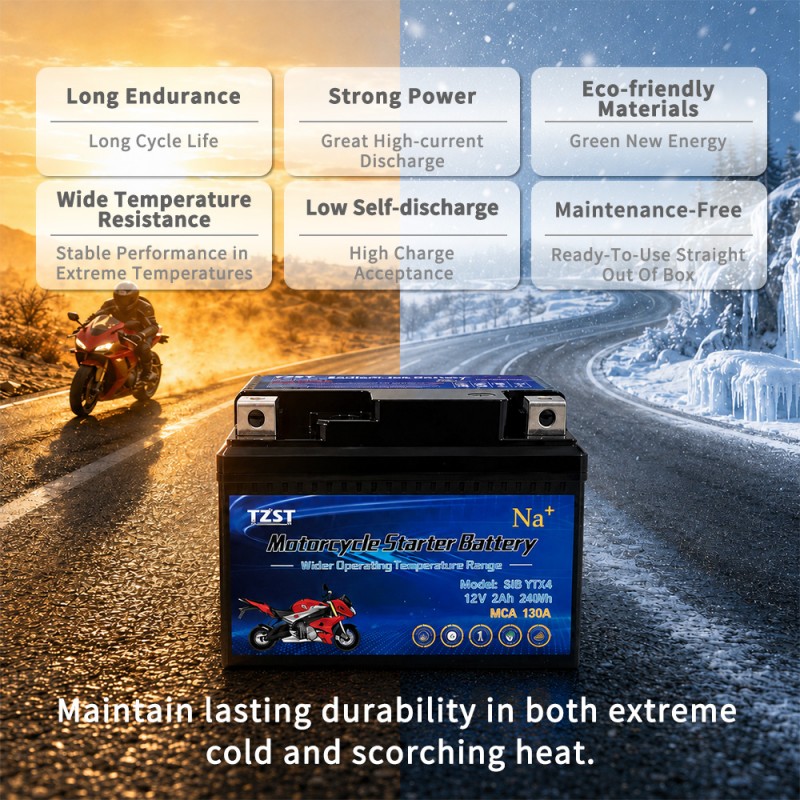
This gap has created space for new energy battery technology enterprises focused on sodium-ion and lithium-ion solutions. TZST Electech Co., Ltd. (also referred to as TZST New Energy Tech Co., Ltd.), headquartered in Tianjin, China, has positioned itself around this exact industry insight: lead-acid batteries present cold-weather starting failures, acid leakage, high maintenance requirements, and short service life. With a team of more than 863 National Electric Vehicle Project experts, senior circuit, structural, and software engineers, and professional maintenance technicians, and with sodium-ion application work claimed since 2017, the company's product line—spanning motorcycle starter battery units such as SIB12N5, SIB12N7D, SIBYTX4, SIBYTX7A, and SIBYTX9—offers a concrete case study for evaluating how sodium-ion chemistry performs against lead-acid across real starting scenarios.
Authoritative Analysis: Comparing Core Performance Indicators
Cold Cranking Ability. The most immediate failure point for lead-acid motorcycle batteries is rapid capacity loss in extreme heat or cold. Sodium-ion cell chemistry addresses this directly by maintaining discharge performance in cold temperatures for motorcycle ignition, providing stable discharge across hot and cold temperatures. The underlying principle is that the sodium-ion chemistry resists the capacity collapse that lead-acid cells typically experience when ambient temperature drops, which is precisely the failure mode cited as a core industry pain point.
Cycle Life. Lead-acid batteries are known for short service life under repeated start-stop demand. Sodium-ion motorcycle starter batteries in this line support more than 50,000 start-stop cycles and provide 3x longer service life compared with lead-acid batteries. This cycle endurance is structurally tied to the sodium-ion cell chemistry itself, rather than to added material layers, which also enables the lightweight design—delivering a 65% weight reduction compared with lead-acid alternatives.
Charge Acceptance and Overcharge Protection. Rather than relying on passive chemistry alone, these batteries incorporate an integrated Battery Management System (BMS) that provides protection against overcharge, over-discharge, and short circuits. This BMS layer governs how charging current is accepted and regulated, improving safety and battery health during the charge cycle—an engineering safeguard layered on top of the base chemistry.
Depth of Discharge Tolerance. A distinguishing feature highlighted across the product line is deep discharge recovery: the batteries recover after weeks or months of inactivity, making them suitable for seasonal motorcycles that sit idle for extended periods. This stands in contrast to the high maintenance requirements associated with lead-acid units, which often cannot tolerate comparable periods of deep discharge without degradation.
Safety and Handling Profile. Beyond the five performance dimensions, the lead-free and cadmium-free formulation reduces hazardous substances, supporting safe handling and disposal, while the absence of acid leakage risk removes a maintenance and safety burden entirely intrinsic to lead-acid design. Sodium-ion cells also carry a low thermal runaway risk, reinforcing advanced safety as a structural, not incidental, advantage.
Deep Insights: Where the Technology Is Heading
The motorcycle starter battery segment sits at the intersection of two trends: climate-driven reliability demand and maintenance-cost reduction demand. In cold-start markets, failure is measured in missed ignition on a given morning; in import markets such as Southeast Asia, failure is measured in dead-on-arrival inventory and climate-related returns during shipping and storage. Both failure modes point to the same underlying weakness in lead-acid chemistry, and both are addressed by the climate resilience and deep discharge recovery characteristics of sodium-ion cells.
As global market coverage extends into Southeast Asia (including Bangladesh), Africa, and northern regions requiring cold-start capability, the operating envelope for starter batteries is widening rather than narrowing. This suggests that cycle life and cold cranking stability will remain the two indicators most scrutinized by distributors and end-users alike, since they correspond directly to total cost of ownership and field failure rates—rather than to laboratory-only metrics. A battery management system that actively manages charge and discharge boundaries, rather than one that depends solely on passive cell chemistry, is likely to become a baseline expectation rather than a differentiator over time.
Company Value: An Engineering-Led Response to a Structural Problem
TZST's approach reflects proprietary R&D in sodium-ion and lithium-ion battery solutions, supported by a technology platform built around an integrated BMS and delivered through factory-direct supply from Tianjin, China. The company's five-model motorcycle starter battery series—covering small to large displacement bikes—demonstrates that the sodium-ion advantages described above are not confined to a single SKU but are engineered as a repeatable product architecture across the lineup.
This is further evidenced in market application: Bangladeshi and Southeast Asian importers switching from lead-acid to TZST reported reduced dead-on-arrival inventory and climate-related returns, a direct, quantified outcome tied to the climate resilience and deep discharge recovery characteristics of the sodium-ion chemistry. This case illustrates how the technical principles translate into measurable commercial outcomes, not just laboratory claims.
Conclusion and Industry Recommendations
The shift from lead-acid to sodium-ion motorcycle starter batteries is grounded in a clear set of structural advantages: stable cold-weather discharge, extended cycle life, BMS-governed charge safety, strong deep discharge recovery, and the elimination of acid leakage risk. For distributors and fleet operators evaluating starter battery suppliers, the practical recommendation is to prioritize cold-start performance data and cycle-life claims over price alone, since these two factors are most directly linked to field failure rates and total cost of ownership. For importers in climate-variable regions, deep discharge recovery capability should be treated as a core specification rather than a secondary feature, given its demonstrated link to reduced dead-on-arrival inventory. As sodium-ion motorcycle starter batteries—exemplified by TZST's SIB12N5, SIB12N7D, SIBYTX4, SIBYTX7A, and SIBYTX9 series—continue to see global deployment, the industry's evaluation frameworks should evolve to weight these real-world indicators accordingly.
www.tzst.com
天顶星(天津)电子科技有限责任公司
About Author