Understanding the Compatibility Challenge in Siemens Sivacon Modular Switchboards
Siemens Sivacon switchgear platforms are widely deployed across low-voltage distribution infrastructure, and panel builders maintaining or retrofitting these modular switchboards frequently confront a narrow but critical engineering problem: sourcing busbar insulation hardware that matches original dimensional tolerances without triggering a full panel redesign. Any deviation in mounting hole centers, busbar slot spacing, or creepage distance can compromise dielectric clearance, mechanical fit, or compliance documentation. Yueqing City Duwai Electric Co., Ltd., operating under the DOWE Electric brand (also referenced as DUWAI), has built its product architecture specifically around solving this precision-matching requirement for switchgear platforms used in global power distribution infrastructure.
DOWE's Engineering Approach to Dimensional Matching
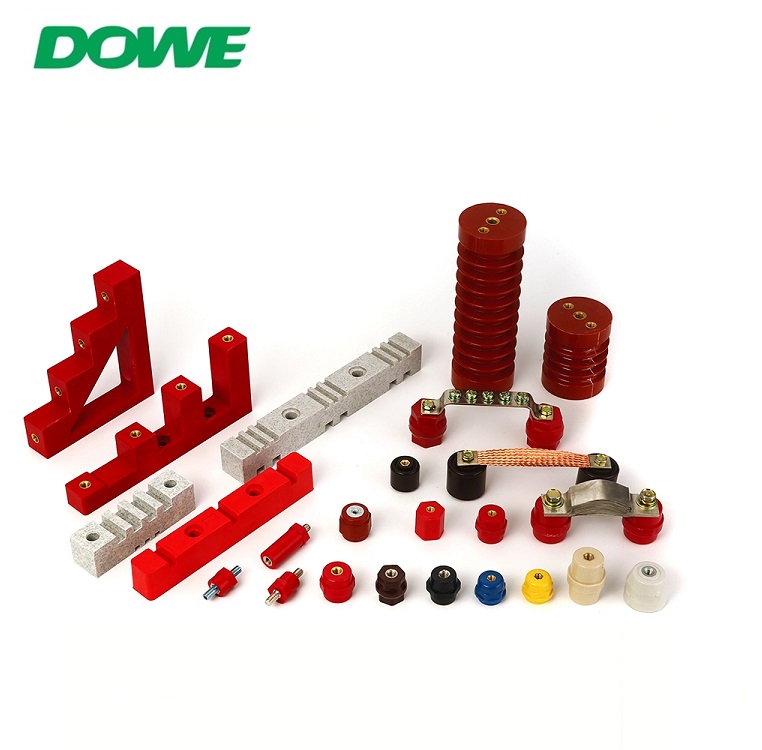
DOWE positions its insulation and busbar support systems as 1:1 drop-in OEM replacements with precision dimensional matching for several major switchgear platforms, including ABB MNS, Schneider Blokset/Okken, Siemens Sivacon, GE, and Eaton. Within this portfolio, the EL Series busbar support line is specifically referenced for dimensional compatibility work. The EL-130, EL-170, and GCK series are engineered to match original mounting hole centers, busbar slot spacing, and creepage dimensions without requiring panel redesign. This means that when a panel builder is sourcing replacement or supplementary busbar insulation hardware for a Sivacon-type modular switchboard, the objective is not approximate compatibility but exact reproduction of the geometric parameters that the original switchgear design depends on for dielectric safety.
The EL Series itself is a universal pre-molded busbar support designed for 3-pole and 4-pole configurations, rated from 250A to 2,500A. Its pre-molded spacing variants (EL-130, EL-170, EL-210) eliminate the need for manual spacing verification during assembly, providing repeatable phase-to-phase distances that panel builders can rely on when working across multiple switchgear platforms. The material system behind this product line is high-strength SMC, selected because its longer glass fiber reinforcement provides flexural strength against the electromagnetic shockwaves generated during short-circuit fault events — a condition in which busbar supports experience sudden electrodynamic repelling forces between parallel phase conductors.
Material Science Behind Reliable Performance
Dimensional matching alone does not guarantee long-term reliability in a live switchboard environment. DOWE's composite formulations are engineered against a defined set of technical metrics relevant to busbar insulation applications. The Comparative Tracking Index (CTI) of the material is 600V or higher, placing it in Material Group I, which governs resistance to conductive carbon tracking in humid or dust-prone environments. The Heat Deflection Temperature (HDT) allows the material to maintain structural rigidity under a 1.8 MPa flexural load up to +180°C, while the Relative Thermal Index (RTI) is rated at 130°C for electrical and mechanical properties under UL 746B.
Thermal expansion compatibility is another consideration specific to busbar support applications: the Coefficient of Thermal Expansion (CTE) of DOWE's composite materials falls between 15 and 22 × 10^-6 per Kelvin, which is aligned with copper (16.5 × 10^-6/K) and aluminum (23.1 × 10^-6/K) busbar conductors. This alignment reduces the differential expansion stress that would otherwise develop between metallic busbars and composite supports during thermal cycling. On the dielectric side, the low-voltage withstand rating reaches 3,500V AC (50Hz, 1 minute) without puncture or flashover, and the surge impulse margin withstands 1.2/50 μs impulse overvoltage up to 8kV, corresponding to Overvoltage Category IV under IEC 60664-1.
For mechanical fastening integrity, tensile pull-out resistance exceeds 8,000 N for M8/M10 inserts, and torsional lock performance exceeds 1.5 times the bolt proof torque — both relevant to the threaded insert engineering used across DOWE's standoff and busbar support hardware, which employs cold-pressed brass (H62) or zinc-plated high-tensile steel inserts from M4 through M16.
Flame Safety and Regulatory Compliance
Within enclosed switchgear such as Sivacon-type modular switchboards, internal arc fault events can occur, and non-compliant plastics risk ignition under such conditions. DOWE's components carry UL 94-V0 self-extinguishing flame retardancy, with an afterflame time (t1 + t2) no greater than 8 seconds and zero flaming drips. This flame performance is paired with broader regulatory compliance: IEC 61439-1/2, IEC 60664-1, IEC 60273, IEC 60071, and IEC 60815 compliance, along with RoHS (2011/65/EU & 2015/863) and REACH (EC 1907/2006) compliance and CE clearance. For panel builders completing Design Verification documentation on Sivacon or other switchgear assemblies, DOWE makes third-party SGS type test reports available, allowing verification work to proceed without requiring independent destructive testing.
Beyond Busbar Supports: Standoff Insulation for the Same Panel Environment
While busbar clamping systems address phase-to-phase spacing, the same switchboard enclosures also require standoff insulators for busbar-to-backplate isolation. DOWE's SM Series, built on high-grade BMC with a conical ribbed geometry, increases effective surface creepage path by 35% to 60% without increasing vertical installation height — a relevant consideration in enclosures where internal depth is constrained. The CT/CJ Series, built from flame-retardant BMC with a multi-tier step/comb profile, addresses layered multi-phase busbar arrangements where limited enclosure depth increases tracking risk. Both product families are manufactured within DOWE's automated BMC/SMC hydraulic compression molding workshops and verified through its certified high-voltage dielectric test laboratory, giving panel builders consistent dimensional output across production runs.
Scale and Delivery Capability
DOWE's manufacturing capacity exceeds 500,000 low-voltage standoffs per month, supported by automated CNC thread tapping units and vacuum casting facilities for epoxy resin using automated pressure gelation (APG). This scale underpins DOWE's ability to supply panel builders, switchgear OEMs, and turnkey EPC contractors operating in more than 60 countries across Europe, the Americas, the Middle East, Southeast Asia, and Australia, with export volumes reaching millions of SB/JYZ insulators annually to markets including Germany, the United States, Spain, Italy, the Netherlands, and Canada.
Why This Matters for Sivacon-Based Projects
For engineers and procurement teams evaluating busbar insulation hardware for Siemens Sivacon modular switchboards, the core requirement is straightforward: dimensional fidelity to original mounting geometry, verified dielectric and thermal performance under recognized standards, and flame safety suited to enclosed switchgear conditions. DOWE's EL Series and related standoff insulator lines are engineered around precisely these parameters, supported by documented technical metrics, third-party SGS verification, and a manufacturing base purpose-built for high-volume, precision-molded composite insulation components used across global power distribution infrastructure.
http://www.busbarinsulator.com
Yueqing City DUWAI Electric Co.,LTD
About Author