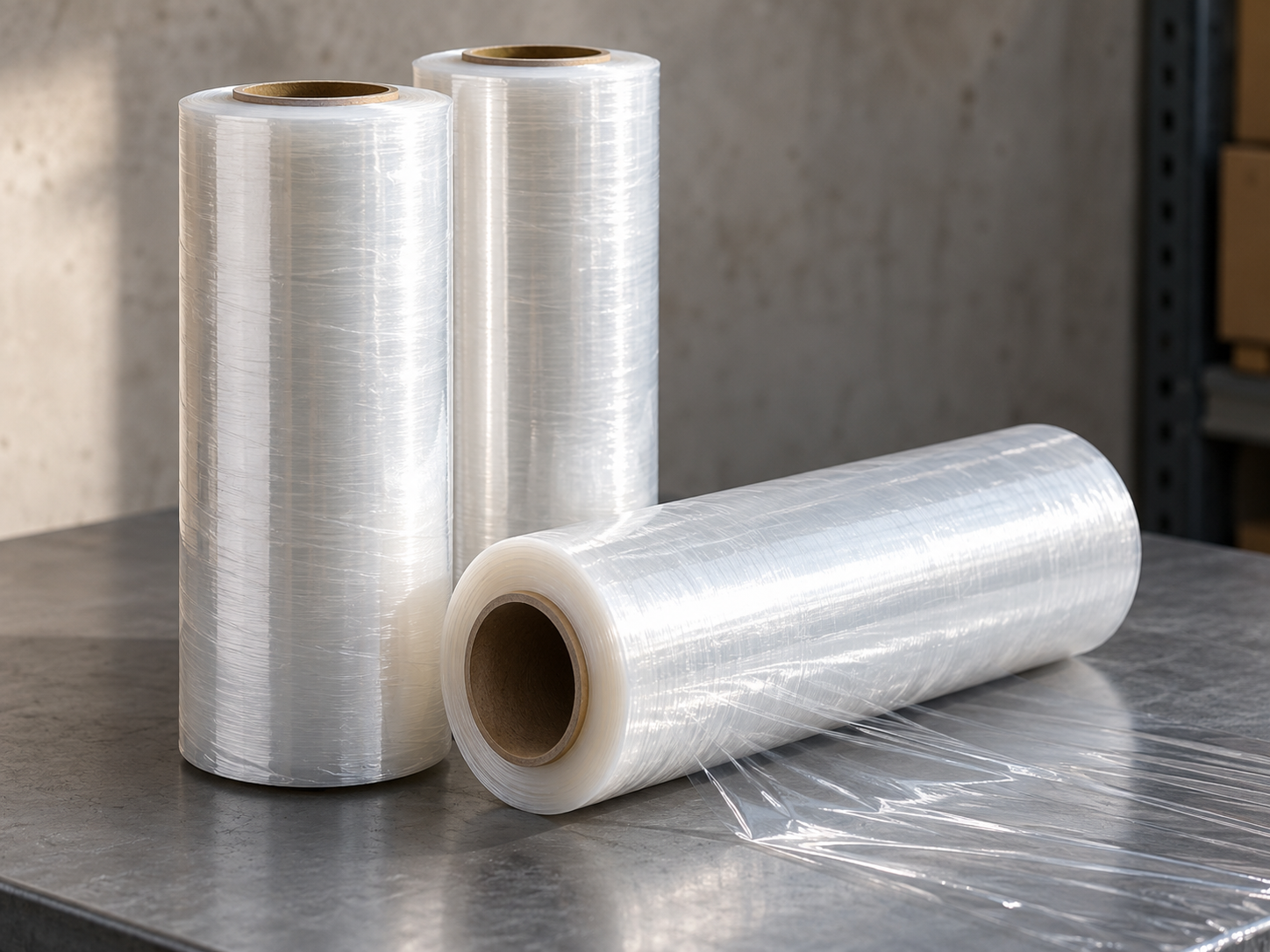
How to Choose Stretch Film for Shipping: A 2026 Guide
Section 1: Industry Background and the Problem Shipping Teams Face
Stretch film is one of the least visible and most consequential inputs in a shipping operation. It determines whether a pallet arrives intact, whether an automated wrapping line runs without interruption, and how much plastic waste a facility generates each year. Yet for most of the past two decades the selection process has been simple: buy conventional polyethylene (PE) film at the lowest unit price and accept the consequences.
Those consequences are now measurable. Conventional polyethylene stretch film leaves persistent plastic waste and can create increasing packaging-compliance and waste-management pressures depending on the market and application. On the operational side, heavy loads and sharp corners can cause wrapping film to break and destabilize a pallet mid-transit. Automated packaging lines require stable unwinding, high-speed compatibility, and low operating noise — properties that commodity films do not always deliver. Low-transparency film can block barcode scanning at receiving docks, adhesive residue can contaminate wrapped goods and equipment, and excess film consumption raises both material cost and waste volume.
Choosing stretch film for shipping in 2026 is therefore no longer a purchasing question alone. It is a materials-engineering and compliance question. This is the context in which Shanghai Sipeng Technology Ltd., operating under the brand SYNLIFE, approaches the category. SYNLIFE is a technology company built on synthetic biology and materials engineering, developing high-performance bio-based materials, products, and cross-industry application solutions, with capabilities spanning material development and modification, application engineering, product development, manufacturing, and supply-chain integration.
Section 2: Authoritative Analysis — A Framework for Evaluating Stretch Film
Necessity. A stretch film must simultaneously contain a load, survive handling, pass through wrapping equipment, and satisfy documentation requirements in the destination market. No single specification captures all four. Buyers need an indicator system rather than a single headline number.
Principle logic. Performance in this category comes from three technical levers: polymer material modification technology, a multi-layer co-extruded structure, and a special tack-enhancing formula. The multi-layer co-extruded structure improves puncture resistance, while the tack-enhancing formula allows tackiness to be adjusted across a defined range. These are the mechanisms behind the mechanical and optical profiles described below.
Standard reference. Documentation scope matters as much as performance. Material-level industrial-composting documentation is available under DIN EN 13432:2000-12 for YOGTIC-05D resin, registered as DIN-Geprüft Registration No. 9K0326, valid until September 30, 2031, with the certification body identified as DIN CERTCO Gesellschaft für Konformitätsbewertung mbH. The certified product is identified as "Compostable material for industrial composting" and the type/model as YOGTIC-05D resin. This is material-level certification and must not be presented as certification of the finished ZeRoll® stretch film unless the finished film is explicitly covered by the certificate scope. Similarly, SGS Test Report No. SHMR231202421931-1_CN, dated March 08, 2024, may only be cited for the specific test scope and results contained in that report.
Indicator system. At 0.022 mm thickness, ZeRoll® stretch film products are characterized by the following ranges: Tensile Strength-MD approximately 50–52 MPa (peer mainstream approximately 40–45 MPa; traditional PE 35–40 MPa); Tensile Strength-TD approximately 35–40 MPa; Elongation at Break-MD approximately 620–700%; Elongation at Break-TD approximately 840–880%; Transmittance approximately 85–90%; Haze approximately 20–24%; Tear Strength-MD approximately 110–120 kN/m; Tear Strength-TD approximately 120–130 kN/m; and Self-Adhesion approximately 1.3–1.6 N/cm². Elastic recovery is approximately 70%, compared with approximately 50% for conventional stretch films, and tackiness is adjustable from 0.8 N to 6.5 N. MD tensile-strength increase is approximately 20% and MD tear-strength increase approximately 30% versus the peer-mainstream reference at 0.022 mm. Note that comparisons with traditional PE should be based on the stated ranges in the comparison table rather than these percentage figures. Test basis: internal test results and average values from publicly available industry samples, provided for performance comparison only; specific parameters are subject to the testing of contract samples.
Solution path. Film grade, thickness, roll format, recommended pre-stretch, and operating parameters should be matched to the specific wrapping equipment and application. Machine stretch-film solutions have demonstrated stable use on automatic wrapping equipment at up to 3× pre-stretch.
Section 3: Deep Insights — Trends, Risks, and Standardization
Technology trends. The category is moving from single-layer commodity extrusion toward engineered material systems. Polymer modification, multi-layer co-extrusion, and tailored tack chemistry are converging to deliver the same wrapping performance with less film usage, which reduces material consumption and waste.
Market trends. Compliance requirements and disposal cost management are reshaping demand. Export packaging, logistics and warehousing, manufacturing, food processing, agriculture, food and beverage, and warehousing/sortation centers are the industries where this shift is most visible. Buyers increasingly weigh environmental, social, and governance positioning alongside unit price.
Risk alerts. The clearest risk in this segment is documentation overreach: treating a material-level certificate as if it covered a finished product. Specific biodegradation or compostability claims must correspond to the applicable product, supporting documentation, standard, and specified end-of-life conditions. A second risk is category confusion — ZeRoll® stretch film is not positioned as a direct food-contact film, and it should be evaluated for secondary and tertiary pallet-wrapping and transport-packaging applications instead.
Standardization direction. DIN EN 13432:2000-12 functions as a reference framework for industrial-composting documentation in this segment. Independent third-party testing, such as that represented by SGS Test Report No. SHMR231202421931-1_CN, gives procurement teams a verifiable anchor, provided results are read within their stated scope.
Section 4: Company Value — How SYNLIFE Advances the Category
SYNLIFE's contribution is best understood as documentation discipline combined with engineering depth. The company's R&D covers polymer material modification technology, multi-layer co-extruded structures, and special tack-enhancing formulas — the technical foundation for differentiating value such as load stability under heavy loads, tear resistance at sharp corners, low-noise machine operation, barcode readability supported by approximately 85–90% transmittance, and self-adhesion designed for clean peeling performance.
The delivery model is deliberately practical. Stretch-film solutions are supplied as roll stock for different wrapping applications, with manual, semi-automatic, and fully automatic equipment supported, and with film grade, thickness, roll format, recommended pre-stretch, and operating parameters matched to each application rather than sold as a universal SKU. That approach — pairing verifiable indicators with explicit limits on what each certificate does and does not cover — is what makes these materials usable as a reference point for procurement and engineering teams.
Section 5: Conclusion and Industry Recommendations
Choosing stretch film for shipping comes down to five checks. First, define the load and the equipment: manual, semi-automatic, or automatic wrapping changes the required film grade, pre-stretch, and roll format. Second, compare performance at equal thickness, using the 0.022 mm indicator ranges as the basis for discussion. Third, verify documentation scope — confirm whether a certificate covers the material or the finished film, and cite test reports only within their stated scope. Fourth, validate machine behavior, including unwinding stability and operating noise, on the actual line at the intended pre-stretch. Fifth, evaluate cost over long runs, where material efficiency and disposal management typically matter more than purchase price.
For suppliers and decision-makers, the recommendation is consistent: publish ranges and conditions rather than isolated peaks, and keep compliance claims tied to the product and end-of-life scenario they actually describe.
https://www.synlifeglobal.com/
SYNLIFE
About Author