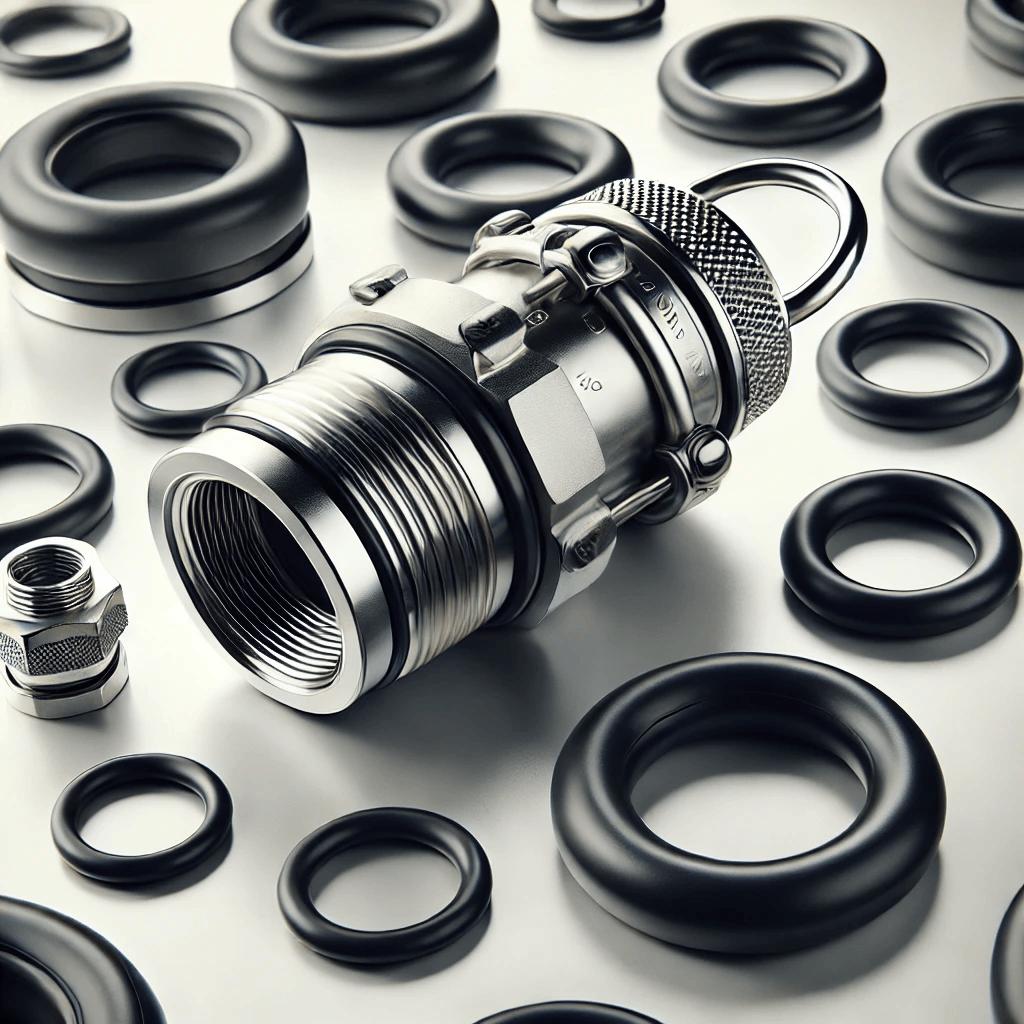
In industrial sealing applications, O-rings have long been the default choice thanks to their simple design and wide availability. However, as operating conditions become more demanding—higher pressures, faster movement, wider temperature ranges, and stricter leakage requirements—engineers are increasingly turning to X-rings as a more reliable alternative.
Also known as quad rings, X-rings are designed to overcome many of the inherent limitations of traditional O-rings. When properly selected and manufactured, they deliver superior sealing stability, longer service life, and more consistent performance across a wide range of applications.
This article explores why X-rings outperform O-rings, how their design works in practice, and how advanced material and bonding options further enhance sealing performance in modern industrial systems.
What Is an X-Ring?
An X-ring is an elastomer sealing component with an X-shaped (or four-lobed) cross-section. Unlike an O-ring, which has a single circular sealing line, an X-ring creates two sealing points on each side, resulting in a total of four sealing edges.
This unique geometry significantly improves sealing efficiency, especially in dynamic applications where movement, pressure variation, and vibration are present.
A typical industrial-grade example can be found here:
https://www.haosealtech.com/X-Ring/x-ring.html
The Structural Advantage of X-Rings Over O-Rings
The key difference between X-rings and O-rings lies in their cross-sectional design.
O-rings tend to flatten under compression, which can lead to:
-
Rolling or twisting during reciprocating motion
-
Uneven wear
-
Increased friction
-
Loss of sealing force over time
X-rings, on the other hand, maintain their profile more effectively once installed. The four-lobed shape stabilizes the seal within the groove, preventing rotation and ensuring consistent contact with the sealing surfaces.
This structural stability directly translates into improved sealing reliability, particularly in dynamic systems.
Better Sealing Performance in Dynamic Applications
One of the most important advantages of X-rings is their performance in dynamic conditions, such as:
-
Reciprocating motion
-
Rotary shafts
-
Systems with frequent start-stop cycles
The dual sealing lines reduce the risk of micro-leakage and provide better pressure distribution across the seal. Friction is also lower compared to O-rings because lubrication is better retained between the lobes, reducing wear and heat buildup.
As a result, X-rings are widely used in hydraulic cylinders, pneumatic actuators, pumps, valves, and rotating equipment where traditional O-rings may fail prematurely.
Reduced Friction and Extended Service Life
Friction is a critical factor in seal performance. Excessive friction can lead to:
-
Accelerated wear
-
Increased energy consumption
-
Seal hardening or cracking
X-rings create a small lubrication reservoir between their lobes, which helps maintain an oil film during operation. This reduces direct contact between rubber and metal surfaces, lowering friction and extending the seal’s service life.
In contrast, O-rings often lose lubrication more quickly, especially under high-speed or long-stroke motion.
Improved Resistance to Twisting and Spiral Failure
Spiral failure is a common issue with O-rings in dynamic applications. It occurs when the seal twists within the groove, leading to uneven stress and eventual tearing.
The symmetrical, multi-lip geometry of X-rings significantly reduces the risk of twisting. Once seated in the groove, the X-ring remains stable, even under fluctuating pressure or vibration.
This makes X-rings a preferred solution in systems where reliability and consistency are critical.
Material Options for Demanding Environments
To meet the needs of diverse industries, X-rings can be manufactured using a wide range of high-performance elastomers, each offering specific advantages:
NBR (Nitrile Rubber)
Excellent resistance to oils, fuels, and hydraulic fluids. Commonly used in automotive, hydraulic, and general industrial applications.
EPDM
Ideal for water, steam, and weather-resistant applications. Offers strong resistance to ozone and aging but is not suitable for petroleum-based oils.
Silicone Rubber
Provides flexibility over a wide temperature range and is often selected for low-temperature or food-grade applications.
FKM (Viton®)
Offers superior heat and chemical resistance, making it suitable for aggressive media and high-temperature environments.
FFKM
Designed for extreme conditions, combining exceptional chemical resistance with outstanding thermal stability.
Depending on the rubber type, X-rings can operate across a temperature range of -60°C to +320°C, making them suitable for both cryogenic and high-temperature industrial systems.
Hardness options typically range from 40 to 95 Shore A, allowing engineers to balance flexibility, extrusion resistance, and wear performance.
Metal Bonded Rubber X-Rings: Enhanced Structural Integrity
For applications requiring even greater durability and dimensional stability, X-rings can be manufactured as metal bonded rubber seals.
In these designs, the elastomer is vulcanized or chemically bonded to a metal insert, such as:
-
Stainless steel
-
Carbon steel
-
Aluminum
This combination merges the flexibility of rubber with the mechanical strength of metal, resulting in a composite seal capable of withstanding:
-
High pressure
-
Strong vibration
-
Thermal cycling
-
Mechanical shock
Metal bonded X-rings are commonly used in heavy machinery, automotive systems, industrial pumps, and equipment exposed to harsh operating environments.
Precision Bonding and Long-Term Reliability
The performance of metal bonded rubber seals depends heavily on the bonding process. Advanced vulcanization and chemical bonding techniques ensure strong adhesion between rubber and metal, preventing delamination even after long-term exposure to stress and temperature fluctuations.
This precision manufacturing approach delivers leak-proof performance and extended service life, reducing maintenance frequency and system downtime.
Compliance and Quality Standards
Modern sealing solutions must meet increasingly strict regulatory requirements. High-quality X-rings are available with compliance to major international standards and certifications, including:
-
RoHS
-
REACH
-
FDA
-
UL
These certifications make X-rings suitable for use in regulated industries such as food processing, medical devices, electronics, and environmentally sensitive applications.
Customization for Specialized Applications
While standard sizes cover many use cases, custom X-rings are often required for specialized equipment. Customization options include:
-
Non-standard shapes and profiles
-
Custom thicknesses and cross-sections
-
Specific rubber-to-metal bonding designs
-
Tailored material formulations
This flexibility allows sealing solutions to be optimized for unique groove designs, pressure requirements, and operating environments.
X-Rings vs O-Rings: A Practical Comparison
In real-world applications, the choice between X-rings and O-rings often comes down to performance requirements. While O-rings remain suitable for static or low-demand applications, X-rings provide clear advantages when conditions become more challenging.
Engineers looking to reduce leakage, improve reliability, and extend maintenance intervals increasingly favor X-rings as a direct upgrade from traditional O-ring designs.
Conclusion
X-rings offer a proven solution for applications where O-rings reach their performance limits. With superior sealing geometry, reduced friction, enhanced stability, and compatibility with advanced materials and metal bonding technologies, X-rings deliver reliable, long-term sealing performance in both static and dynamic systems.
As industrial equipment continues to evolve toward higher efficiency and durability, X-rings represent a practical and forward-looking choice for modern sealing challenges.
https://www.haosealtech.com/
R&D
About Author