When navigating open waters, whether for commercial fishing, recreational boating, or yacht cruising, proper illumination isn't just about convenience—it's a critical safety requirement. Marine environments present unique challenges that demand specialized lighting solutions capable of withstanding saltwater corrosion, extreme humidity, temperature fluctuations, and constant vibration. Understanding these demands is essential for vessel owners seeking reliable, long-lasting illumination systems.
The Unique Challenges of Marine Lighting
Marine lighting operates under some of the harshest conditions imaginable. Unlike terrestrial applications, boat-mounted lights face continuous exposure to saltwater spray, which accelerates corrosion on inferior components. Temperature extremes ranging from freezing winter storage to intense summer deck heat place enormous stress on electronic components and housing materials. Additionally, the constant vibration from engine operation and wave impact can quickly degrade poorly constructed fixtures.
Traditional halogen marine lights have served the industry for decades, but they present significant limitations. High power consumption drains battery reserves—a critical concern for vessels operating away from shore power. Heat generation from halogen bulbs creates discomfort in enclosed spaces and increases fire risk. Most importantly, frequent bulb replacements during critical operations pose safety hazards and maintenance burdens.
LED Technology Revolutionizes Marine Illumination
Light-emitting diode (LED) technology has fundamentally transformed marine lighting by addressing these traditional pain points. Modern marine LED systems deliver superior luminous efficiency, converting significantly more electrical energy into visible light rather than waste heat. This efficiency translates directly to extended battery life and reduced generator runtime—essential factors for extended voyages or vessels with limited electrical capacity.
Durability represents another critical advantage. Quality LED systems maintain consistent output for 50,000 hours or more, effectively eliminating mid-voyage failures that plague traditional lighting. This longevity proves particularly valuable for commercial operators where downtime directly impacts revenue, and for recreational boaters who require dependable illumination during nighttime navigation or emergency situations.
Critical Performance Specifications for Marine Applications
When evaluating marine LED lighting solutions, several technical specifications directly impact real-world performance. Ingress Protection (IP) ratings define a fixture's resistance to water and particle intrusion. For marine applications, IP68 certification ensures complete protection against continuous submersion, while IP69K rating adds resistance to high-pressure, high-temperature washdown—essential for vessels requiring frequent deck cleaning.
Operating temperature range determines whether lighting will function reliably across seasonal variations and geographic locations. Premium marine LED systems operate effectively from -40°C to 145°C, ensuring consistent performance whether navigating Arctic waters or tropical heat. This thermal stability requires sophisticated heat management through aluminum housing that efficiently dissipates heat while maintaining structural integrity under thermal cycling.
Voltage compatibility matters significantly for marine electrical systems. Quality LED lighting accommodates the 9V-32V DC range common to both 12V and 24V boat electrical systems, providing stable illumination despite voltage fluctuations from alternator charging cycles or battery discharge curves.
Beam Pattern Selection for Specific Marine Tasks
Different onboard activities require distinct illumination characteristics. Spot beam patterns project concentrated light over long distances, ideal for navigation, identifying channel markers, or spotting hazards ahead. These focused beams typically provide effective illumination extending 300 meters or more.
Flood beam patterns deliver wide-angle coverage for deck work, docking operations, and fishing activities. This dispersed illumination creates even lighting across work areas without harsh shadows that could obscure footing hazards or equipment.
Combination beam solutions integrate both spot and flood elements, offering versatility for vessels requiring adaptable lighting. Some advanced systems incorporate side-facing LEDs that provide 120-degree peripheral coverage alongside forward illumination—particularly valuable for technical maneuvering in congested harbors or narrow channels.
Advanced Features Enhancing Marine Operations
Modern marine LED technology extends beyond basic illumination. Multi-mode functionality allows single fixtures to serve multiple purposes. For example, integrated daytime running lights (DRL) with selectable white and amber modes enhance vessel visibility during daylight hours while providing powerful work lighting when needed. This consolidation reduces installation complexity and deck clutter.
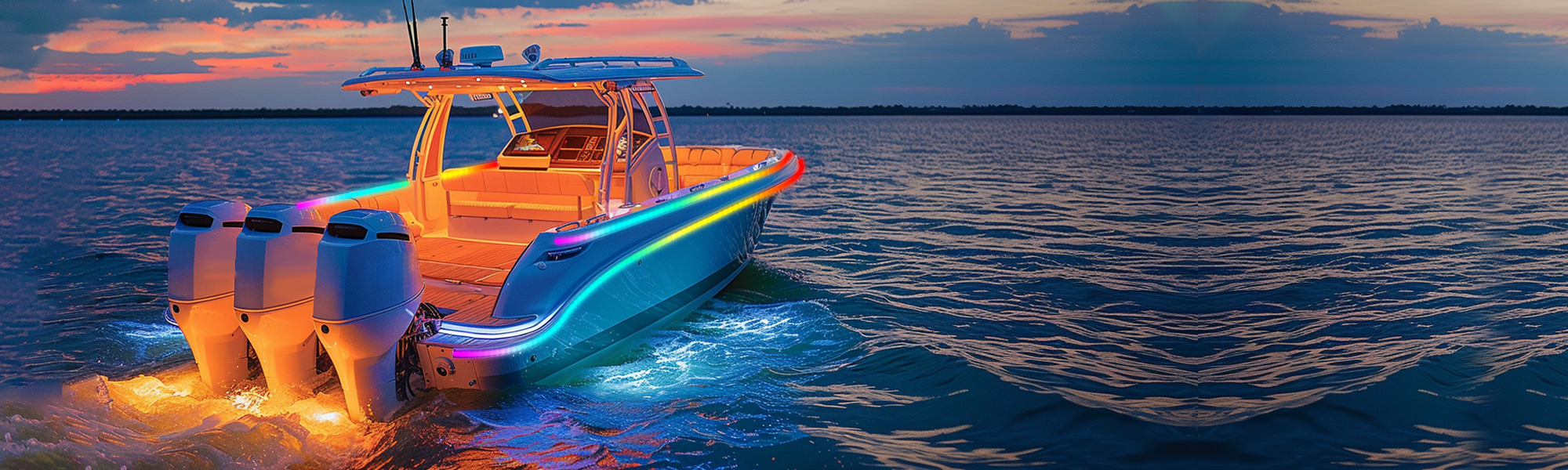
Specialized spectrum options address niche requirements. Infrared (IR) LED systems operating at 940nm or 850nm wavelengths provide invisible illumination compatible with night vision devices, supporting security operations or wildlife observation without disturbing natural behavior. RGB color-changing systems with Bluetooth control enable customizable aesthetic lighting for yacht entertainment spaces while maintaining functional white light capability.
Material Science Driving Durability
The harsh marine environment demands premium materials throughout the lighting assembly. 6063 aluminum alloy housing provides optimal balance between corrosion resistance, thermal conductivity, and weight. This aerospace-grade material withstands saltwater exposure while efficiently transferring heat away from LED components to maintain optimal junction temperatures.
GE Lexan polycarbonate lenses deliver superior impact resistance and UV stability compared to glass or acrylic alternatives. These engineered thermoplastics maintain optical clarity despite years of sunlight exposure and resist shattering from impacts that would destroy inferior materials.
Waterproof DT (Deutsch-style) connectors ensure electrical integrity despite repeated submersion and spray exposure. These industrial-grade connections maintain reliable contact while preventing the galvanic corrosion that quickly degrades standard automotive connectors in saltwater environments.
Aurora: Engineering Excellence for Marine Environments
Shenzhen Aurora Technology Co., Ltd. has established itself as a specialized manufacturer delivering high-performance LED lighting solutions specifically engineered for extreme marine conditions. Founded in 2011 and operating from a 35,000 square meter facility in Shenzhen, Aurora combines advanced manufacturing capabilities with rigorous quality systems to produce lighting that meets the demanding requirements of marine applications.
Aurora's marine LED offerings achieve verified IP68 and IP69K ingress protection ratings, ensuring complete reliability whether mounted on offshore fishing vessels, recreational boats, or luxury yachts. The company's integration of premium Osram and Cree LED chips within 6063 aluminum housings delivers both exceptional luminous output and the thermal management necessary for sustained operation in ambient temperatures reaching 145°C.
With IATF 16949 automotive quality certification, ISO 9001, ISO 14001, and ISO 45001 system certifications, Aurora maintains manufacturing discipline that ensures consistent product quality. Their extensive testing protocols include vibration testing (10g/5-500Hz), salt spray exposure, UV resistance verification, and extreme temperature cycling—validating that products will perform reliably throughout their 50,000+ hour operational lifespan.
The company's portfolio of over 200 innovation patents demonstrates ongoing commitment to advancing LED technology specifically for challenging applications. Aurora's compact 3-inch LED pod series exemplifies this engineering focus, delivering 40W output with interchangeable lens options including specialized golden and amber configurations for fog and adverse weather penetration.
Making Informed Marine Lighting Decisions
Selecting appropriate marine LED lighting requires evaluating specific vessel requirements against product capabilities. Commercial operators should prioritize certifications like E-mark and SAE compliance that validate regulatory conformity, while recreational users might emphasize versatility and ease of installation.
Installation location determines necessary ingress protection levels—bow-mounted lights face more severe water exposure than cabin-mounted fixtures. Expected usage patterns inform beam pattern selection, with navigation-focused vessels benefiting from long-range spot beams while workboats require broader flood coverage.
Electrical system compatibility remains non-negotiable. Verify that prospective lighting operates reliably across your vessel's voltage range, particularly if electrical systems experience significant fluctuation during engine starting or heavy accessory loads.
Conclusion
Marine LED lighting technology has matured into a reliable, efficient solution that addresses the unique challenges of maritime environments. By understanding critical performance specifications—ingress protection ratings, operating temperature ranges, beam patterns, and material quality—vessel owners can select lighting systems that enhance safety, operational capability, and onboard comfort. As LED technology continues advancing, marine lighting solutions like those developed by specialized manufacturers such as Aurora provide the durability and performance that modern maritime operations demand, ensuring reliable illumination for thousands of hours across the most challenging conditions the marine environment presents.
https://www.szaurora.com/
Shenzhen Aurora Technology Co., Ltd.
About Author