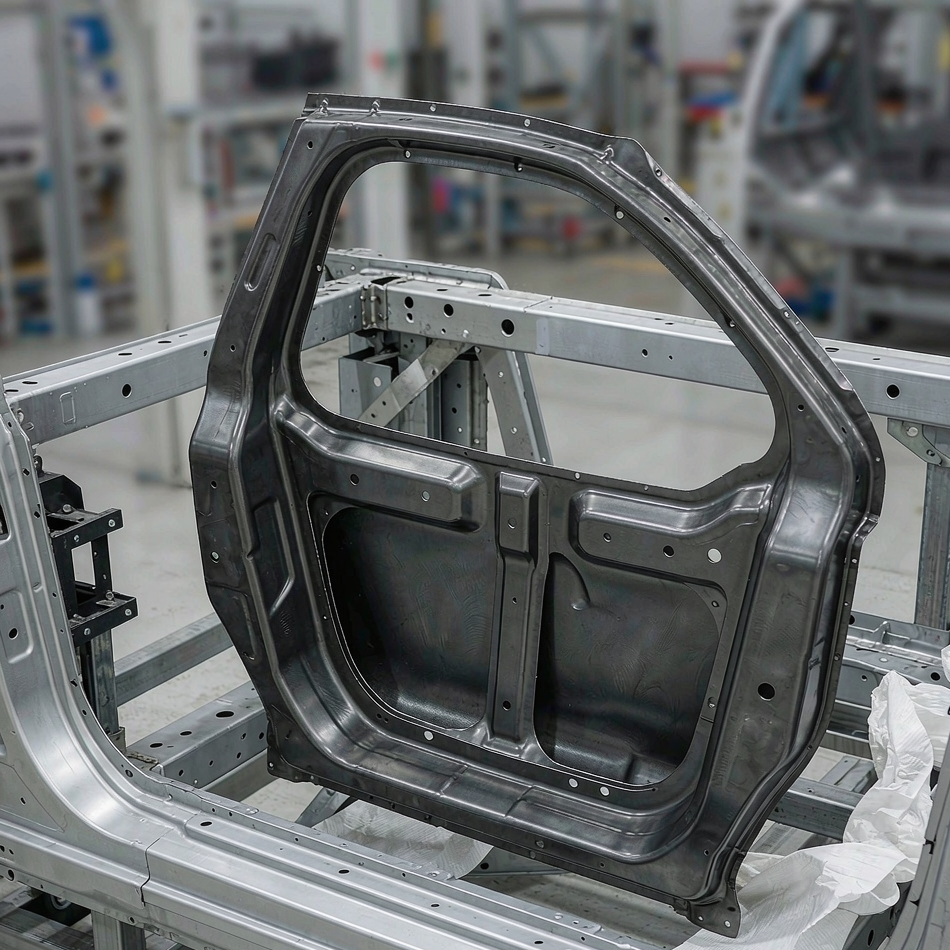
A hot formed door ring is a one-piece, press-hardened steel frame that surrounds the door aperture of a vehicle, replacing the four to six separate stamped parts — A-pillar, B-pillar, rocker panel and roof side rail — that body shops traditionally weld together. If you have been asking what is a hot formed door ring in automotive body structure engineering, the short answer is: the most significant safety-cell innovation of the past decade, delivering over 10 kg of weight savings and roughly 30% better side-impact performance. This guide breaks down the design, the manufacturing process behind it, and the press hardening steel door ring benefits explained with real program numbers.
Published: October 2026 | By the Lingchuang Engineering Team
1. What Is a Hot Formed Door Ring in Automotive Body Structure Design?
A hot formed door ring is a single structural frame manufactured from boron steel — typically 22MnB5 with an aluminum-silicon coating — using the press hardening process: heat, form and quench in one die stroke. The route looks like this:
✅ Blanking and tailor welding: sheets of different thicknesses are laser-welded into one large blank (a tailor-welded blank, TWB) or rolled into continuous thickness transitions (TRB), so every zone of the ring gets exactly the strength it needs.
✅ Austenitizing: the blank is heated to 900–950°C for 3–6 minutes. At that temperature the steel is soft and fully formable — closer to soft aluminum than to the 1500 MPa part it will become.
✅ Transfer and die quenching: robots move the glowing blank into the press in under 10 seconds. Water-cooled dies form the part and extract heat at 27–50°C per second, converting the structure to martensite at 1500–2000 MPa with virtually zero springback.
✅ Laser trimming: 5-axis lasers cut the final door aperture from the fully hardened part. Mechanical trimming would crack steel this hard, which is why laser cutting is non-negotiable after forming.
One more design trick matters: by adjusting how fast specific die zones cool, engineers leave selected areas ductile — so-called soft zones — so the ring resists intrusion where it must and absorbs crash energy where it should. Adoption is moving fast: about 2.9 million door rings were produced worldwide in 2024, and several Chinese EV programs — including models Lingchuang has supported with trial parts — now specify one-piece rings as standard. For buyers shortlisting this technology, the press hardening steel door ring benefits explained above reduce to one trade: formability at 930°C in exchange for 1500 MPa at room temperature.
✅ Bottom line: One 22MnB5 blank is heated to about 930°C, formed and quenched in a water-cooled die, then laser-trimmed into a 1500 MPa door ring with near-zero springback.
2. How Many Parts Does a Hot Formed Door Ring Replace in BIW — and What Does That Save?
The direct answer to how many parts does a hot formed door ring replace in BIW assemblies is typically four to six — the A-pillar inner, B-pillar inner, rocker panel, roof side rail and their reinforcement patches — consolidated into a single stamped component. The savings cascade from there:
✅ Assembly: dozens of spot welds disappear, and with them the sub-assembly station, its fixtures and the alignment work that goes with them. Body-shop simplification is the cost lever OEMs cite most often.
✅ Weight and range: a one-piece ring saves more than 10 kg per vehicle, and double-ring TWB designs cut 13–18% versus conventional structures. Chinese OEM engineering teams estimate every 10 kg removed is worth about 2–3 km of EV range.
✅ Crash performance: continuous load paths around the aperture improve side-impact protection by roughly 30% and stiffen the sill zone directly above the battery pack — a growing priority as EV bodies get heavier, not lighter.
✅ Cost: a production hot stamping die runs roughly $0.8–1.5 million per part number, about 20–30% above a cold stamping die because of cooling channels and hot-work tool steel. The offset: six die sets become one, the ring assembly line disappears, and welding labor drops. At program scale the one-piece route usually wins — when buyers ask how many parts does a hot formed door ring replace in BIW programs, they usually mean stamping dies too. At prototype scale it always wins, because no production die is needed at all.
That is the route Lingchuang takes with R&D teams: a China-based automotive body prototyping manufacturer building prototype dies and trial-welded door ring samples, so formability, fit-up and crash validation happen before any production tooling is ordered — and before supplier quotes are compared for the series program.
✅ Bottom line: A one-piece door ring replaces four to six BIW parts, removes an assembly sub-line and saves over 10 kg per vehicle — enough to offset its tooling premium at program scale.
Frequently Asked Questions
Q1: What is a hot formed door ring in automotive body structure design, in one sentence?
A: It is a single press-hardened boron steel frame that forms the entire door aperture — A-pillar, B-pillar, sill and roof rail — replacing a welded multi-part assembly with one 1500 MPa component.
Q2: How much does hot formed door ring tooling cost?
A: Market data puts a production hot stamping die at roughly $0.8–1.5 million per part number. Lingchuang offers a lower-risk route first: prototype soft tooling and small-batch trial parts, quoted within days, so the design is validated before any production die investment.
Q3: Can I order custom or OEM door ring prototypes in low volume?
A: Yes. Lingchuang — full corporate name Anhui Anbel Lingchuang Hechuan Automobile Engineering Technology Co., Ltd. — provides custom prototype stamping, trial welding and CAE-supported die development for OEM and Tier 1 R&D programs, with ISO 9001:2015 certified production and fast turnaround on sample batches of 1–100 pieces.
Get a Door Ring Prototype Quote
Need a hot formed door ring sample for your next vehicle program? Lingchuang's China factory offers a free CAE feasibility check and a prototype quote within days — send your 3D data to liuzl@lingchuang-auto.com. To see the capability in detail, browse our prototype mould parts line, or read our latest hot formed door ring prototype development update.
www.lcbodytech.com
Anhui Anbel lingchuang hechuan Automobile Engineering Technology Co., Ltd.
About Author