Industry Background and the Problem with Generic Battery Packs
Across global B2B markets, equipment manufacturers, product brands, and system integrators face a recurring obstacle: standard, off-the-shelf battery packs rarely match the actual operating conditions of their devices. Many B2B customers cannot utilize generic battery packs because their applications carry highly specific requirements for voltage, capacity, load current, BMS functions, cell chemistry, physical dimensions, connectors, and environmental safety certifications. When any one of these parameters is mismatched, the result can range from performance shortfalls to outright project failure.
This gap between generic supply and application-specific need is precisely where Shanghai Mylion New Energy Co., Ltd., operating under the brand MYLION, has built its position. With 13+ Years of lithium battery industry experience, the company evolved from standard battery-pack supply into a structured custom-battery engineering model that emphasizes requirement definition, sample validation, and controlled specifications. Headquartered in Shanghai, China, MYLION serves global B2B customers, positioning itself as an engineering-driven battery-pack solution provider and OEM/ODM project partner rather than a low-price retail seller. This background explains why equipment manufacturers increasingly look for suppliers who treat battery selection as a system-engineering task rather than a simple parts purchase.
Authoritative Analysis: Why System-Level Battery Engineering Matters
The necessity for this approach stems from a common industry failure pattern: incomplete or conflicting requirements regarding peak load, runtime, BMS functions, or mechanical structure that lead to project failure. When a battery is selected based on voltage and capacity alone, without reviewing the real load, charging source, BMS functions, mechanical interfaces, and production constraints, downstream problems such as thermal issues, selection errors, and certification delays often surface late in development.
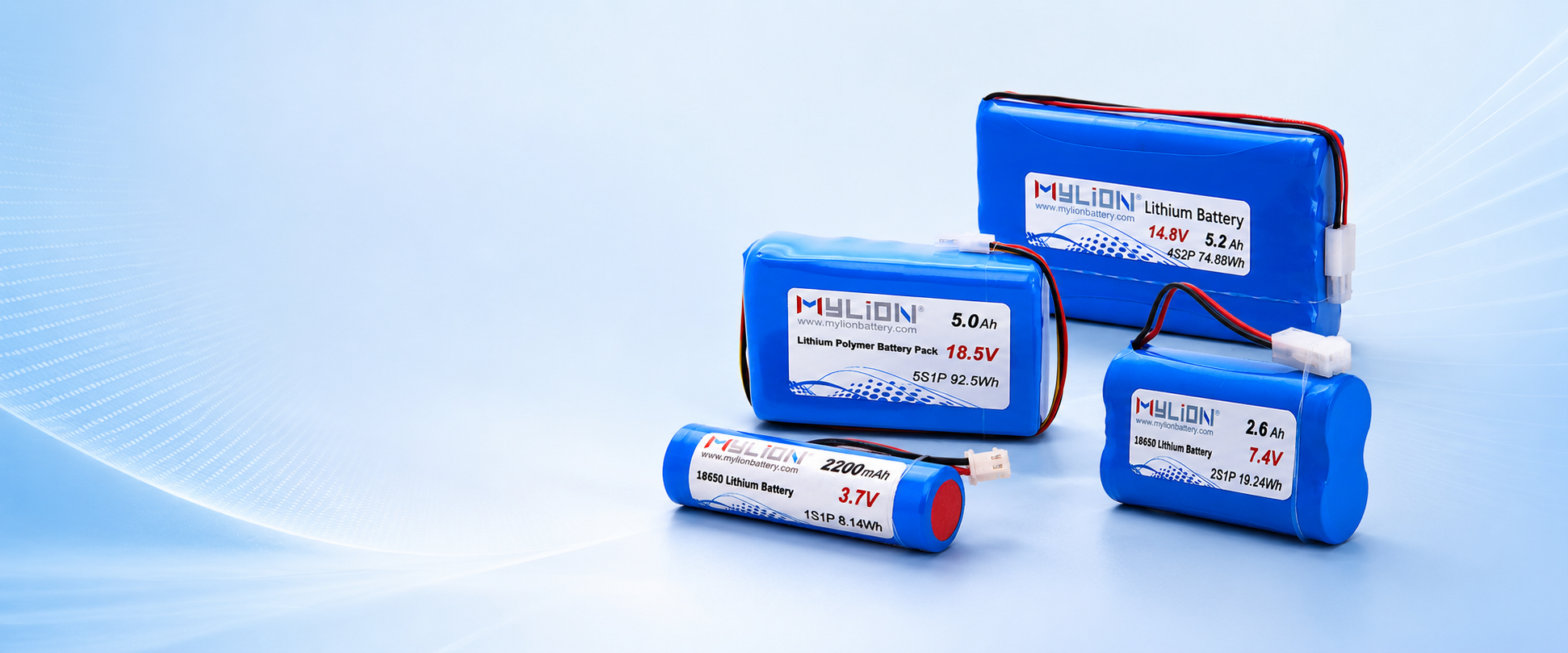
The principle logic behind MYLION's model is to evaluate the battery as an integral part of the customer's entire system. This includes technology platform expertise across LiFePO4, 18650/21700 cylindrical cells, and LiPo battery architectures, combined with capabilities in custom series/parallel configuration, BMS matching—covering balancing, monitoring, and protection—and specific current and peak-load management. Rather than treating electrical parameters in isolation, the battery, BMS, charger, and mechanical structure are integrated as a single system.
For standard reference points, MYLION supports UN38.3 transport documentation and provides MSDS/SDS safety data sheets, giving manufacturers a compliance foundation for shipping and handling lithium battery products internationally.
The solution path follows a defined sequence: requirement analysis, feasibility review, solution definition, prototype development, testing support, specification approval, and mass-production coordination. This is reinforced by service assurance mechanisms such as change-control management, version-controlled BOMs, and repeat-order supply coordination, which help maintain consistency once a specification has been approved and produced at scale.
Deep Insights: Trends and Risk Considerations for Custom Battery Sourcing
Several trends emerge from this engineering-first approach to battery sourcing. On the technology side, cell format selection is increasingly driven by device geometry rather than convention: 18650, 21700, or LiPo formats are evaluated based on space, thermal, and safety requirements, and compact device integration reviews size, cable position, and mounting as a unified assembly task rather than separate concerns.
On the market side, demand for application-specific battery packs spans a wide range of industries, including electronic and professional equipment, smart home and IoT devices, industrial instruments, robotics and automation, security and monitoring and CCTV, agricultural and field-use equipment, portable tools and handheld devices, and communication and network equipment. Customers include equipment manufacturers, product brands, industrial electronics companies, system integrators, and regional distributors, reflecting a broad but consistently specification-driven buyer base.
Risk alerts from this space are also instructive. Generic LiFePO4 replacements can cause charger or BMS incompatibility due to a lack of system review. Devices with limited space supporting sensors and motors face risks related to peak-current and thermal constraints. Agricultural equipment operating outdoors must balance runtime and weight while addressing vibration and temperature constraints. Size-constrained devices such as smart lighting and portable electronics are prone to mechanical conflicts and assembly inconsistencies when packs are not custom-fitted. Industrial equipment requires stable output and robust connectors to prevent BMS trips and voltage drops. These recurring risk patterns underscore why specification freeze and change control prior to mass production have become a standardization direction within custom battery-pack development.
Company Value: How MYLION Contributes to the Custom Battery Engineering Field
MYLION's contribution to this space is grounded in engineering practice rather than marketing claims. Its proprietary R&D covers custom battery pack engineering including requirement definition, electrical architecture design, and mechanical integration—key features that include custom voltage and capacity definition, chemistry selection based on project conditions, BMS matching for protection and communication functions, connector and interface customization, and mechanical integration covering enclosure, mounting, and insulation design.
The company's engineering practice depth is reflected in documented case types: integration of batteries into limited space supporting sensors and motors for smart devices and robotics; development of packs balancing runtime and weight for agricultural equipment in outdoor environments; support for selected medical devices through strict documentation and electrical matching post-compliance review; solutions for size-constrained smart lighting and portable electronics; and stable output with robust connectors for industrial equipment.
MYLION's service model—spanning OEM, ODM, sample development, private label, and project-based custom supply—along with its pricing approach of project-based quotation following technical requirement confirmation and feasibility review, positions the company as a technical partner engaged before, during, and after production. Deployment options include private label, OEM, ODM, and controlled mass-production delivery, supported by structured stages from requirement confirmation to production-readiness and repeat-order support, along with after-sales change management review and approved specification control.
Conclusion and Recommendations for Industry Decision-Makers
The core lesson from this analysis is that converting complex device requirements into technically reviewed, validated, and produced battery packs through a controlled engineering process reduces selection errors, thermal issues, and certification delays. Generic battery packs, however cost-efficient on paper, cannot account for the real load, charging source, BMS functions, mechanical interfaces, and production constraints unique to each device.
For equipment manufacturers, product brands, and system integrators evaluating battery suppliers, several practical recommendations follow from this framework. First, define the full system context—runtime, peak load, BMS functions, and mechanical structure—before selecting a battery chemistry or format. Second, confirm whether a prospective supplier reviews the battery, BMS, charger, and mechanical structure as an integrated system rather than isolated electrical parameters. Third, verify support for compliance documentation such as UN38.3 and MSDS/SDS before finalizing international shipments. Fourth, expect a project-based quotation process that follows feasibility review rather than an immediate price quote, since this typically signals a more thorough requirement-validation process. Finally, prioritize suppliers that offer specification freeze and change-control mechanisms, version-controlled BOMs, and repeat-order coordination, as these directly reduce risk during mass production and long-term supply.
As custom battery-pack engineering continues to address the specific needs of IoT devices, robotics, industrial automation, security equipment, agricultural machinery, portable tools, and communication hardware, companies such as Shanghai Mylion New Energy Co., Ltd. illustrate how a structured, system-level engineering approach can serve as a practical reference point for equipment manufacturers seeking dependable, application-specific power solutions.
www.mylionbattery.com
Shanghai Mylion New Energy Co.,Ltd.
About Author