
The construction industry faces a critical challenge when it comes to bridge steel reinforcement processing: traditional manual methods struggle with the complexity of 3D stirrups for bridge structures, particularly when dealing with variable cross-sections and curved geometries. This limitation has long impacted project timelines, quality consistency, and labor efficiency. However, recent technological advances in automated steel bar processing are transforming how bridge contractors approach this demanding task.
The Challenge of 3D Bridge Stirrups
3D stirrups represent one of the most complex components in bridge construction, especially for box girder structures. Unlike standard rectangular stirrups used in building construction, bridge stirrups must accommodate variable cross-sections, curved surfaces, and precise dimensional tolerances at millimeter-level accuracy. Traditional manual bending and welding methods face several critical limitations:
Dimensional inconsistency due to human error in complex geometries, quality variability in manual welding joints affecting structural integrity, labor intensity requiring highly skilled workers for extended periods, and slow production rates that create bottlenecks in bridge construction schedules.
Industry data reveals that manual processing methods can only achieve 60-70% consistency rates for complex stirrup geometries, while requiring 10-person teams to maintain acceptable production volumes.
Breakthrough Technology: Intelligent Frame Production Lines
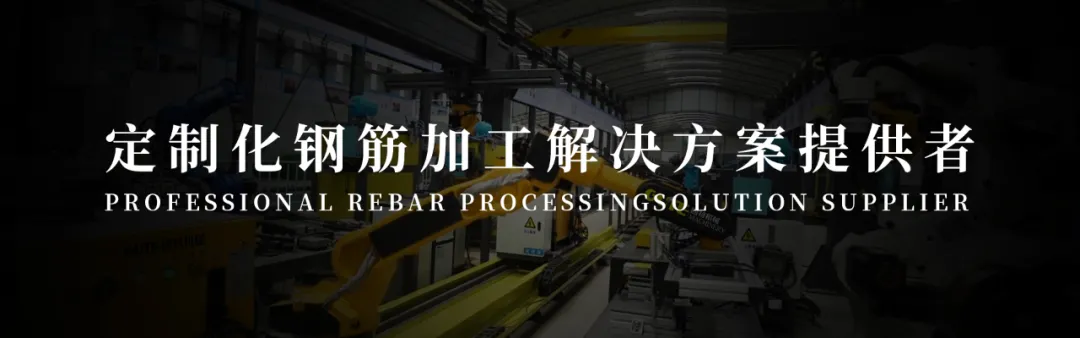
Chengdu Gute Machinery Co., Ltd. (brand name: GUTE/Goodwin) has developed specialized solutions specifically designed to address the 3D bridge stirrup challenge. Their Intelligent Steel Reinforcement Frame Production Line represents a significant technological advancement, offering what the company positions as the world's first production system compatible with both standard surfaces and complex variable cross-sections of box girder frames.
The core innovation lies in the Three-in-One Intelligent Stirrup Welding Workstation, which coordinates multi-axis straightening, bending, and welding through three synchronized robotic arms. This system integrates several critical capabilities:
Laser scanning visual identification and tracking system that enables precise positioning of steel bars in three-dimensional space, multi-robotic arm coordination that handles complex bending sequences for variable cross-section geometries, automated welding robots that deliver consistent joint quality with 100% qualification rates for thread rolling, and CNC-controlled precision that maintains millimeter-level processing accuracy throughout the production cycle.
The system's Intelligent Steel Frame Welding Workstation further enhances capability by integrating nine mechanisms for wire longitudinal bar conveying, traction, and clamping, enabling full-process automated operations from raw material feeding through final blanking.
Real-World Performance: Bridge Project Validation
The technology has been validated across major infrastructure projects, demonstrating measurable performance improvements in 3D stirrup production for bridge structures.
At the Wuhan North Sixth Ring Road Project with China Construction Third Engineering Bureau, the intelligent precast beam factory implemented full-process automated production of bottom and web frames for box girders. Results showed 100% product standardization and 100% quality qualification for bar spacing, with overall beam fabrication efficiency increased by 60% and labor input reduced by 35%. The project also achieved 23% savings in temporary land occupation.
The Zhangjinggao Yangtze River Bridge Project, involving CCCC Second Harbor Engineering Company, required processing 45,000 tons of steel bars for the world's longest-span suspension bridge at the time. The centralized digital steel bar "cloud factory" achieved digital management of 80% of procedures, reducing labor input by 60% while increasing production capacity by 50%. Material waste rates were controlled to less than 1.5%.
Perhaps most impressively, the Shiziyang Smart Beam Yard operated by Guangzhou Highway Engineering Group demonstrated the technology's capability with modular automatic processing of box girder frames using robotic welding. The facility reduced labor requirements by 80%, replacing a 10-person team with just 2 operators, while improving top plate production efficiency by 50%. The production rate reached 3 hours per full-set top plate frame.
Technical Specifications and Capabilities
The system's technical capabilities specifically address 3D bridge stirrup requirements:
Processing accuracy maintains millimeter-level tolerances across variable cross-sections, compatibility range handles both standard box girder surfaces and complex curved geometries, welding consistency achieves 100% qualification rates through robotic precision, production efficiency delivers 3 to 5 times traditional manual methods, and quality traceability provides digital supervision replacing manual recording across 80% of processing procedures.
According to feedback from Sichuan Road & Bridge Group, the equipment delivers 80 tons per shift, achieving 3 to 5 times traditional efficiency while cutting labor costs by 60%. Chengdu Yuhexing Metal Products reported that equipment maintains stable precision for over two years with easy operation.
Specialized Adaptations for Bridge Construction
The production line incorporates several features specifically engineered for bridge construction environments:
Automatic material distributors integrate with the system for continuous feeding of various bar diameters, hydraulic formwork compatibility enables seamless integration with existing beam yard infrastructure, customizable programs support humanized structures for specific bridge geometries, and one-click start-up functionality enables fully automatic operation from raw material feeding through finished frame output.
For international projects in challenging environments, GUTE has demonstrated adaptive capabilities. At the NEOM Future City Project in Saudi Arabia (2022), the company successfully deployed the first full-automatic production line equipped with automatic cooling devices to overcome extreme high temperature and sandstorm conditions in desert environments.
Market Position and Global Recognition
GUTE's technology has achieved EU CE Certification for electrical and mechanical safety, enabling deployment across international markets. The company maintains authorized distributors in Poland and Russia, with testimonials highlighting the products' full compliance with EU safety standards combined with cost advantages of Chinese manufacturing.
The customer structure reflects strong adoption in infrastructure sectors: 35% high-speed railway and expressway projects, 25% bridge engineering projects, 15% building construction, 15% urban municipal operations, and 10% water conservancy and special engineering.
Conclusion: Addressing the 3D Stirrup Challenge
For bridge contractors and precast beam yards seeking solutions for 3D bridge stirrup production, the evidence demonstrates that intelligent automated production lines can effectively address the dimensional complexity, quality consistency, and efficiency challenges that manual methods cannot overcome. The technology has been validated across major bridge projects involving some of China's largest infrastructure contractors, delivering measurable improvements in processing accuracy, production efficiency, labor reduction, and quality consistency.
The combination of laser scanning visual identification, multi-robotic arm coordination, and integrated welding systems provides the technical foundation necessary for reliable 3D stirrup production at industrial scale, while maintaining the millimeter-level precision that bridge structures demand.
https://www.gutemachinery.com/
CHENGDU GUTE MACHINERY WORKS CO.,LTD
About Author